Immersion Work I first learned about immersion work from a former staff developer at the Teachers College Reading and Writing Project, Annie Taranto. Annie led a 3-day institute on the Coaching of Writing at the Ovington School in Brooklyn, New York. One of the most impactful methods I learned that week was immersion. I remember… Continue reading Getting Ready for Literary Essay
Category: writing workshop

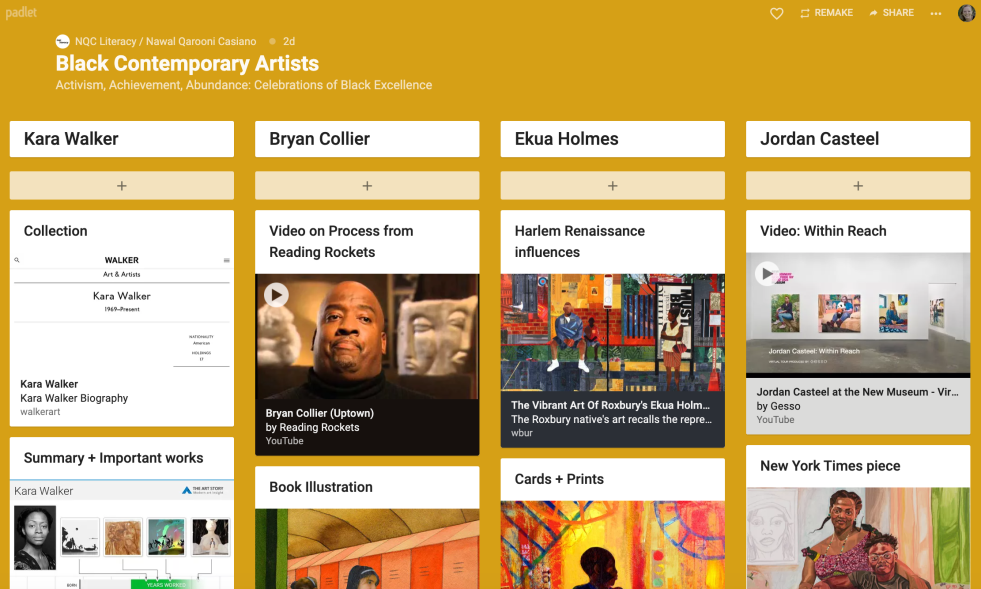
Activism, Achievement, Abundance: Celebrations of Black Excellence
Through the variety of resources, the widening of access points, the flexibility of expression, and the inclusion of art as a mode for interpretation and analysis, all students- especially students who have been historically marginalized- have additional opportunities for impactful instruction and participation.
Share this:

Share this:
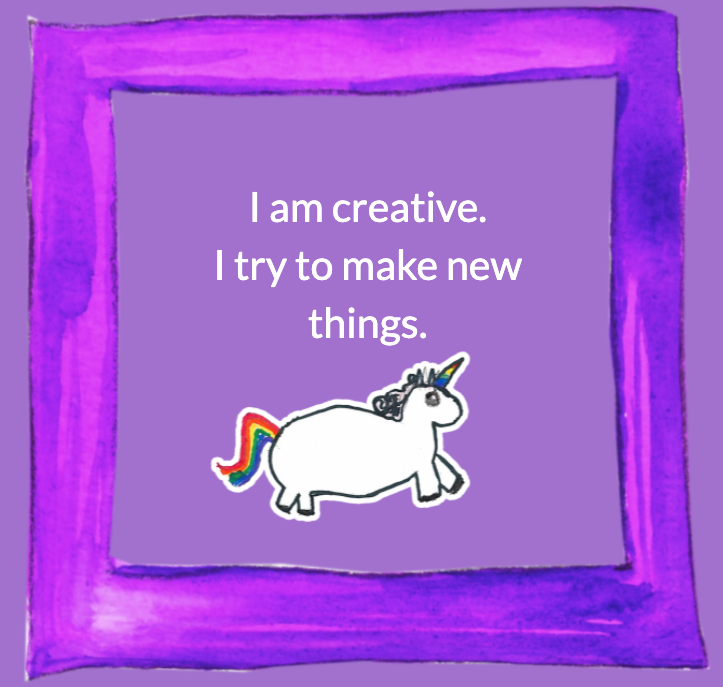
Words Matter: Using Affirmations in Writing Workshop
Our words to our students matter. What our students say to themselves matters. We can inspire and uplift the conversation by using affirmations throughout our teaching and in writing workshop.
Share this:

Share this:
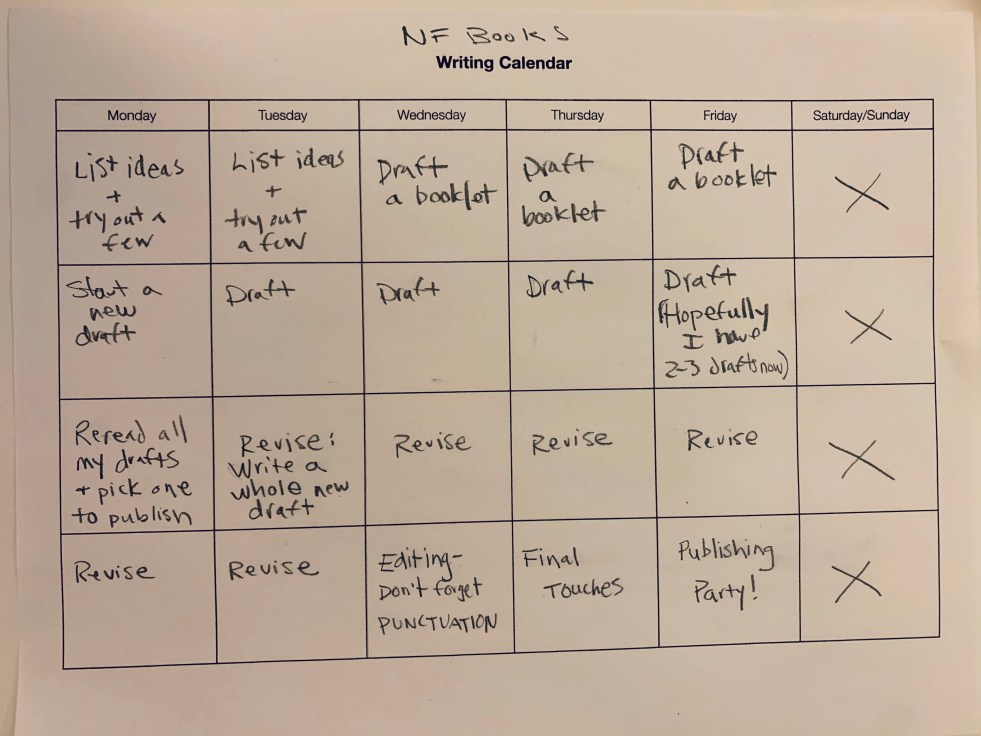
Personal Writing Calendars for Each Student
With a personal writing calendar, each kid can see what is going to happen in the unit of study, and has the power to adjust it.
Share this:

Share this:
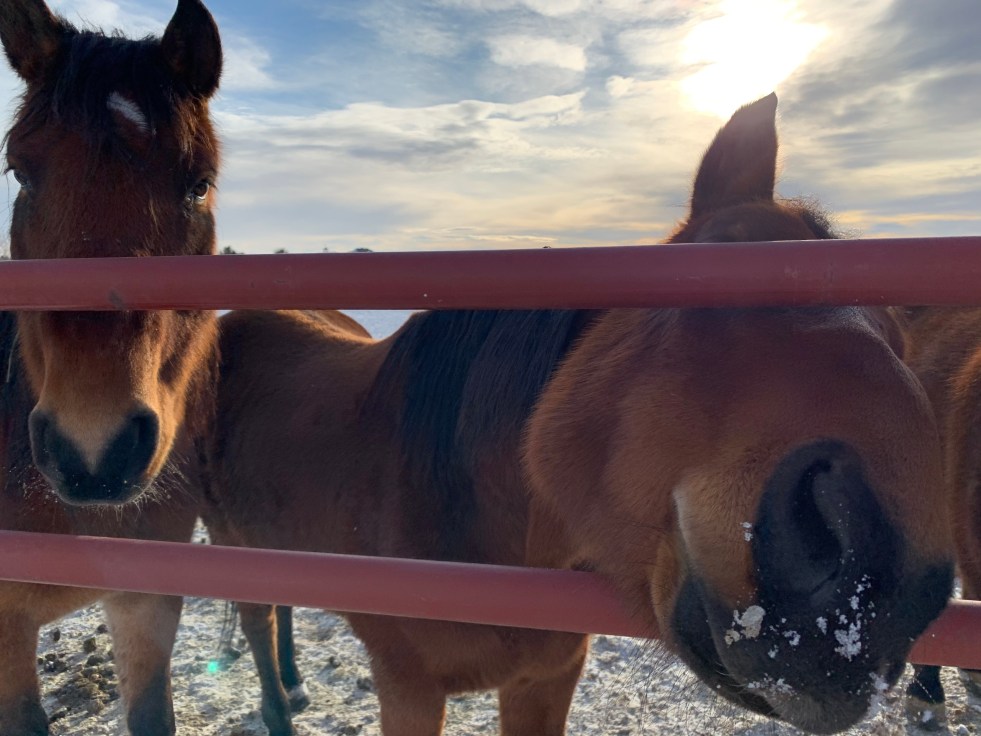
Horse-Sitting and How-to Writing
A silver lining of teaching remotely has been opportunities, like this one, to elevate authentic reasons to read and write. Kids are curious about how others do things, and they have so much real-world expertise to share. A strategy such as this one gives our youngest writers access to topics that might otherwise exceed their emergent writing skills.
Share this:

Share this:
Seeking Prize Donations for the 14th Annual Slice of Life Story Challenge
Two Writing Teachers offers prizes to participants of the Slice of Life Story Challenge. At the present time, we are seeking readers of our blog who are willing to donate a prize for the participants of the Slice of Life Story Challenge .
Share this:

Share this:
What Now? Pause. Observe. Reflect.
There is a freshness in a new year that can feel like an opportunity to evaluate our practices. In this post, I'm sharing what I'm doing to determine where I am and where I want to go. Maybe you want to come along too!
Share this:

Share this:
How do we give permission?
At the start of the pandemic, a teacher friend of mine noticed his students weren’t quite as independent as he thought they were. Students who were working from home, specifically, those who had access to technology seemed a bit helpless. It caused him to reflect and wonder about the levels of independence students experienced in… Continue reading How do we give permission?
Share this:

Share this:

Active Engagement with Pear Deck
Active engagement looks different now than it did pre-COVID-19. One digital tool for active engagement is Pear Deck. Read on to find out how I'm using Pear Deck with my third grade writers!
Share this:

Share this:
Resources Teachers Can Share With Families: How to Help A Child With Writer’s Block At Home
A child who is experiencing writers block at home might appear to be refusing to write. It might seem like they are simply choosing not to do the work, or that they are being stubborn. But as an educator, I know that there is more to it than meets the eye.
Share this:

Share this:

Spinach in a Writer’s Teeth: To Point it out, or not to Point it Out?
When this scenario happened to me (years ago), it did give me pause. As a teacher of writers, I am not the conventions police—I have always been the kind of writer who values content over conventions in the workshop. This is not to say I do not teach conventions or have high expectations for their use. However, it would be fair to say that this particular situation challenged me to think about grammar, punctuation, and spelling differently—shifting the way I approached conventions in the classroom going forward.
Share this:

Share this:

The Three E’s of Remote K
Janet Ahn and I share our strategies and ideas for teaching the youngest writers in remote settings.

