Estimated Reading Time: 4 minutes (825 words)
Audience: Teachers and Coaches, Grades K-12
A Backstory
One year while teaching fourth grade, I had a student named Jordan. On the first day of school, I handed out brand-new writer’s notebooks, and I’ll never forget watching Jordan sit down, open up to the first blank page, and just stare. I watched his shoulders drop as he put his head in his hands. I walked over and asked him what was going on, and he said, “I don’t even know where to start.”
Jordan’s comment—and his general view of writing—have stuck with me all these years later. He had spent all of third grade going through the writing process, creating pieces he was genuinely proud of. He had tried-and-true strategies to use to generate, draft, revise, and edit. He had stamina. He had a writing identity. And I knew it. Because I had been his third-grade teacher.
Jordan had come to me in third grade as a reluctant writer. We had worked on building his confidence, finding his writing territories, and fostering a general love of something that had once been so overwhelming. So I knew he could do it.
But seeing that blank notebook, that blank first page, made Jordan feel like he was starting from scratch.
A new school year is an opportunity for a fresh start. A new room, a new teacher, a new community, new possibilities. But a fresh start doesn’t mean our students are starting from scratch. They’re walking in with years of writing experiences to draw on, and our job in September is to help them see that all of those experiences still count.
If you’ve read Why Transfer Doesn’t Happen on Its Own—and How to Teach for It, you know that it can often be hard for students to make connections across contexts unless we explicitly support those connections. The same is true across school years. We have to build the bridge to support transfer of last year’s learning into this year’s workshop. Here are three easy ways to do it.
Activating Prior Knowledge on Day One
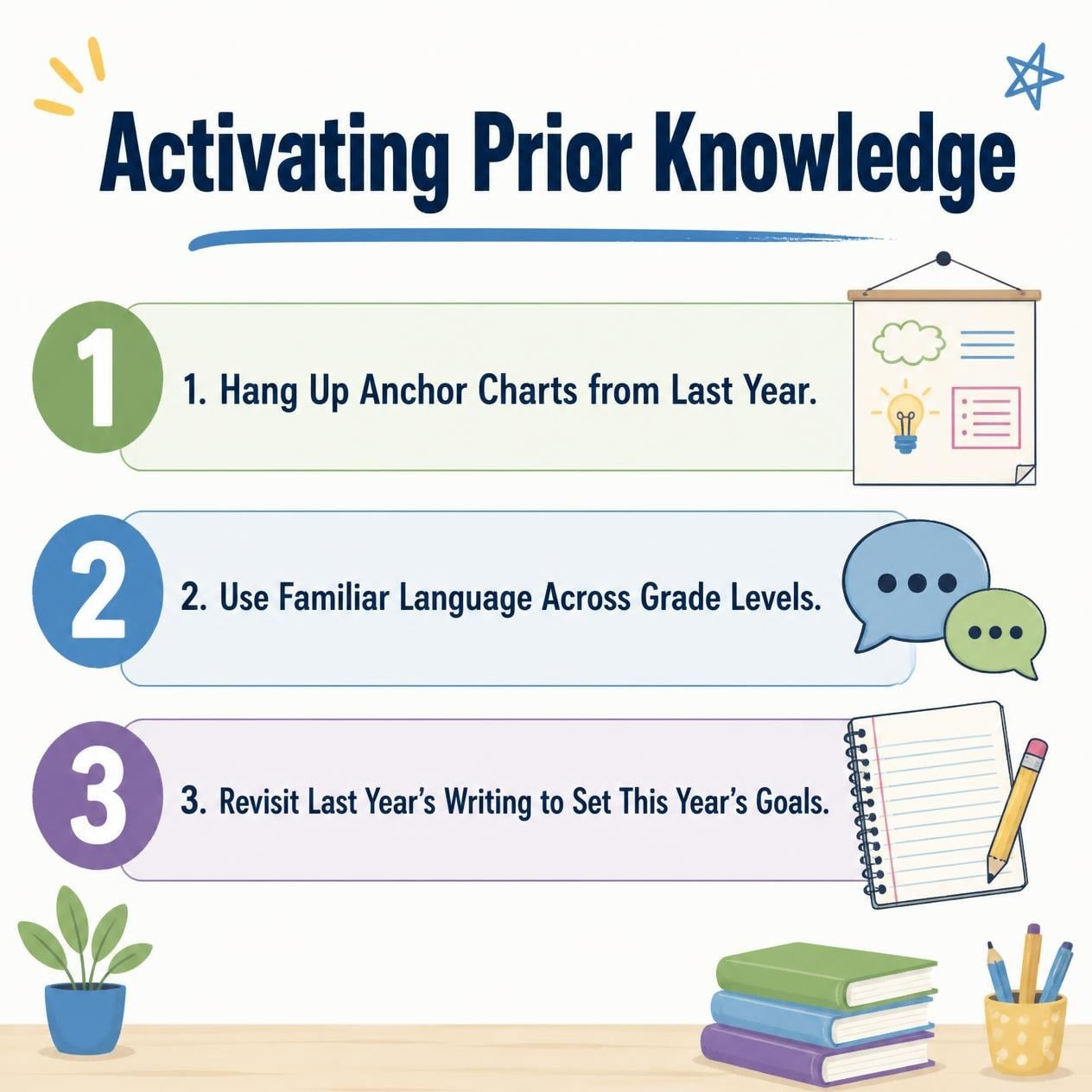
Hang Up Anchor Charts from Last Year. Before you unveil a single new chart, put a few familiar ones back on the walls. You might grab them from last year’s teachers—or better yet, ask students to help you build them by recreating from memory. A chart on generating ideas, a chart on stretching small moments, a chart on using dialogue: these aren’t just review; they’re proof that students already know and own this knowledge. Invite your students to add to the chart or revise it based on what they’re noticing this year. The message is clear: you already know this. We’re building on it, not starting over.
Use Familiar Language Across Grade Levels. Our students will make more connections and transfer more of what they know if we use language that echoes what they heard last year. Try explicitly naming the grade-level shifts. You might say something like:
“In second grade, a strong lead might have included starting with dialogue or small action. Now, in third grade, you might also think about including clues about the setting.”
Using this kind of language does two things at once. It validates what students already know, and it shows them exactly how that skill is growing in the new year. You might even ask students to make connections themselves by saying things like, “Last year, revision looked like… This year, I want to try…” Getting students to self-reflect and set goals based on old and new learning can activate a lot of prior knowledge.
Revisit Last Year’s Writing to Set This Year’s Goals. If your students wrote “Dear Future Me” letters at the end of last year (see this post if you haven’t tried it yet), day one is when those letters finally get opened. Even without letters, you can ask students to dig through old writing folders, notebooks, or portfolios from last year. Have them look for a piece they’re proud of, a strategy they used often, or a pattern in their revision notes. Then they can ask, “What do I want to keep doing as a writer this year? What’s one thing I want to try that’s new?” Starting the year by setting goals rooted in real evidence of growth is far more powerful than starting with a blank goal-setting worksheet.
The Bottom Line
September can feel like a clean slate for us as teachers—new class lists, new routines, new possibilities. But our students aren’t starting over. They’re arriving with a writing history, and it’s our job to help them see it, name it, and build on it. When we activate what students already know instead of starting from the beginning, we don’t just save instructional time. We tell every writer in the room: you’re not new at this. You’re already a writer. Let’s keep going.
Discover more from TWO WRITING TEACHERS
Subscribe to get the latest posts sent to your email.


