Estimated Reading Time: 10 minutes (1,909 words)
Audience: K-6 educators

What’s Happening: Many teachers are now expected to use new ELA curricula that often limit writing or reduce it to a series of assignments. If you’ve taught with a workshop approach before, this change can feel disconcerting at best.
How We Got Here: Over the last five years, the science of reading has driven many of the curriculum changes seen in schools. There’s been talk about the science of writing, too. John Warner, an author and former college instructor, had this to say about the science of writing:

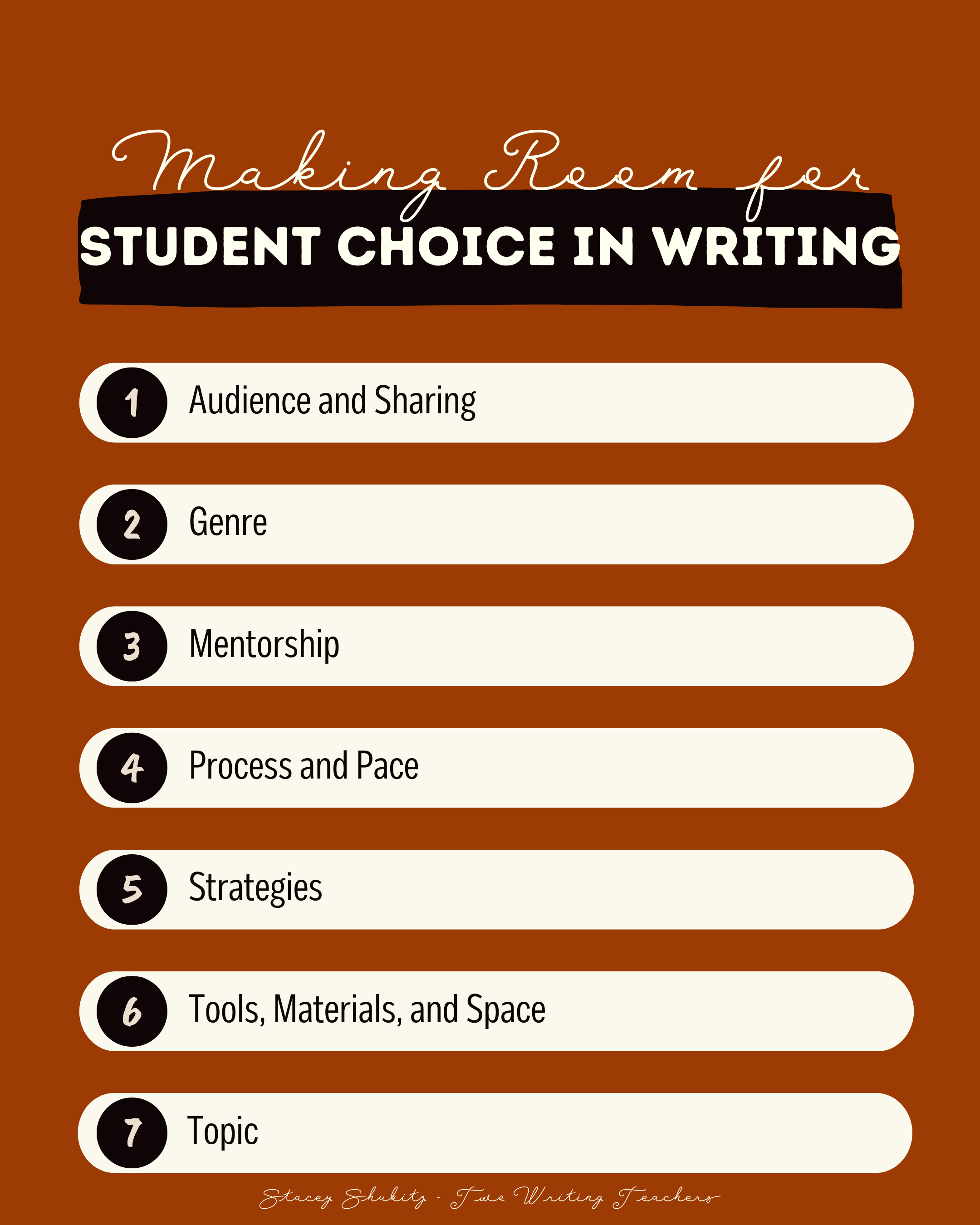
The Big Picture: Even if you’re working with a writing curriculum that doesn’t fit your instructional approach, you can still offer students meaningful choices in these areas:
- audience and sharing
- genre
- mentorship
- process and pace
- strategies
- tools, materials, and space
- topic
You might not be able to offer every choice all the time, but you can find a balance between required assignments and the choices you want students to have.
How It Works: Look for opportunities when you can give students some of these seven choices, even as you meet your curriculum’s requirements.
Topic Choice
Students choose their own writing topics within a unit, instead of being given a set prompt or story starter. For example, during a nonfiction unit, they can choose any informational topic that interests them. Kids often draw ideas from their lives, interests, and concerns—like family, sports, pets, or social issues. This builds ownership and leads to more writing. They also decide what they want to say about their topic, so two students writing about swimming might create completely different pieces.
In a writing workshop, students usually get to choose their own topics. Teachers use prompts for assessments, not daily lessons. If your students are used to being assigned topics, you’ll need to teach them how to generate their own ideas, a critical skill for writers. Try having them make either a simple or a more elaborate heart map. Other options include bone maps, lists, memory chains, neighborhood maps, or writing territory maps.
When we let kids choose their own topics, we show them that their ideas matter. They become more invested in their writing because they’ve picked a seed idea they care about and want to grow.
Dig deeper into topic choice:
- Freewrite Fridays: The Freedom Writers Deserve! by Leah Thomas
- Poop, Gamers, and Guns, OH MY! by Leah Thomas
- Uncomfortable Topic Choices in Writing Workshop by Beth Moore
Genre Choice
Giving students a choice of genre can feel challenging because it feels like too much deviation from the curriculum, which usually focuses on genre studies. But genre choice doesn’t have to mean weeks of independent projects. You can offer options within a unit you’re already teaching. For example, in a narrative unit, students might choose to write a personal narrative or a memoir. In an informational unit, they could write an article or create an infographic to show what they know. Pam Koutrakos has put together lists of possible writing products for each grade level and type. Her work includes sample unit plans that can help you get started if you want to try this in your classroom.
Explore more about genre choice:
- Designing Writing Units Where Students Choose the Product by Pam Koutrakos
- One Topic, Different Genres: Many Possibilities! by Kathleen Neagle Sokolowski
- Passionate Writers: Save a Seat for Every Writer by Stacey Shubitz
- Writing in Choice Time: Not Just a Center by Kelsey Sorum
Process and Pace
The writing process is not a straight line. It’s recursive, messy, and inconsistent. Oversimplifying it doesn’t help anyone. Most students don’t benefit from moving through the process in lockstep. Revision doesn’t have to happen only on Thursdays—it can happen any day.
It’s important for students to understand the steps of the writing process—such as collecting ideas, developing them, drafting, revising, editing, publishing, and reflecting. However, they should also know that these steps don’t always happen in a strict order. For example, a student might be editing a piece they developed, but during a conference with the teacher, they may realize they need to revise some parts. Moving back and forth between steps is a natural part of the writing process.
Kids work at different speeds. Some move quickly through the writing process and are ready to start something new. Others need more time, maybe because of working memory challenges, trouble finishing tasks, or typing slowly. Whatever the reason, it’s important to let students work at the pace that helps them finish their writing.
Learn more about the writing process and pacing choices:
- Considering Processes With Students by Melanie Meehan
- Offering Choice in the Planning Process by Melanie Meehan
- Students Can Draw at Every Stage of the Writing Process (For All Ages) by Beth Moore
- Three Ways to Exalt Process for Young Writers by Nawal Qarooni
- Writing Process Mentor: Ready-to-Go-Tip by Betsy Hubbard
Tools, Materials, and Space
Students at every grade level need choices. Younger students do need to learn basics like holding a pencil with a tripod grasp and keyboarding. As skills develop, giving them a choice of writing tools matters. Tools might include pencils, pens, colored pencils, markers, or digital options such as tablets and writing apps. Students learn to explore options and ultimately find the tools that work best for them when they’re given choices.
Letting students choose paper formats—whether they need more space for drawing, extra lines for writing, or different layouts—helps them match their strengths and needs to the kind of writing they want to do.
Giving students a choice of where to write—at a table, on the floor, in a beanbag, or in a quiet corner—helps them focus because they’re comfortable. It also helps to find locations where students can work with a peer editor or a writing group without disturbing others, especially on days when they don’t want to work alone.
Discover more about tools, materials, and space:
- Creating Comfortable, Inviting Spaces For Our Readers And Writers by Katie LeFrancois
- Focus Spots by Stacey Shubitz
- Paper Choices for Opinion and Argument Writing: Reaching Your Writers by Beth Moore
- Paper Choices: What’s up with that? by Beth Moore
- Pens Versus Pencils: Which One is Better for Writing Workshop? by Beth Moore
- Re-imagining Classroom Work Spaces: Reaching Your Writers by Stacey Shubitz
- Revising the Classroom: Adventures in Flexible Seating by Kathleen Neagle Sokolowski
Strategies
Many teachers strive to teach students skills, strategies, and techniques they can use in any kind of writing. The goal is for them to hold on to these strategies and use them throughout the year and beyond, empowering young writers with a toolbox of strategies.
Letting students decide when and how to use a strategy—in their notebook, in a current draft, or when revisiting older writing—gives them real choice in strategy application.
See more on choosing writing strategies:
- Can We Talk?: Teaching Dialogue in Narrative Writing by Lainie Levin
- Graphic Organizers Aren’t Magic by Betsy Hubbard
- Language to Convey Choice Versus Assignment by Beth Moore
- Recording, Revision and Repetition: Empowering Multilingual Writers by Nawal Qarooni
- What’s in a Strategy? by Betsy Hubbard
Mentorship
Mentorship means studying other writers’ work. This can include published mentor texts, student-written pieces, or demonstration texts you create. While teachers have often chosen their own mentor texts, mandated reading programs usually determine which books to use. I wrote a whole book about using mentor texts to help students grow as writers, and I still believe kids can find their own mentor texts, even if their teacher is using a boxed program.
Offer students a range of texts to choose from. Let them pick which ones to read on immersion days. Then, confer with writers or lead small groups to show them how to study a mentor text. As students get better at choosing and studying mentor texts, they’ll know when to borrow a move from a text to strengthen their own writing.
Take a closer look at providing a choice of mentor texts:
- 10 Books Celebrating Black Joy and Daily Life by Stacey Shubitz
- Comforting Picture Books by Stacey Shubitz
- Inviting Students to “Read Like a Writer” by Sarah Valter
- Six New Narrative Picture Books for Your Mentor Text Basket by Stacey Shubitz
- What’s the Big Idea? by Morgan Davis
Audience and Sharing
When students have a say in who will read their writing, it helps them as they craft their writing. Knowing whether the piece will be just for the teacher, for their classmates, for families, younger readers, a blog, or for a classroom anthology, children make changes to their tone and will likely inform word choice and craft decisions.
One type of publishing celebration doesn’t fit every student. Some kids enjoy being in the spotlight, but others feel anxious about reading their work aloud. Let students choose how they want to share their writing. They might read to a small group, post on a class blog, record themselves reading, create a poster or digital presentation, or share with a trusted adult.
Take a closer look at choices in audience and sharing:
- Make Your Audience’s Eyes Shine by Chana Stiefel
- Spontaneous Sparks by Betsy Hubbard
- Thinking About Audience by Stacey Shubitz
- Where is the Attention? by Lanny Ball
- Writing for Audience: Authentic Purposes for Writing by Lisa Keeler

One Small Shift: Beth Moore, who was a TWT co-author for ten years, shared sage advice in Language to Convey Choice Versus Assignment. She explained that one of the things we can control is the language we use, choosing words that convey choice rather than those that convey an assignment.
Beth explained that the language of choice sounds like: “One thing you might try…,” “One thing I do as a writer…,” “Make a plan for your writing today using this list/chart/checklist for ideas,” and “A strategy for doing this is….” Whereas the language of assignment sounds more like: “Today you will…,” “I want you to…,” “Make sure you do everything on this list/chart/checklist,” and “You have to…” Language that’s suggestive of choice represents a shift that will help students have more autonomy over how they approach their writing.
The Bottom Line: Even if you have to follow a required curriculum, you can still give students meaningful choices. Look for ways to balance what’s required with flexible, student-centered options.
Go Deeper
The following posts are a round-up to help you think more deeply about choice in writing.
- Getting to Know Writers: Unboxing Fresh Routines Blog Series by Jessica Carey
- Never Write About the Same Topic as Your Students–Except Sometimes by Beth Moore
- When Writing Feels Right: Exalting Choice and Purpose in Workshop by Nawal Qarooni
- Year-Long Planning: Keep the Big Picture in Mind from the Beginning by Shawnda Fukano
ICYMI
Today is the third day of our Back to School Blog Series. Be sure to read these posts:
- Jess Carey’s post from day one, which explored the balance between explicit and responsive instruction.
- Sarah Valter’s post from our second day, which looked at the ways writing is taught during a designated workshop block and during content area instruction.
- Melanie Meehan’s post explored the value of foundational writing skills and composition at all stages of children’s writing development.
Up Next: Join us again tomorrow for the final day of the series when Leah Thomas will help us think through ways to use demonstration texts and mentor texts to grow young writers.
Discover more from TWO WRITING TEACHERS
Subscribe to get the latest posts sent to your email.


