Estimated Reading Time: 4 minutes (691 words)
Audience: Grade 3-8 Classroom Teachers and Instructional Coaches
Here’s Why
Teachers love graphic organizers. Acronyms have been shown to reduce students’ cognitive load during the writing process. Examples like CER, RACE, RACES, OREO, and hamburger paragraphs are commonly used and feel supportive. They reduce overwhelm. They make invisible writing structures visible for students who are still learning how writing works. And, I’ve used many of these over the years with multiple grade levels. But breaking down a writing task doesn’t always have to look like boxes filled in and stitched together with transition words as glue.
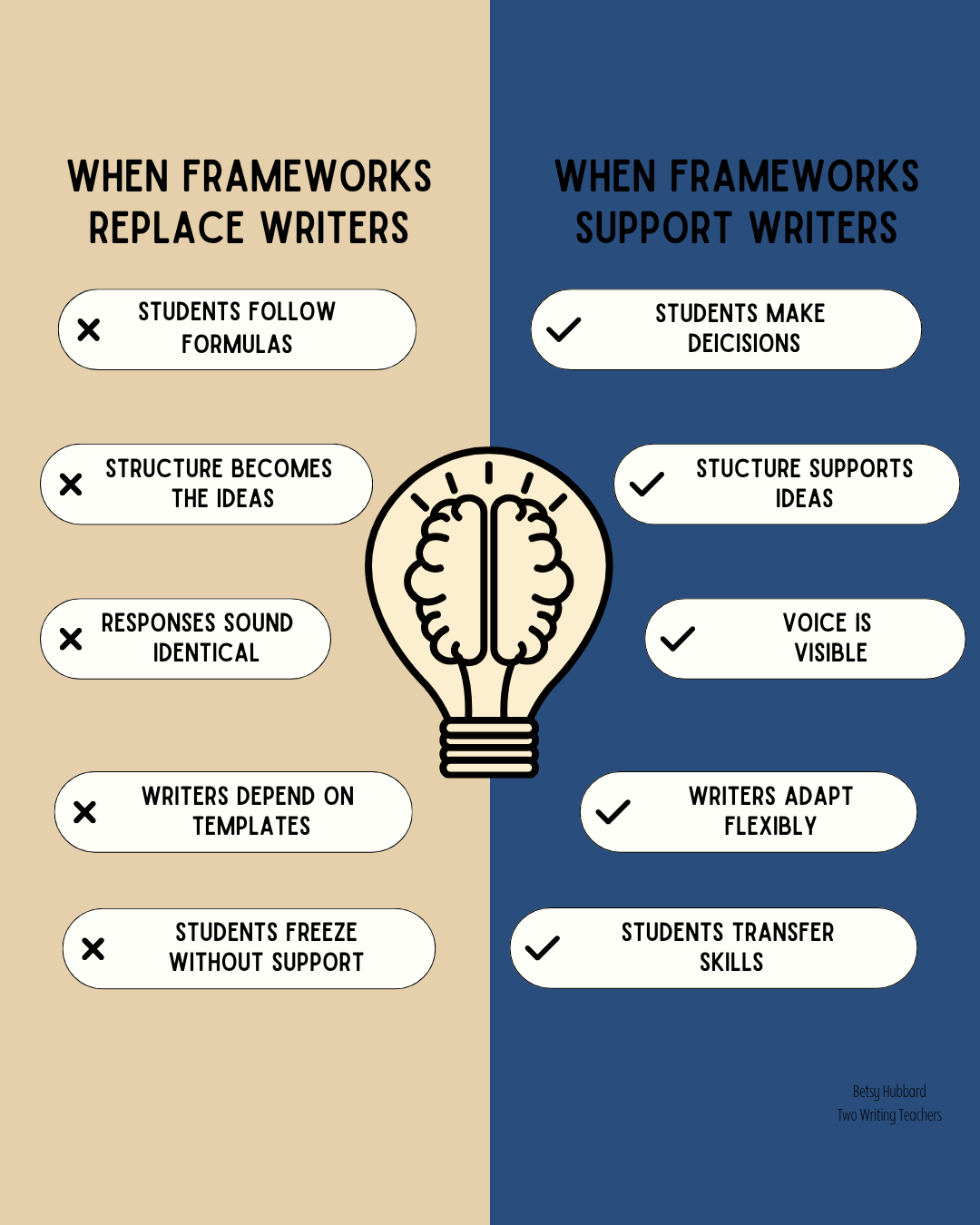
Over time, I’ve found myself returning to the same concern: sometimes the structure quietly becomes the writing itself. Students stop making writing decisions and start following formulas instead. Frameworks absolutely have value. Acronyms can help students carry the organizational demands of writing while they are learning. The problem begins when students rely on the acronym as a prompt for what they have to say. Then, it’s no longer what they have to say; it’s all they say.
Graphic organizers are tools, not strategies.
The Big Picture
Frameworks and graphic organizers have an important place in writing instruction. They help novice writers manage complexity. They provide a starting point. They build confidence. The problem isn’t the tool itself. The problem is when the tool becomes the writing.
Students begin writing to satisfy the formula rather than to communicate meaning. CER becomes a checklist instead of a way to support reasoning. RACES becomes a sentence-ordering task instead of a thoughtful response. Hamburger paragraphs become rigid structures where every paragraph sounds identical, no matter the topic or purpose.
The same can happen with OREO writing. The acronym helps students remember organizational pieces, but eventually, some students become so dependent on the formula that they stop making intentional writing decisions altogether. Instead of developing opinions with voice, specificity, and audience awareness, they simply move from one required part to the next.
At first, these frameworks reduce cognitive load. But over time, if they are never released, they can actually limit flexibility, independence, and transfer.
Behind the Scenes
I’ve noticed this tension most clearly when students move from planning to drafting. Students fill every box on the organizer, but still struggle to write the paragraph.
They ask:
- “What goes here?”
- “How many sentences do I need?”
- “What comes after the evidence?”
instead of:
- “What idea matters most?”
- “How do I want this to sound?”
- “What would make this clearer for my reader?”
I’ve found myself in this spot time and time again, and often what snaps me out of it is the lack of student voice within the writing they create. The writing starts sounding robotic. Responses become repetitive. Students rely on transition words to glue ideas together, but the thinking underneath stays shallow. Even when students complete every part of the organizer correctly, many still struggle to elaborate meaningfully because the formula carries too much of the thinking for them. Perhaps most concerning, students often freeze when the framework disappears.
The structure should support the writer, not replace the writer.
Here’s a Secret
The answer is not throwing out graphic organizers altogether. The answer is making sure they remain temporary supports while students develop internal writing strategies.
Frameworks should act as bridges, not cages.
We can still use CER, RACES, OREO, sentence frames, and graphic organizers while also explicitly teaching the thinking behind them. Students need opportunities to see how writers:
- choose relevant evidence,
- prioritize ideas,
- elaborate with purpose,
- adapt structure flexibly,
- and make decisions based on audience and meaning.
That kind of instruction cannot live entirely inside pre-filled boxes.
This is where think-alouds, mentor texts, oral rehearsal, collaborative discussion, and flexible planning become so important. Students need to see writing as decision-making, not simply task completion.
One Thing to Remember
Non-strategic writers do not simply need more structure. They need more strategic instruction. Otherwise, it’s no longer what students have to say; it becomes all they say.
Discover more from TWO WRITING TEACHERS
Subscribe to get the latest posts sent to your email.


This is such a great post! It captures a lot of what I was thinking when reading a professional book recently with a book club at school. That book had lots of strategies, but no heart. I sent a link to your post along to my colleague, and printed it out for myself, too. Thank you!
LikeLike
Betsy! This is a post to keep and that I will share again and again. Thank you!
LikeLike
I appreciate this post, as I am in the middle of this transition with my freshmen right now. I have tried different ideas from guiding questions to sentence strip rearranging. What lesson ideas or prompts do you have to help this process when they relied for years on frames? Thanks.
LikeLike
One idea that comes to mind is using demonstration texts that show an example of a paragraph that matches a CER style format, and then one that also includes the same information, but maybe the claim is last, or the exaplanation and reasoning comes first with anecdotal details. Using the demonstration texts to first analyze the differences, and then using mentor texts to see the elements of these formats in real-life.
But long before this, building detailed sentences is the foundational skill that is necessary before trying to create well balanced paragraphs with varied sentences, strong evidence, and relevant explanations. I hope that gives you some ideas to try. I truly understand the difficulty you are talking about. Building their confidence in the small parts first is always a good place to start.
LikeLike