Reading Time: 5 mins (897 words)
Target Audience: Teachers, Coaches, Building and District Leaders
A Backstory: My district has a literacy program that is comprehensive in addressing skills and standards, has an abundance of resources, and builds a strong knowledge foundation, yet teachers consistently report that they never have enough time for writing. This is especially true when it comes to giving students time to deeply study mentor texts, name craft moves, and try these strategies in their own writing.
For the past few months, inspired by sessions with the authors at NCTE, our elementary coaching team has been taking a deep dive into the second edition of Wondrous Words (Ray & Villalba, 2025). Our discussions, paired with observations about the types of reading kids have been engaging in independently, led us to partner with a few eager second-grade teachers this spring to integrate a new rotation into our reading block: Read Like a Writer.
Behind the Scenes: We entered this work with a clear structure and goal. The teachers, excited to give students new reading opportunities with less screen time, collaborated with us to design a 4-day rotation of literacy activities during students’ independent work time. In addition to meeting in small groups, each student has about 20 minutes of independent work time each day with structured tasks to extend their learning.
Applying new ideas from Wondrous Words, we designed the “Read Like a Writer” rotation to engage students in reading familiar texts that are closely aligned with the topics being studied while also clearly showing several characteristics of strong writing.
For our introductory lesson, we selected a Time for Kids article on volcanoes. Students are currently reading and writing extensively about earth systems and weather, but our reasons for choosing this piece went far beyond the topic. As we reviewed the second-grade writing standards and the expectations for writing in this unit, the article showcased several high-leverage writing moves for kids:
- Using a question to start a paragraph (What do you call a scientist who studies volcanoes?)
- Strong verbs (sputters, shoot, rumbles)
- Onomatopoeia (Boom!)
- Twin sentences to contrast ideas (Volcanoes can be beneficial. Volcanoes can be dangerous.)
- Defining new words in a variety of ways (A volcano is an opening in the Earth. Magma, or hot melted rock…)
- Clear main idea sentences.
Though we eventually want kids to notice, name, and try skills on their own, we recognize that this is new and scaffolding is needed. Because of this, we highlighted each of these writing moves in the text, subtly color-coding them into easy, on-level, and challenging. We also prepared a template for students to add to their writing binders to capture their work.
What We Did: We introduced kids to Read Like a Writer with modeling, oral rehearsal, and guided practice using the following sequence:
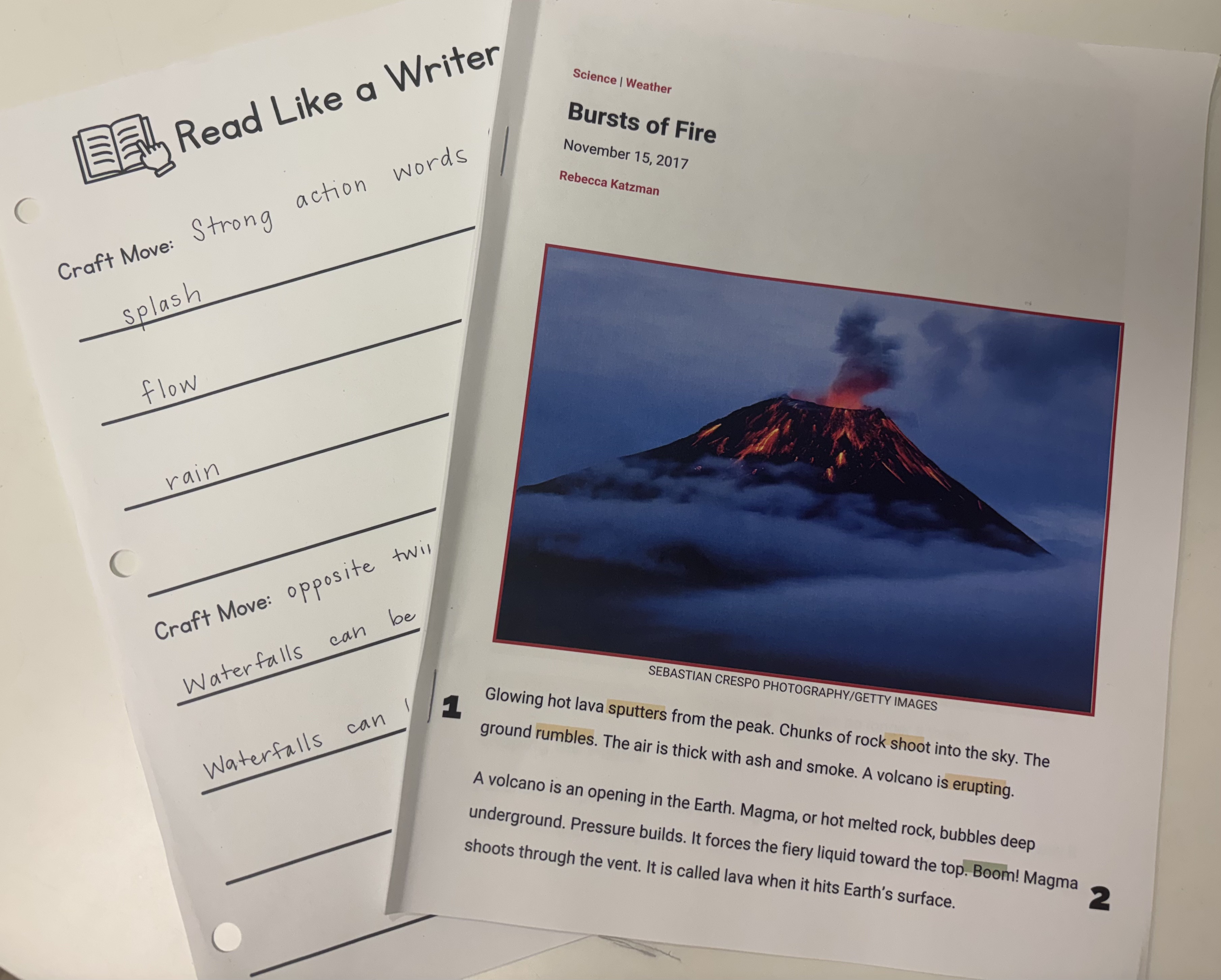
- Read the article together. We read and discussed the article, focusing on what the author taught us and new and interesting information. *Ideally, we will use a familiar text moving forward.
- Reread to name 1-2 craft moves. I reread the first few paragraphs aloud, selecting one craft move (strong verbs) to notice and name.
- Model with think-aloud and oral rehearsal. I modeled thinking of strong verbs to go with my topic or waterfalls (flowing, splashing, tumbling), then asked kids to try this work orally with a partner.
- Model with rehearsal and writing. I repeated this work with twin sentences (Waterfalls can be big. Waterfalls can be small.), this time demonstrating how to write down my ideas while I thought aloud.
- Invite kids to practice. We gave each student a copy of the text and a template page to practice. Though many of them repeated the work we rehearsed together, a few noticed other moves and tried them out.
What’s Next: This work lends itself to both immediate next steps in the classroom and goals we hope to achieve down the road.
- Now: Students will have time to independently work with this text next week, trying out the moves they notice. Our goal right now is to allow them to engage with a mentor text and try out some of the moves, which the teacher will guide them to incorporate into their drafts during their writing block. The work doesn’t have to be perfect; the desired outcome is for these students to know they can read texts through the lens of looking for writing moves.
- Soon: Staying true to the heart of scaffolding, we have identified a few additional texts to introduce and use during the remaining weeks of the school year. We will pull away a bit of the scaffolding each time, being mindful of ways we might differentiate and opportunities to push kids to do a little more each time.
- Later: Next year, this work will begin from the first writing unit (and in more classrooms). The teachers and coaches have both already recognized the power of this work and the value of introducing it slowly across the school year. By consistently building in time during across the literacy block, we know we can take students further as writers and as readers.
Go Deeper: Both the TWTBlog and TWTPod have extensive backlists of resources for using mentor texts in the classroom. Here are some highlights:
- In this 2022 TWTpod episode, “Extending the Power of Mentor Texts: A Digging Deeper Dialogue”, Melanie and Stacey provide both text ideas and teacher resources.
- A click on this link will take you to the archives of all TWTBlog posts that are categorized under mentor texts.
- If you’re looking for a new twist on mentor texts, check out the 2025 blog series “Modernizing Mentor Texts.”
Discover more from TWO WRITING TEACHERS
Subscribe to get the latest posts sent to your email.


I love this piece. I think when we, as teachers, stop during a read aloud and deliberately point out the author move it can be so powerful for our students.
LikeLike