Estimated Reading Time: 8 minutes (1,465 words)
Primary Audience: K-12 Teachers & Coaches

One of the most important parts of learning to write is seeing writing in action. Teachers often use demonstration texts and mentor texts as windows into the writing process and the possibilities of what writing can become. These two types of text shed light on different parts of the writing process. Demonstration texts are used to model a writing strategy or skill. They may be written by the teacher or provided by a curriculum, but their purpose is to make the writing process visible to students. Mentor texts are completed pieces that writers can mine for craft moves. Student writers grow the most when both windows are open. These terms are sometimes used interchangeably by teachers and publishers, but it’s worth knowing the difference because they serve different, yet essential, purposes.
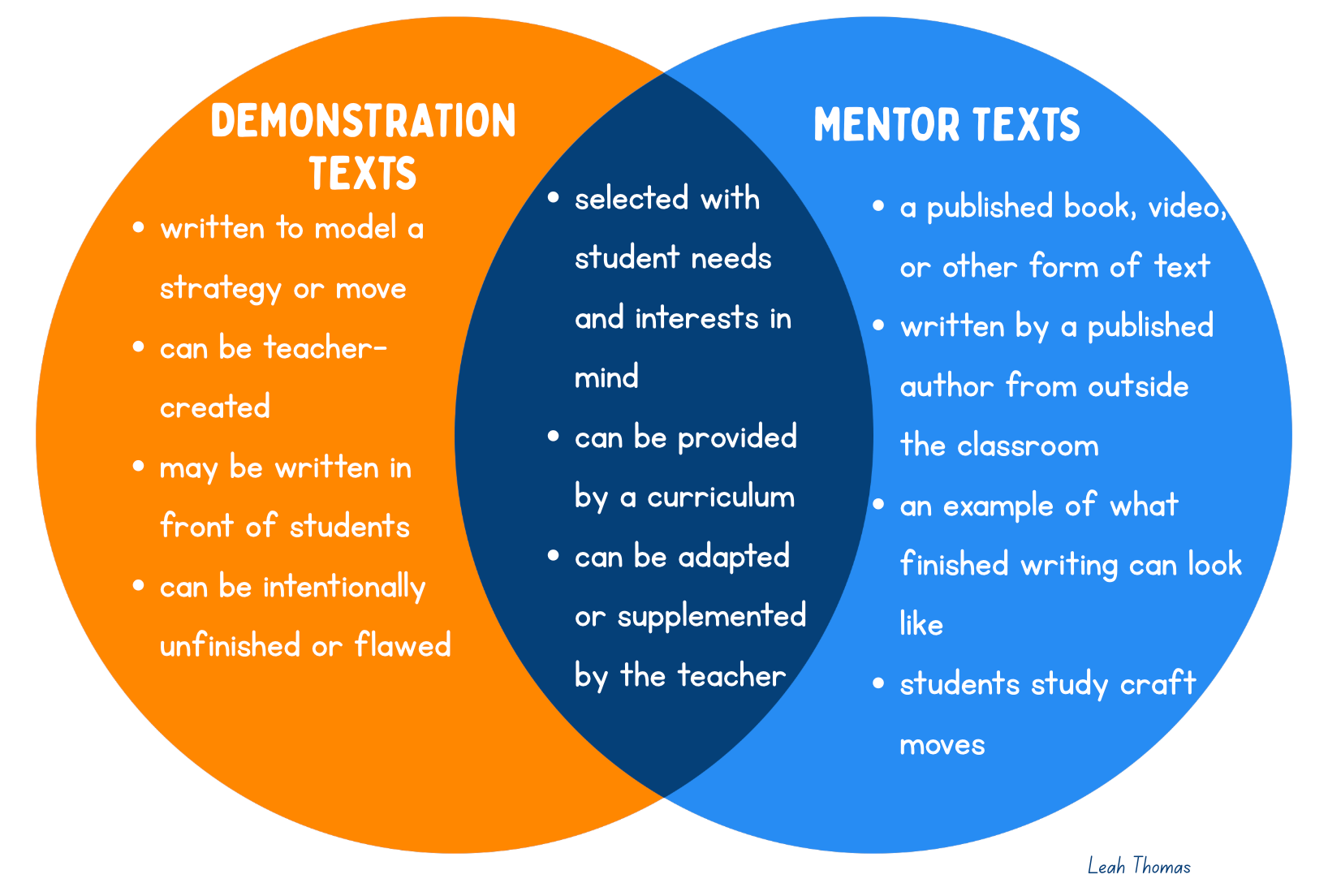
Demonstration texts and mentor texts each have a place in writing instruction, and both are often included in boxed curricular resources because research supports their use. In the 2018 IES practice guide Teaching Elementary School Students to Be Effective Writers, Steve Graham and colleagues recommend using models of writing for students to study and emulate (mentor texts), as well as modeling writing strategies through explicit instruction (demonstration texts). Students benefit from seeing what effective writing can look like and how writers use strategies to create it. When you see a demonstration text or mentor text in your curriculum, consider it an opportunity for you to tailor instruction to your students’ individual needs.
Modeling With Demonstration Texts
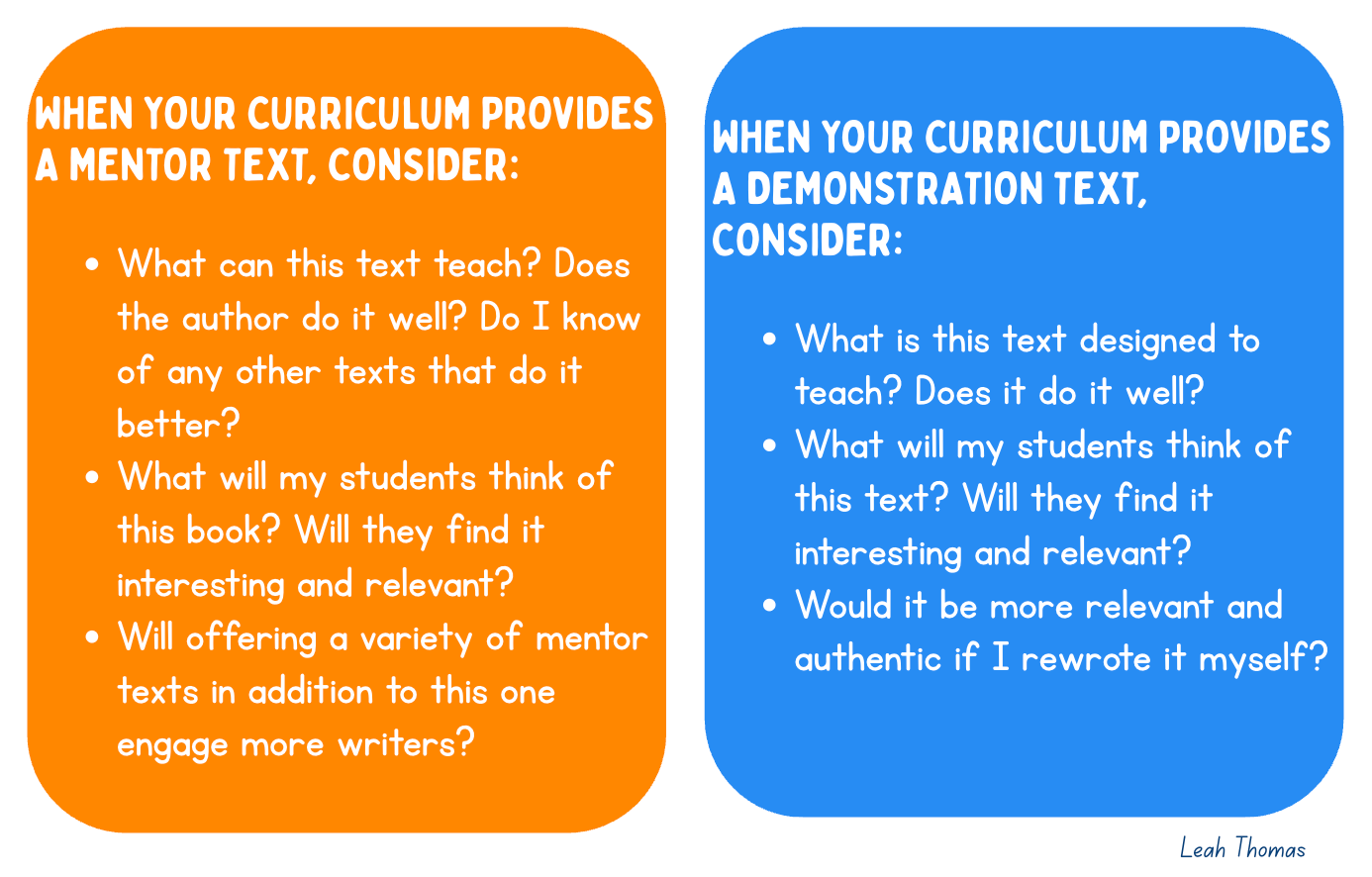
When your curriculum provides a demonstration text, it helps to consider:
- What is this text designed to teach? Does it do it well?
- What will my students think of this text? Will they find it interesting and relevant?
- Would it be more relevant and authentic if I rewrote it myself?
This was evident a few years ago, as I prepared to introduce narrative writing to second graders. Unfortunately, this genre focus came after a few weeks of choice writing, so when I told students that some of that choice would be taken away, they groaned. I looked down at the demonstration text I’d used year after year. It was a story about seeing a swan land on a lake while I was kayaking. In the past, I used this demonstration text to introduce writing a narrative with a clear beginning, middle, and end. But this time, my students were already disengaged. I knew this demonstration text wasn’t going to cut it.
So, I changed course. I started crafting a demonstration text about the time a student threw up on my shoes. After screaming and laughing through the lesson, students went off to write with a new energy.
The swan story wasn’t a bad demonstration text, but it wasn’t the right text for those students in that moment. I share this story to caution you: Demonstration texts are sometimes created without students in mind, whether you borrow them from a colleague, a curriculum manual, or your own teacher toolbox. But when you use demonstration texts without reflecting first, some of the art of teaching is lost. Students learn the most from demo texts when they watch their teacher generate ideas, rehearse a sentence aloud, make decisions, and record those thoughts in real time. Doing so makes the thinking behind the writing authentic and visible. Publisher-created demonstration texts can be valuable planning tools and examples of the intended teaching point. You don’t have to ignore them completely, but you also don’t have to follow them verbatim.
Studying Mentor Texts
Similar thoughtful questions can be applied to mentor texts. When your curriculum provides a mentor text, consider:
- What can this text teach? Does the author do it well? Do I know of any other texts that do it better?
- What will my students think of this book? Will they find it interesting and relevant?
- Will offering a variety of mentor texts in addition to this one engage more writers?
When teaching a personal narrative writing unit as scripted, students quickly grew tired of the frequent references to Owl Moon by Jane Yolen. Owl Moon is a beautiful book, but the experience of going “owling” wasn’t relevant to the second graders in my classroom. Furthermore, while the artful prose was pleasing to me as an adult, it didn’t resonate with many second graders, who were gravitating toward funny, action-packed books like Dog-Man.
Owl Moon is excellent at zooming in on a small moment in time and providing lots of detail, which was the main goal of using it as a mentor text. So, I considered other books that had similar detail-packed “small moments.” I chose:
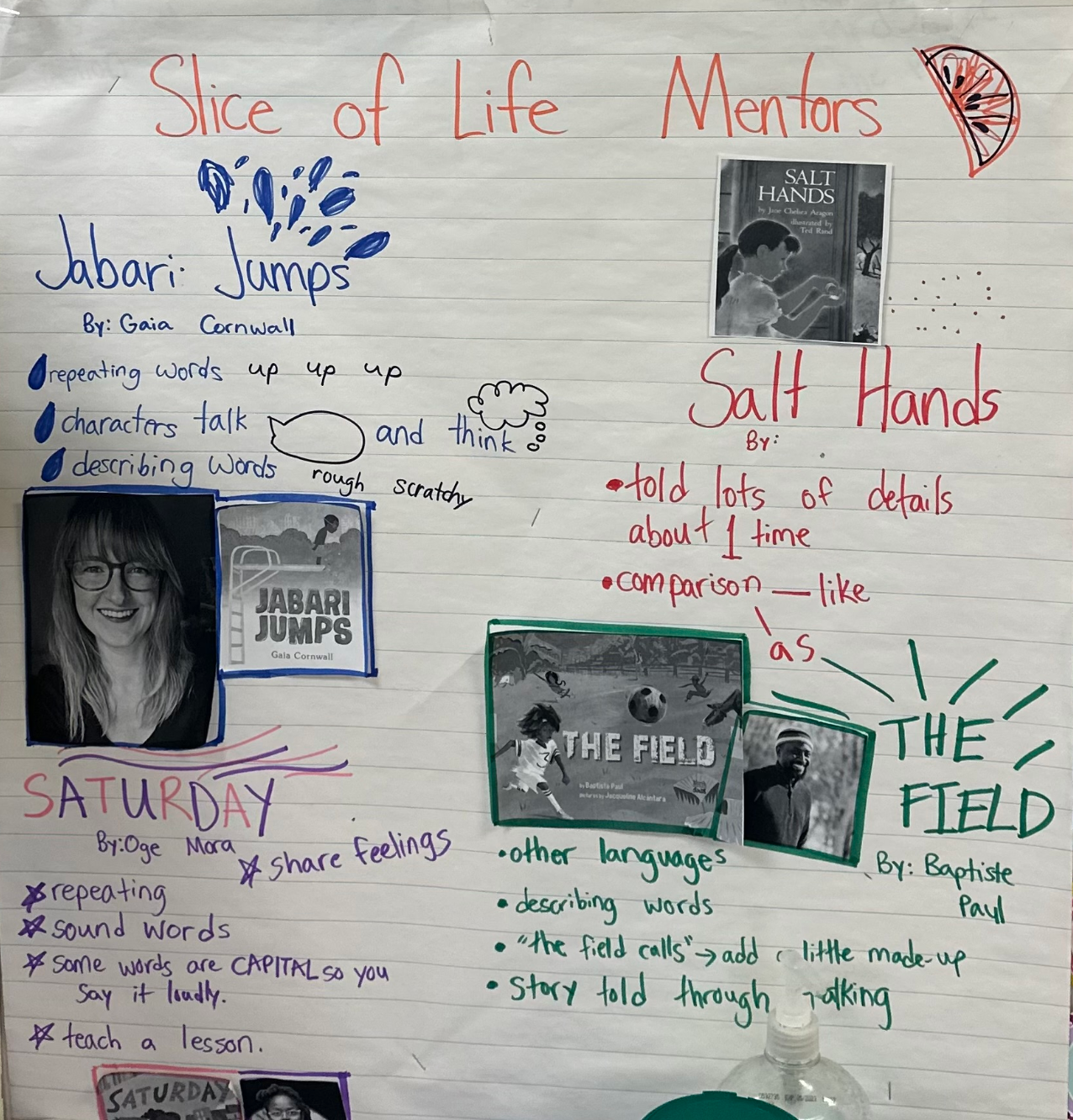
- The Field by Baptiste Paul, because my class at the time was obsessed with soccer.
- Jabari Jumps by Gaia Cornwall, because we’d read it earlier in the year during a lesson about growth mindset, and students loved it.
- Saturday by Oge Mora, because it includes lots of onomatopoeia like Owl Moon.
- Salt Hands by Jane Aragon, which is very similar to Owl Moon, but the experience is more relevant than owling. (P.S: I love the point-of-view illustrations!)
Why four books to replace one? Offering a variety of mentor texts increases the likelihood that every student will find one they connect with. Furthermore, letting kids choose their mentor is more engaging than assigning the same mentor to everyone. Choosing a mentor requires students to reflect on the kind of writer they are and the kinds of writing they aspire to create. These decisions help students develop a stronger sense of writing identity.
Mentors are everywhere! While I’ve primarily described demonstration texts as teacher-written and mentor texts as published pieces, don’t overlook your students and the texts they create:
- Teachers can use student work (with permission) as a demonstration text to model a skill. This often increases engagement and offers an authentic example of grade-level writing.
- Students can write their own demonstration texts and lead a lesson or small group. I wrote more about this here: Increase the Number of Teachers in the Room with Student-Led Small Groups
- Student work can also be used as a mentor text. Learn more in this interview by Stacey Shubitz about the book Learning From Classmates: Using Students’ Writing as Mentor Texts by Lisa Eickholdt.
A note about AI: It can be tempting to ask AI to write demonstration texts for you. After all, AI is very good at following a prompt, so why not say, “Write me a demonstration text for first-grade students that can be used to teach about introductions.” Yet, this misses the primary goal of using demonstration texts. In a 2024 Heinemann Blog post, Carl Anderson and Matt Glover caution against asking AI to write demonstration texts: “Writing their own texts allows teachers to understand what students are experiencing as they write, and also allows teachers to analyze their own process so they can generate process-related teaching points.” Additionally, writing demonstration texts as a team is a great use of collaborative time.
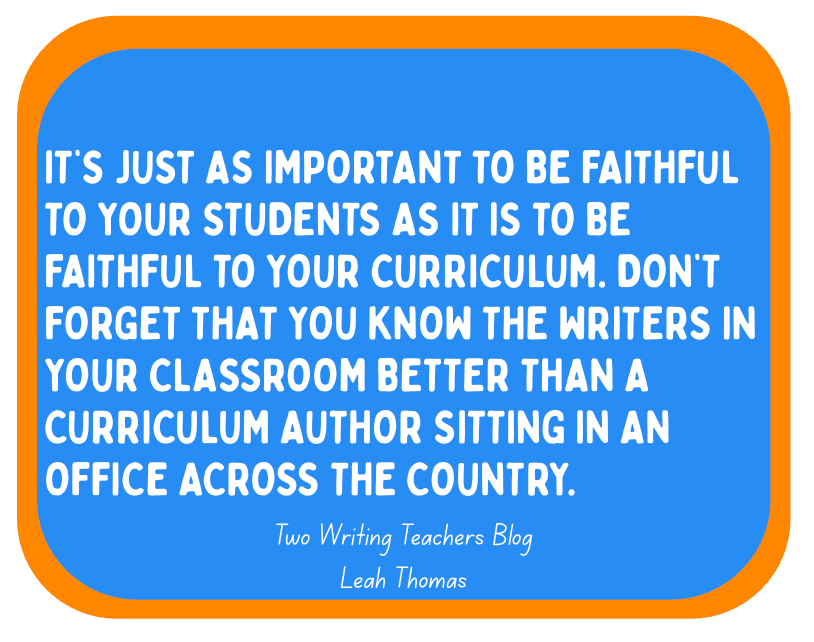
But what about fidelity? You might be wondering whether writing your own demonstration texts or adding mentor texts means you’re no longer teaching the curriculum with fidelity. However, it’s just as important to be faithful to your students as it is to be faithful to the curriculum. If the goal is to model a writing strategy, writing your own demonstration text can actually make that strategy more visible. If the goal is to study a particular craft move, adding mentor texts that illustrate the same craft move can help more students access the lesson. I believe we can honor the instructional goals of a curriculum while still using our professional judgment. Don’t forget that you know the writers in your classroom better than a curriculum author sitting in an office across the country.
Thanks for joining us this week for the Finding Common Ground Blog Series. We hope our posts prompted you to consider how aspects of teaching writing that are often positioned as opposites can actually exist in harmony. If you missed any, here’s a recap of the week:
- Monday: Explicit Instruction and Responsive Instruction by Jess Carey
- Tuesday: Writing Workshop and Cross Curricular Writing by Sarah Valter
- Wednesday: Foundational Skills and Composition by Melanie Meehan
- Thursday: Balancing Choice and Assignments by Stacey Shubitz
- Friday: Modeling and Mentors by Leah Thomas
Discover more from TWO WRITING TEACHERS
Subscribe to get the latest posts sent to your email.


