Estimated Reading Time: 5 Minutes (1,016 words)
Primary Audience: Instructional Coaches and Classroom Teachers
A Back Story
A Backstory
A few years ago, I wrote a post, Teaching Writing: A Creative Process, that was about thinking of curriculum like a recipe. I shared a story about cooking with my Grandma, who never seemed to need a recipe. She knew how to make something delicious by watching, tasting, stirring, and responding to what was right in front of her. She knew when something needed a little more of this or a little less of that. I reflected on how much teaching is like this creative process. We have a curriculum to work from, but we also have to be willing to notice what our students need and think about what we might add.
At the time, I was thinking about the ways we could enhance writing units by adding ingredients like immersion, research days, additional drafting time, revision, and opportunities for celebration. I still believe in that thinking. In fact, as I’ve spent more time working alongside teachers to maximize writing instruction, I find myself returning to many of these same ideas.
Lately, I’ve noticed that regardless of the grade level, the genre, or the particular unit of study, I often find myself sharing a similar set of suggestions. There are certain instructional opportunities that can strengthen almost any writing unit.
My thinking has shifted a bit from simply asking, What should we add to this unit? to thinking more intentionally about the instructional experiences we want to make sure are present in every unit. These aren’t necessarily additional lessons or activities to squeeze into an already full curriculum calendar. They are opportunities to be more deliberate about providing enough time for things that really matter.
The Details
I’ve found myself sharing these ideas again and again, across grade levels. So, I thought it might be worth putting them together to share here, with all of you!
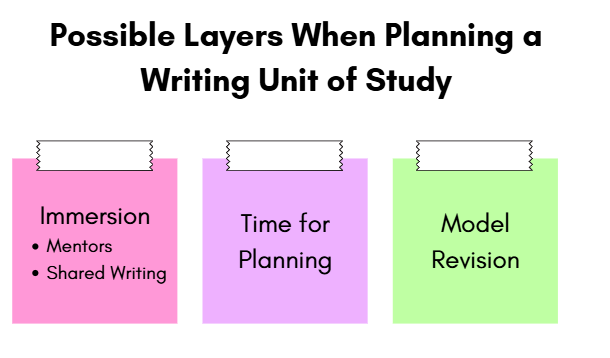
Immersion:
Before launching into a new unit of study, I think it is time well spent for both teachers and students to become reacquainted with the genre they will be studying. This might include studying published mentor texts as well as pieces written by students. It is always a good idea to save or scan student exemplars that can be used as models in future units! As students study mentor texts, they can be invited to notice the structure of the genre as well as the craft moves they might try as they take on this work themselves.
Over the last few years, I have also encouraged and worked alongside teachers to embed shared writing into this phase of the unit. Co-creating a piece gives students a supported experience with getting started and provides another mentor text they can return to as they begin drafting independently.
You can read more in this post from last year, Reimagining Immersion.
Planning Time:
I am always advocating for making time for students to plan their writing and for teachers to confer with students about those plans. It can be difficult to undo major misconceptions or address challenges with a piece once a student has already invested significant time in drafting. I’ve found that students are often more open to feedback and more willing to make changes when those conversations happen during the planning process, before they’ve become too attached to the direction they’ve taken.
Providing clear models of what planning can look like is equally important. When students have opportunities to see and study different ways writers plan, they have a clearer understanding of how to approach their own work. These models help make the process visible, support transfer, and ultimately set students up for success as they begin drafting.
As a literacy coach, I often offer to push into classrooms on planning days to give teachers an extra set of hands and help make time to check in with students about their plans. These conversations can be time-consuming, especially when there are many students to reach, but I have found that the time invested upfront often saves time later. Students are better prepared to get started, and teachers can feel more confident that students are headed in a productive direction before they begin drafting.
Making Revision Visible:
Finally, I believe there is real value in explicitly modeling what revision looks like. It is one thing to teach students strategies for adding to, removing, or rearranging parts of their writing. It is another thing to show them exactly what that work can look like on the page. This might mean using sticky notes, flaps, or revision pens to demonstrate how writers make changes as their thinking evolves.
When students observe different systems for revising, they begin to develop a vision for what this work can look like in their own writing. I think this is especially important because students are often reluctant to make changes when those changes don’t fit neatly onto the page or make their writing look messy. We need to help students see that revision isn’t always neat or tidy. Sometimes it means crossing things out, adding arrows, moving pieces around, or finding a way to squeeze in a new idea.
The mess is something to celebrate and something to model!
You can read more about some tools that can support this work in this post, Writing Centers: A Vision of Independence.
A Final Thought
I still think about my Grandma in the kitchen when I think about teaching. She paid attention to what was happening in front of her and made adjustments along the way. I think we have to approach our curriculum in much the same way. We need a strong foundation, but we also need to be willing to pause, notice, and make room for the instructional experiences that will help our students grow and develop skills they can take with them beyond a single unit of study.
Sometimes the most important additions aren’t entirely new lessons or activities. They are the opportunities we create to slow down, pay attention, and give students the time they need to become better writers.
Share this:

Discover more from TWO WRITING TEACHERS
Subscribe to get the latest posts sent to your email.
