🎧 Prefer to listen? An audio version of this article is available via Paper2Audio.
Estimated Reading Time: 4 minutes (706 words)
Primary Audience: K-6 Classroom Teachers
A Backstory: Over a decade ago, Beth Moore wrote about using minilesson architecture to teach her daughter to hang up her coat. Her example showed how effective teaching structures can appear in unexpected places, and how the way we support learning, even in small moments, can shape a child’s sense of ownership and agency.
Last week, I led a 30-minute session on supporting students with different learning styles for the madrichim (teen helpers in my synagogue’s education program). When first asked, I wondered what I could offer that would be immediately useful. Like Beth, I looked to a familiar structure: the writing conference.
A Familiar Structure in a New Setting: In Welcome to Writing Workshop: Engaging Today’s Students with a Model That Works, which I co-authored with Lynne Dorfman, we included a cheat sheet for teachers to use at different points of a writing conference (figure 7.3, page 98). I adapted these phrases for the madrichim.
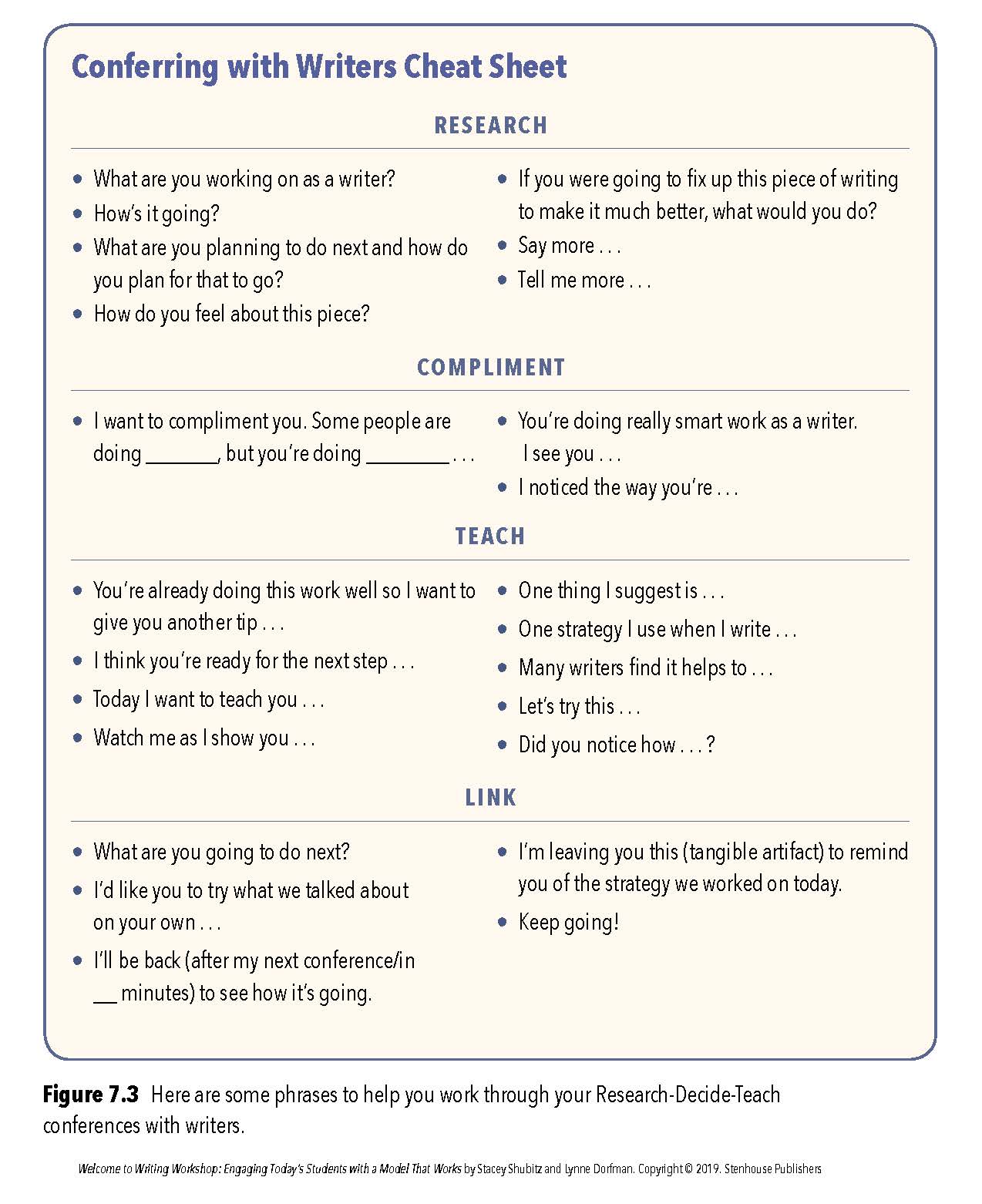
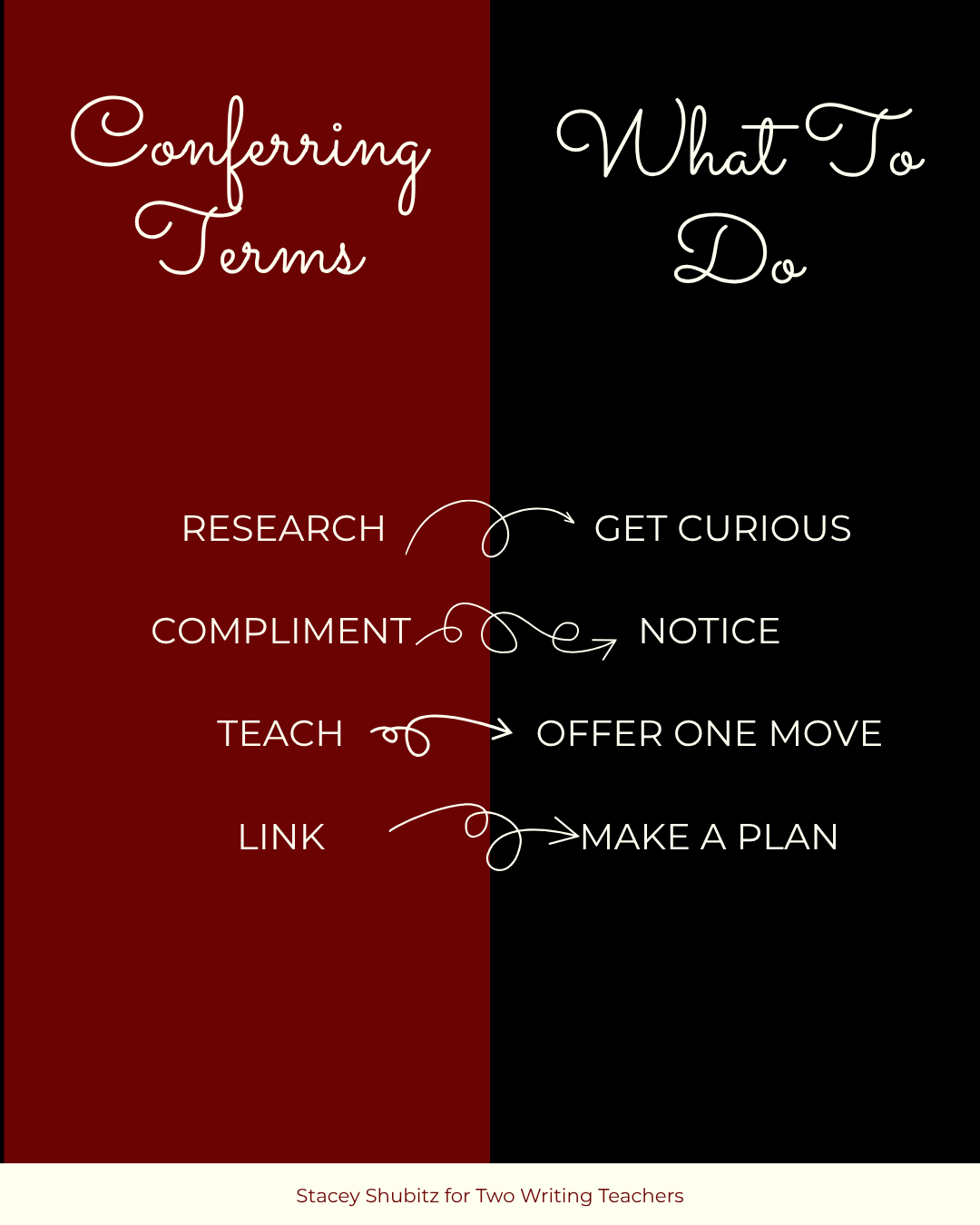
Before sharing the conferring phrases, I demonstrated two approaches to the same task with another adult playing the child: creating a Shabbat illustration and caption for a class book. The goal was to communicate an idea, not perfect spelling. First, we acted out an adult taking over: “Just write, ‘Shabbat is special.’ Here, copy what I write.”
I asked the madrichim, “Who is deciding what the writing will say?” In this version, the adult supplied the message and did not let the child decide what to communicate.
Then, I modeled what a curious conversation could look like:
To debrief, I asked the group:
- What did we learn by asking first?
- Who chose the message?
- What kind of help did the child actually need?
In either version, a child might write a caption. But only one approach began by discovering the child’s message and what help they needed to communicate it. The difference is profound: when students can express their own ideas, they are more engaged, confident, and invested in their work. The madrichim then practiced the same moves in pairs using two other scenarios.
Questions to Carry Back to Workshop: Preparing this session gave me three questions about conferences with students during writing workshop:
- Have I listened long enough to know what I’m teaching into? In the Shabbat demonstration, the child already had a message but needed help getting it onto the page. We want to pause long enough to recognize that before choosing a teaching point.
- What’s enough support to make a next step possible without taking over? Scribing a child’s words and supplying a sentence to copy can both result in a finished caption. But we want the child’s words on the page; we don’t want adult words/thinking to replace theirs.
- Whose plan is the writer implementing? When we ask a student what they’ll do next, we want to listen for their understanding, not for them to parrot back our suggestions or directions. The next step can be figured out writer-to-writer, but students need to be the ones moving their writing forward.
One Final Thing: When we begin with curiosity and focus on student ownership, we not only help kids write what matters to them, but we also show them their ideas are worth sharing. Simple phrases like “Tell me more,” “One thing you could try,” and “What will you do next?” are small but powerful ways to help young writers take the lead and build agency in their writing process.
Go Deeper: While this example comes from a religious school, the principle holds true in any classroom, with any age group: when we begin with curiosity and focus on student ownership, we not only help kids share what matters to them… we show them their ideas are worth sharing.
Here are five posts about conferring to check out:
- Get REALLY Good at Conferring
- Make Space for Conferring: Why Having a Plan Matters (and How to Make It Happen)
- The Conference, Theirs
- The Language to Develop Agency: Amping Up Agency Blog Series
- Understanding Conference Roles for Effective Student-Teacher Collaboration
Share this:

Discover more from TWO WRITING TEACHERS
Subscribe to get the latest posts sent to your email.
