
Congratulations to the winner of this weekend’s Mid-month Commenting Challenge!
Author: Lanny Ball
For more than 29 years, Lanny has taught, coached, presented, staff developed, and consulted within the exciting and enigmatic world of literacy. With unyielding passion and belief in the possibility of workshop teaching, Lanny has worked to support students, teachers, and school administrators around the country in outgrowing themselves as both writers and readers. Working first as a classroom teacher, then as a coach and TCRWP Staff Developer, Lanny is now a literacy specialist, working and living in the great state of Connecticut. Outside of literacy, he enjoys raising his three ambitious young daughters with his wife, and playing the piano. Find him on this blog, as well as on Twitter @LannyBall. Lanny is also a former co-author of a blog dedicated to supporting writing teachers and coaches that maintain classroom writing workshops, twowritingteachers.org.


2018 CLASSROOM SOLSC FOR STUDENTS: DAY 13 OF 31
Day 13 of the Classroom Slice of Life Story Challenge!
Share this:

Share this:
2018 CLASSROOM SOLSC FOR STUDENTS: DAY 12 OF 31
Day 12 of the Classroom Slice of Life Story Challenge!
Share this:

Share this:
2018 CLASSROOM SOLSC FOR STUDENTS: DAY 11 OF 31
Day 11 of the Classroom Slice of Life Story Challenge!
Share this:

Share this:
A NEW KIND OF COMMENTING CHALLENGE #SOL18
Like our adult community, our student writing community thrives on comments and feedback. We invite our students to participate in the Classroom Challenge in hopes that they will be able to connect with other writers from around the community and the world. In the spirit of that global community, we are offering a brand new kind of commenting challenge. As part of the 11th Annual SOLSC, we present our first mid-month challenge! Are you ready?
Share this:

Share this:
2018 CLASSROOM SOLSC FOR STUDENTS: DAY 10 OF 31
Day 10 of the Classroom Slice of Life Story Challenge!
Share this:

Share this:

Urgent Small Groups: Eating the Whole Cookie
Recent longitudinal studies have shown that students who in early years perform as strong writers do not remain strong writers into middle school. Rather, they slip to the middle of the pack- or worse, they become unmotivated to write. Why is that? And what can we do about it?
Share this:

Share this:
2018 CLASSROOM SOLSC FOR STUDENTS: DAY 9 OF 31
Day 9 of the Classroom Slice of Life Story Challenge!
Share this:

Share this:
2018 CLASSROOM SOLSC FOR STUDENTS: DAY 8 OF 31
Day 8 of the Classroom Slice of Life Story Challenge!
Share this:

Share this:
4 Tips for Successful Active Involvement in a Minilesson
In a minilesson, we work to not only demonstrate a strategy sometimes employed by professional writers, but also to provide a quick opportunity for young writers assembled before us to apply it, either in their own writing or in a co-authored class composition. This short segment of the minilesson during which writers 'give a strategy a go' themselves, often called the "Active Involvement" or "Active Engagement," allows writers an immediate opportunity for application in the supportive environs of the meeting area. How can we make this part of the lesson really count?
Share this:

Share this:

Conferring with Writers: Beyond the Fundamentals of Writing Workshop
"How about we read Goodnight, Gorilla?" Raising my eyebrows, I gazed hopefully at my two year-old daughter. "Or maybe we could read The Grouchy Ladybug? You love that one!" "No!" Her brow furrowed, my youngest was emphatic. "That one! That one! Moon!" Using her tiny pointer finger, she pointed to Margaret Wise Brown's… Continue reading Conferring with Writers: Beyond the Fundamentals of Writing Workshop
Share this:

Share this:
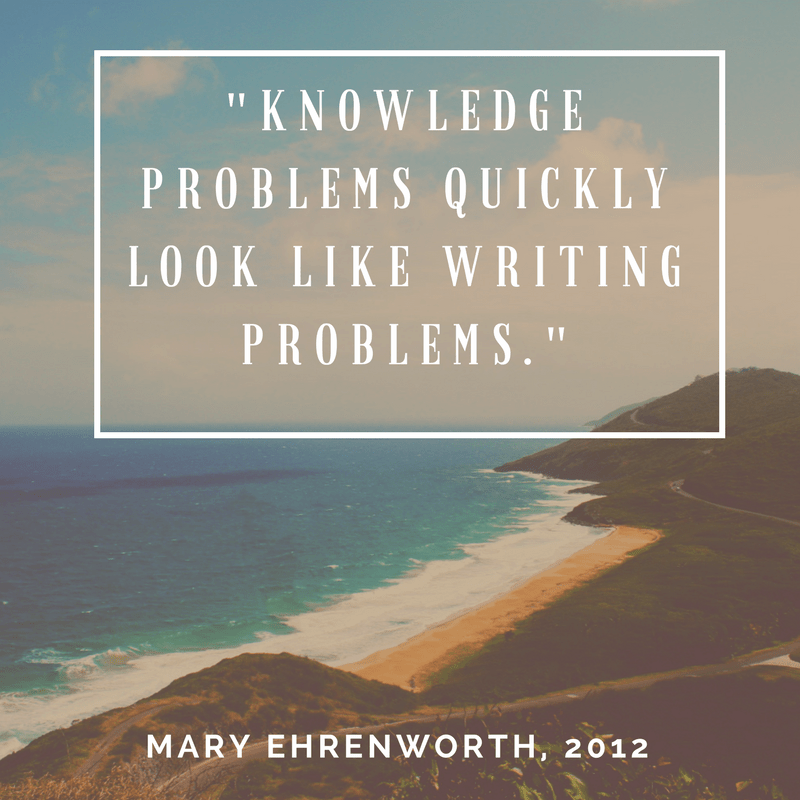
Addressing Knowledge Issues in Informational Writing
If we do not possess a good amount of background knowledge, if we are not interested in the topic, and we were not given a choice, our writing typically suffers. Lack of knowledge in particular, as Mary Ehrenworth suggests, manifests quickly as writing weakness and writing problems. As writing workshop teachers, how might we think about and address these challenges?

