Estimated Reading Time: 6 minutes (1,114 words)
Primary Audience: Early Childhood Teachers (pK-1) and Coaches
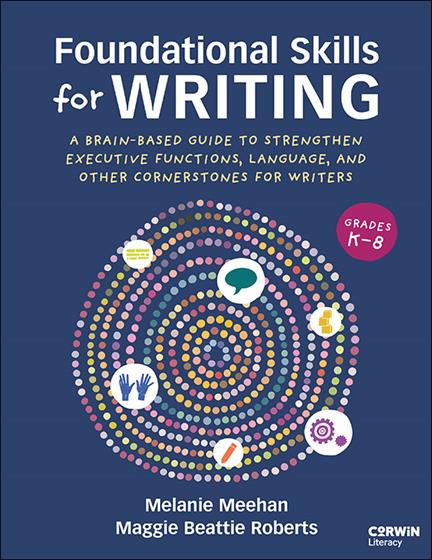
This summer, I read Foundational Skills for Writing: A Brain-Based Guide to Strengthen Executive Functions, Language, and Other Cornerstones for Writers by Maggie Beattie Roberts and TWT Co-Author Melanie Meehan. Chapter three identifies oral language as a foundational skill for writing. In fact, the authors write, “Oral language is an on-ramp to reading and writing” (Meehan & Beattie Roberts 2026, p. 67).
As a Kindergarten teacher, almost everything I do serves as an “on-ramp.” But as I read this book, I realized I haven’t always been intentional about building students’ oral language. This year, I’ve made a few simple shifts based on my professional learning to intentionally strengthen language development throughout our day.
- Morning Circle Marked by Recast and Expansion
Each morning, students gather for a morning circle where we answer a question. Half the time, the question is simply, “How are you feeling today and why?” This gives students a chance to practice identifying and talking about their feelings while also practicing speaking in complete sentences.
When a student’s response contains grammatical errors or less precise language, I use recasting. Rather than stopping the conversation to explicitly correct the student, I repeat their idea using the language I want them to use and then ask them to echo it. It might sound like this:
Student: “I’m happy because I go’ed to the park with my mom today.”
Teacher: “You did that this morning?”
Student: “No, last night.”
Teacher: “Oh, so you went to the park with your mom yesterday. Can you say, “I’m happy because I went to the park with my mom yesterday?”
Student: “I’m happy because I went to the park with my mom yesterday.”
In Kindergarten, there is lots to recast! Accurate pronouns, subject-verb agreement, vocabulary, and even speech articulation all come into play. I also use morning circle to practice speaking and listening skills. I prompt students to look at the speaker and use a loud enough voice so everyone can hear.
Expansion is similar to recasting. In expansion, the adult adds more information to what the student is saying, like this:
Student: “I’m tired. My dad woke me up early.”
Teacher: “You could say, I’m exhausted because my dad woke me up early!”
This expansion example offers more specific vocabulary and more complex sentence structure.
That’s a lot of foundational learning packed into one morning circle. Recasting and expansion are helpful strategies to use throughout the day in formal class discussions and informal chats, but I use morning circle as an opportunity to intentionally use these strategies. These foundational skills (oral language, speaking, listening, and syntax & sentence understanding) are an on-ramp for reading and writing.
2. Playful Story Retell

Our “Book of the Week” routine involves repeated readings of a high-quality text and related activities that build language through reading comprehension, vocabulary, and literacy knowledge. This year, I’ve started adding more playful elements to story retell that get everyone talking: puppets!
Teaching students how to act out and retell a story with puppets has been an impactful way to build story language. Students have to use the characters’ names, describe what happens, and put events in order. The puppets serve as a tangible scaffold for retell. As students retell with puppets, they are:
- Demonstrating that they understood the story.
- Practicing the language needed to tell a story.
- Playing. (What Kindergarteners should be doing!)
These skills transfer directly into writing workshop. Before students can write a story, they need to be able to tell a story. The more opportunities they have to orally rehearse stories, the more language they have available when it’s time to put those stories on paper.
3. Small Shifts in Classroom Discussion
I’ve also made some small shifts to our whole-group discussions. When eliciting answers, I offer oral sentence stems and build in more partner talk time so that every student has an opportunity to practice a response. It might sound like this:
Teacher: “So what is the setting of the story? Tell your partner: ‘The setting is…’
[time to talk]
“So, what is the setting of the story? Raise your hand if you can say, ‘The setting is…'”
Responding with a complete sentence that restates the question helps build school language skills.
In my LETRS Early Childhood course, I learned about the role of phonological processing in language development. Phonological processing includes the ways we perceive, store, recall, and produce spoken language. I saw this in action when I read Wangari’s Trees of Peace by Jeannette Winter. At the end of the book, I asked, “Who was the character?” No one could answer me. Luckily, my LETRS instructor was conducting an observation at this moment. “You never asked them to say ‘Wangari,'” she pointed out. This feedback helped me realize how important it is for students to say new words aloud. Now, when I introduce a new word or concept, I’m more intentional about asking students to say it several times. Saying a word aloud gives students the opportunity to process the word and hold it in their memory before they’re asked to retrieve it. The more words students hear, say, and learn, the more they’ll (eventually) write!
4. Enhancing the Author’s Chair
I’ve always been a big proponent of Author’s Chair, but this year I’ve thought more intentionally about how Author’s Chair can build story language and vocabulary. At the beginning of Kindergarten, most students have few letters and words in their books. As a result, I noticed that when they sat in the Author’s Chair, they just held up their books for the audience to see and silently turned the pages. These books are filled with important drawings that tell stories without words, so I used some of the ideas in this blog post about wordless picture books to model and teach storytelling skills.
Now students can confidently sit in the Author’s Chair and “read” their handwritten books aloud using story structure and precise vocabulary. Throughout this year, they’ll learn more about print and be able to record more of that language. Right now, we’re building the foundation of that future learning.
Oral language should permeate everything we do in our Kindergarten day. This integration ensures students put ideas into words, use new and precise vocabulary, and hear what language sounds like. Since oral language is the on-ramp to reading and writing, these small, everyday opportunities help students get on the road.
References
Meehan, M., & Beattie Roberts, M. (2026). Foundational skills for writing: A brain-based guide to strengthen executive functions, language, and other cornerstones for writers. Corwin.
Share this:

Discover more from TWO WRITING TEACHERS
Subscribe to get the latest posts sent to your email.
