Estimated Reading Time: 3 minutes (602 words)
Audience: Grade 3-8 Classroom Teachers and Instructional Coaches
Catch Up Quick
A while back, I wrote about why “Graphic Organizers Aren’t Magic.” They can be incredibly useful tools, but handing a student an organizer doesn’t automatically help them write more effectively. Like most instructional tools, an organizer works best when it addresses something a student needs.
But that leaves us wondering:
How do we know what a student actually needs?
When a student struggles, it’s easy to reach for a familiar scaffold.
- We add an organizer.
- Break the assignment into smaller pieces.
- Offer a sentence starter.
- Reread the directions.
- Give an example.
And sometimes that’s exactly what the student needs, but sometimes it isn’t.
So, before we decide how to scaffold, we need to figure out what is actually making the task hard.
The Big Picture
When a student struggles, our first question is often something like: What can I give them to help?
I think there’s a better question to ask first: What is preventing this student from doing this independently?
The answer could be any number of things.
Maybe the student doesn’t have enough background knowledge to understand the content. Vocabulary or language is getting in the way. Maybe the student understands the content but doesn’t understand what the task is asking. The student might understand each step but have difficulty managing them all at once because of working memory or cognitive load. Maybe the thinking is there, but the student is struggling to organize or express it. Sometimes the barrier is task initiation. The student knows more than it appears but doesn’t know how to enter the task independently.
And then there’s one more possibility that’s easy to overlook:
Maybe nothing is wrong. Maybe it’s just hard.
Not every pause, blank page, or “I don’t know” signals a need for another scaffold. That’s productive difficulty, and it deserves some room, too.
The visible behavior gives us a place to start looking. It doesn’t necessarily tell us what the problem is.
How It Works
Once we have a better idea of what’s actually hard, scaffolding becomes much more intentional. For each barrier, ask questions to better understand the need and which scaffold is best.
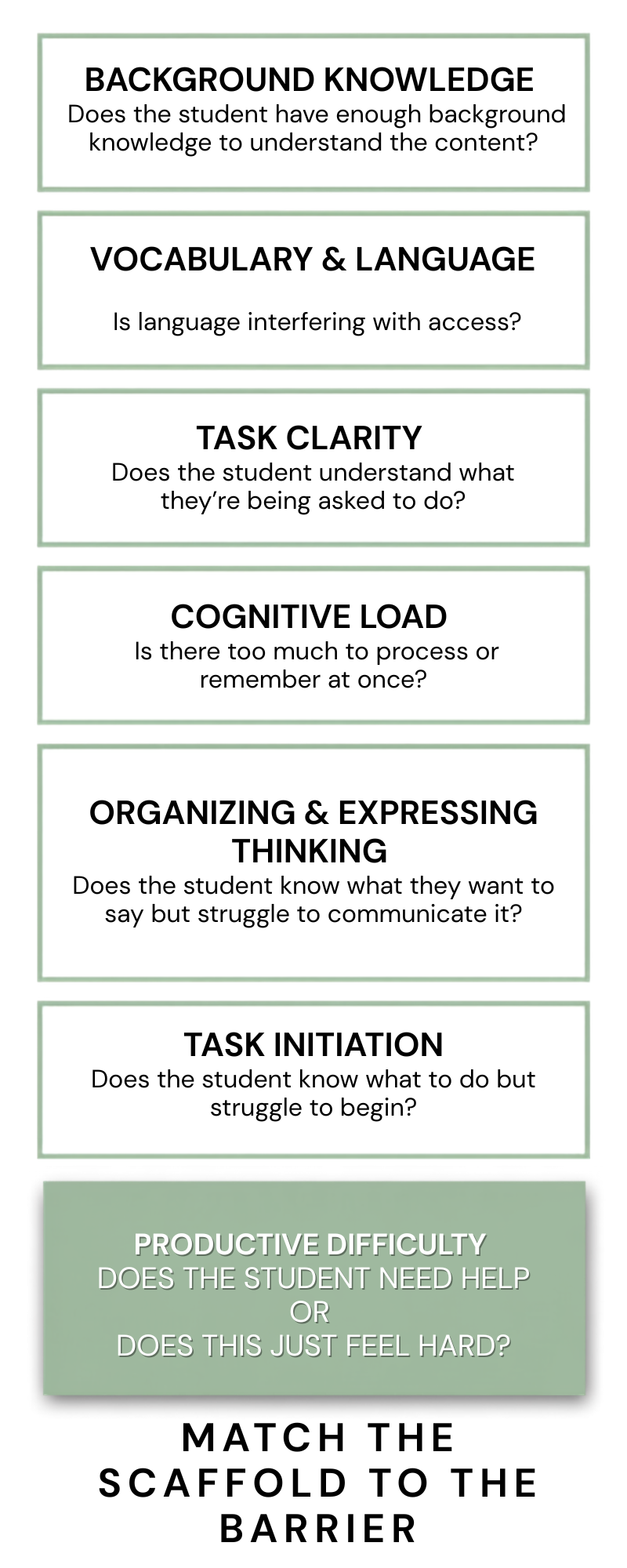
And if the student has what they need and the task is simply appropriately difficult, the best scaffold might be no new scaffold at all. Sometimes the right response is time.
Yes, But…
This sounds great in theory, but teachers with 25 students in a room don’t have time to conduct an individual diagnostic interview every time someone says, “I don’t get it.” Oftentimes, one or two questions can tell us a lot:
Tell me what you understand so far.
What part feels hard?
What have you already tried?
If you could tell me your answer instead of writing it, what would you say?
What do you think the first step might be?
The goal isn’t to develop a complicated diagnostic process. It’s to change what we notice. Instead of seeing struggle and immediately thinking support, we can become a little more curious about what’s underneath it.
That small pause may help us choose a smaller, potentially more useful response.
One Thing to Remember
A good scaffold shouldn’t simply help a student finish today’s assignment. Ideally, it helps a student do something today that moves them closer to doing it independently tomorrow. So before adding another organizer, sentence starter, checklist, example, chunk, or prompt, take a moment to figure out what that support is supposed to accomplish.
Identify the barrier. Match the support. Preserve the thinking. Watch for independence.
Discover more from TWO WRITING TEACHERS
Subscribe to get the latest posts sent to your email.


