Estimated Reading Time: 4 minutes Contains 667 words
Audience: Classroom Teachers and Instructional Coaches
The Context
Conversations about writing progress can feel heavy.
Writing is visible. It comes home in folders and lives in digital portfolios. When it’s hard, it feels alarming. As teachers, we are responsible not only for sharing concerns but also for doing so with empathy, clarity, and professional boundaries.
Trust in these moments doesn’t begin at the conference table. In my experience, it begins months, sometimes years earlier, across many invested and supportive people, through positive emails, celebrations, and invitations for parents to share their observations. Hard conversations rest on a foundation of many prior interactions because writing difficulties are often misunderstood. Families may assume struggles reflect intelligence or effort when, in reality, writing requires several different systems working together. Framing the conversation by building understanding of writing’s complexity can help teachers explain concepts in ways that reduce fear and open the door to productive problem-solving.
The Big Picture
Writing is not a single skill. It is the coordination of several systems working together, including:
- Motor Development
- Language Development
- Working Memory
- Executive Function
When a child struggles with writing, it can be helpful to consider what system is under strain rather than assuming a lack of effort or ability. Researchers who study writing development, some of whom will be listed at the end of this post, consistently point to the complexity of the writing process. Writing asks children to generate ideas, organize language, recall spelling patterns, and coordinate fine motor movements, all at once.
Zoom In
Looking closely at student work can help teachers describe what they are observing without jumping to conclusions. Some common areas that influence writing development include fine motor/graphomotor challenges, developmental dysgraphia, phonological or letter-sound confusion, language formulation challenges, working memory, or multilingual language development. Below is a breakdown of each challenge, along with observations teachers might make to better inform specific challenges for students.
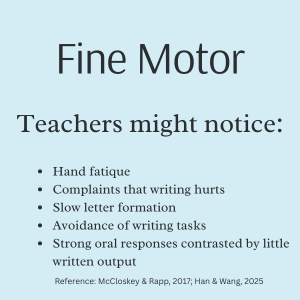
Handwriting development is partly a motor learning process and not just a cognitive one. A parent-friendly explanation might sound like this: Handwriting develops much like other motor skills. Some children need more time to build the coordination required for fluent writing.
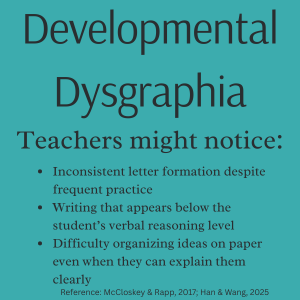
Developmental dysgraphia refers to a persistent difficulty with handwriting or written expression that cannot be explained by a lack of appropriate instruction.
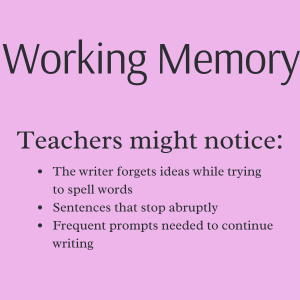
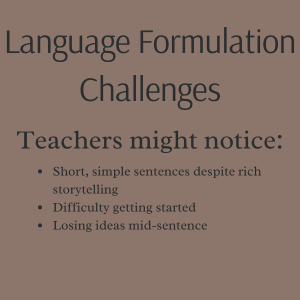
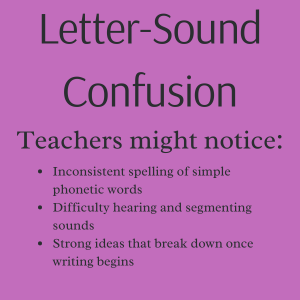
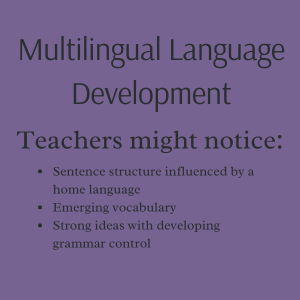
These patterns often reflect language development rather than a learning difficulty.
As a Teacher
When beginning a conversation with parents, curiosity and observation go much further than certainty.
Teachers can open conversations with language like:
- I’ve noticed something in your child’s writing I’d love to talk through.
- Before I share what I’m seeing at school, what are you noticing at home?
- Let’s look at a few writing samples together.
Writing samples are powerful because they ground the conversation in observable patterns rather than labels. They also invite parents into the analysis instead of positioning the teacher as the sole expert.
It is also important to avoid diagnostic language before a formal evaluation. Teachers describe patterns; we do not diagnose.
The Bottom Line
When writing progress raises concern, our goal is not to label students. Our goal is to understand what might be making writing difficult and to work collaboratively with families to support growth. Teachers serve students best when we:
- Approach conversations with empathy
- Describe observable patterns
- Share data and writing samples
- Stay within our professional role
Writing development is complex, and growth rarely follows a perfectly smooth path. When teachers communicate that complexity clearly and compassionately, families are far more likely to feel supported rather than alarmed.
Go Deeper
For teachers who want to explore writing development and learning differences further, these resources provide accessible starting points.
- Effective Writing Instruction for All Students by Graham, 2008
- Reading Rockets: When Writing is Hard, Accessing Skills Toward Successful Writing Development, Role of Parents in Writing Development
- Developmental Dysgraphia: An overview and framework for research by McCloskey & Rapp, 2017
- From Motor Skills to Digital Solutions: Developmental Dysgraphia Interventions over Two Decades by Han & Wang, 2025
Discover more from TWO WRITING TEACHERS
Subscribe to get the latest posts sent to your email.


