Estimated Reading Time: 4 minutes (638 words)
Audience: Grade 3-8 Classroom Teachers and Instructional Coaches
A Backstory
There’s a moment in a writing workshop that feels familiar in my seventh-grade classroom. Students are working on a paragraph, trying to balance direct and summarized evidence. A few are moving along, many are approximating well, but some get stuck, stacking quote after quote, unsure of how to put ideas in their own words, or repeating themselves because they’re not quite sure what else to do. I can see the issue immediately.
And that’s the moment.
Do I point it out? Do I show them what’s missing? Do I fix it so they can move on, or do I wait?
Why it Matters
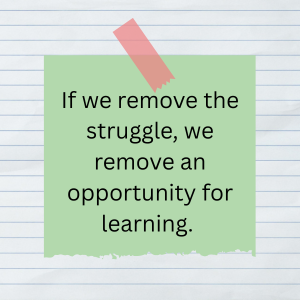
Treating struggle as something to solve quickly might be robbing students of an opportunity. It’s easy to read hesitation, silence, or confusion as a signal that a student needs immediate support in a busy classroom. But in writing, the struggle is often the work.
When students are trying to decide how to explain an idea, how to avoid repeating a quote, or organize their thinking, they are doing the exact kind of cognitive lifting that leads to progress. Observing this productive struggle gives students the opportunity to work through it and own the outcome.
Zoom In
Of course, not all struggle is productive. There’s a point where a student moves from thinking to frustration. In these moments, the work stops and may lead to shutting down. The challenge isn’t deciding whether to help, it’s recognizing when to help. Then, how quickly and how much!
These moments show up in our small-group work, roving check-ins with independent writers, and in peer conversations.
Example:
You ask, “Can you show me where you explained your evidence?”
They respond, “I don’t know.”
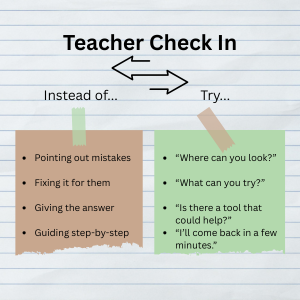
It may be tempting to point it out or show them where it could go. Instead, slowing the moment down with the following prompts might lead to productive struggle:
- “Do you know how to find it?”
- “I’ll go check in with some other students and come back when you’ve found it.”
- “I get it, sometimes it’s not easy to find those individual parts of our paragraphs. Is there a way to find it?”
In these examples, the work shifts back to the student. They might turn to a chart in their notebook, or they might reread their paragraph. There will likely be a pause. Letting that silence linger offers space for thinking and struggle.
When a student says, “I don’t know,” it doesn’t always mean they don’t know. It can be a response or reaction to uncertainty or insecurity.
How it Works
If we want students to work through challenges, we also have to teach them that struggle is not a sign they’re doing something wrong. It’s a sign they are doing the work. This means giving them clear, repeatable ways to respond when they feel stuck.
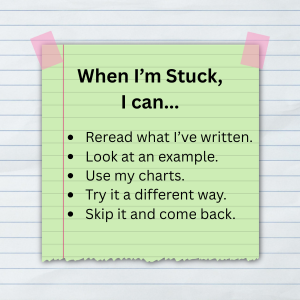
Over time, students begin to rely less on immediate teacher intervention and more on their own strategies.
One Small Shift
Before stepping in, try pausing and asking yourself:
Before I jump in:
- Has the student attempted something?
- Are they thinking (this can sometimes look like disengagement)?
- Have I given enough wait time?
- Is there a tool they could use instead of me?
- Can I ask a question instead of giving an answer?
It’s time to step in when:
- The student is fully shut down
- Frustration is escalating
- They’ve tried multiple times with no progress
- They don’t know how to begin
The Bottom Line
The goal isn’t to make writing easier in every moment. It’s to help students become writers who can stay in the hard parts long enough to grow. Because when we give students the time, space, and trust to struggle productively, we’re not stepping back from the work; we are putting the learning exactly where it belongs.
Discover more from TWO WRITING TEACHERS
Subscribe to get the latest posts sent to your email.


