Estimated reading time: 3 minutes, 0 seconds. Contains 600 words
Primary Audience: Teachers, Coaches, Administrators
Remember When
It was my first day of student teaching. Becky, my cooperating teacher, greeted me as I entered the room. She told me to look around, then asked, “What does this classroom say about my teaching?” Our very first conversation focused on the way classroom spaces reflect a teacher’s philosophy of teaching and attitudes towards learners.
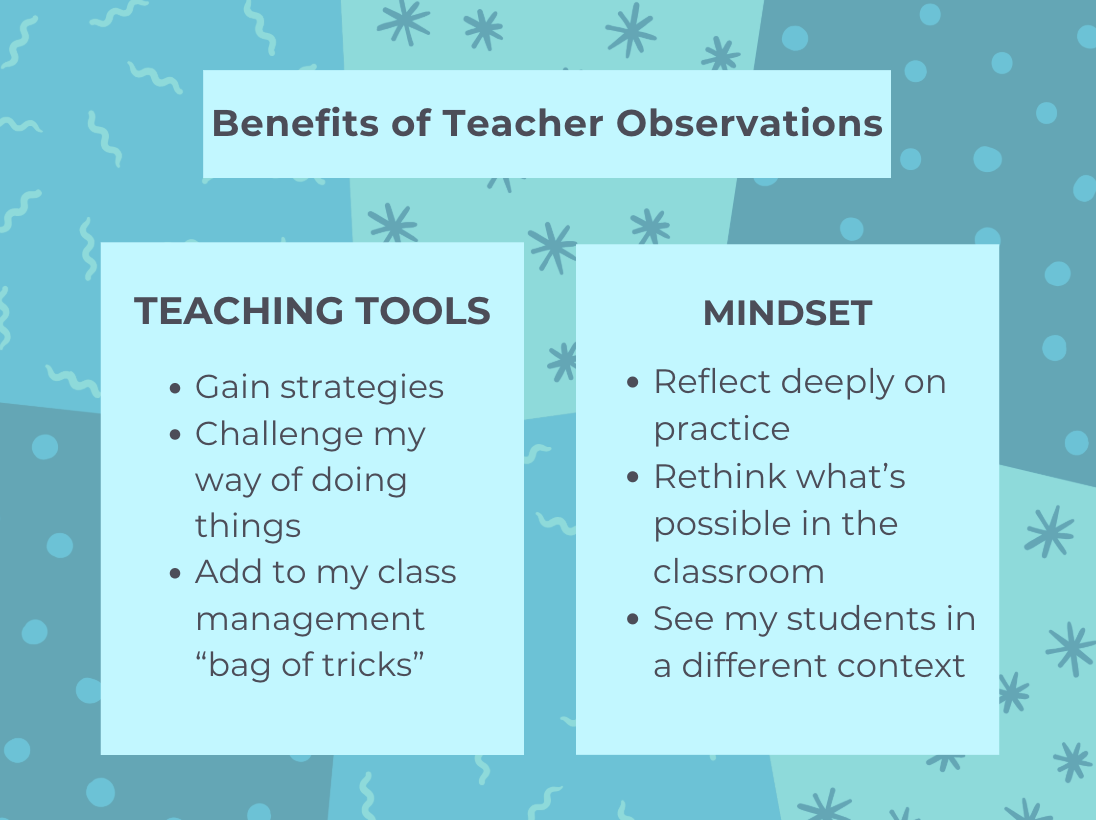
From the beginning, Becky taught me that my colleagues have worlds of knowledge, and it’s my job to learn from them. Just imagine: if I could gather a wealth of information just by looking at a teacher’s room, consider what I could learn by watching their teaching. Since then, I’ve been an advocate of observing teachers and letting them observe me. Below is just a partial list of what peer observation offers me:
Why it Matters
Research suggests that teachers observing one another improves instruction in a variety of ways. For example, Mather & Visone (2024) note that teacher observation and classroom visits improve teachers’ self-efficacy, creating positive emotions and increased agency. Ridge and Lavigne (2020) also assert that peer observation fills a gap in teachers’ professional development. When teachers collaborate to observe and discuss their practices, their reflections can result in more profound changes in instruction. Teachers consider new strategies and evaluate the effectiveness of current ones. Daniels, Pirayoff, and Besant (2013) contend that structured observation and conversation don’t just result in stronger teaching strategies, but teacher partnerships can even change the way teachers see and respond to their students.
There’s a term for teachers believing in their ability to work together and improve instruction: collective efficacy. It’s the belief that our work is important; we have the power to influence student learning in a positive way. And when it comes to collective teacher efficacy, I consider John Hattie (2017). Hattie’s large-scale meta-analyses of studies on student achievement offer a broad range view of teaching practices. Factors with an effect size of 0.4 or more are considered to have a positive effect on student learning. Teacher collective efficacy, with an astounding effect size of 1.57 on Hattie’s scale, is among the strongest factors contributing to improved student performance. There is little doubt that teachers, working and learning together, can do good things.
Making it Happen
It takes time and planning to set up partnerships with other teachers. Ideally, administrators will give release time and support to help facilitate this important professional development:
- Observe during plan time
- Set up an iPad / device to observe asynchronously (feels awkward at first, but it’s a solid option!)
- Get coverage from an instructional coach or specialist
Imagine If
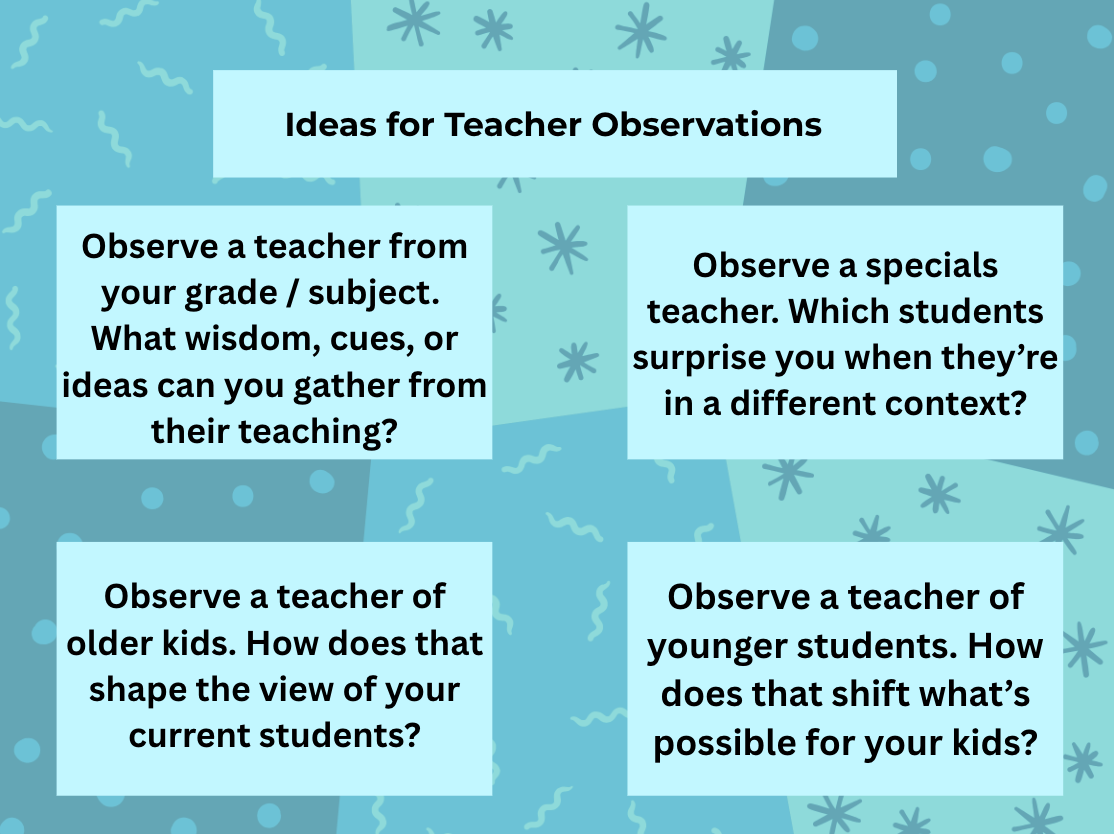
- Imagine if we could see our students in a different light. How do they respond creatively when learning music, art, or physical education? How do they interact differently with other adults? How do their peer interactions change?
- Imagine if we had new insight on how to reach “that kid.” What other ways of communicating, or what other cues, might set them on a better path as a student and as a writer?
- Imagine if we use the experience of our colleagues to expand our own scope of thinking? What if others can bring out creativity or skill in writers that we never thought possible?
- Imagine having a conversation partner as we reflect on the choices we make as teachers. How would it shape the instruction we provide?
It’s been over thirty years since that first conversation with Becky in her classroom, thirty years since she taught me the power of learning from others. Her advice came to me long before Hattie’s research ever did, but the wisdom still stands. If you have a chance, I encourage you to give it a try.
Giveaway Information:
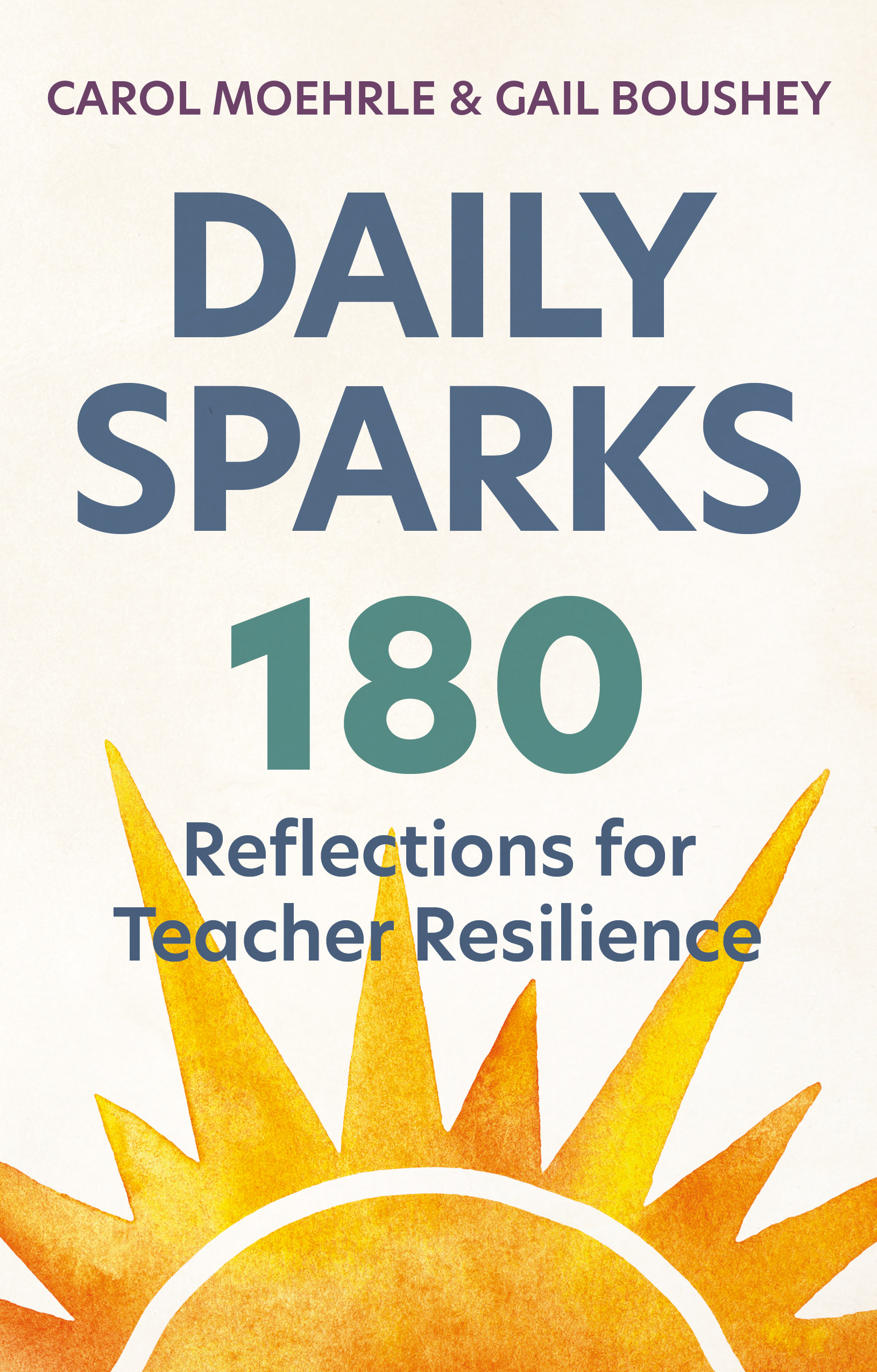
This is a giveaway of Daily Sparks: 180 Reflections for Teacher Resilienceby Gail Boushey and Carol Moehrle, donated by Stenhouse Publishers (Routledge). Three copies will be given away to three separate winners. To enter the giveaway, readers must leave a comment on any Practices of Great Writing Teachers Blog Series post by Tuesday, Feb. 3 at 12:00 PM EST. The winners will be chosen randomly and announced on Thursday, Feb. 5. Each winner must provide their mailing address within 5 days; otherwise, a new winner will be selected. The publisher will ship worldwide so that anyone may enter.
References
Daniels, E., Pirayoff, R., & Bessant, S. (2013). Using Peer Observation and Collaboration to Improve Teaching Practices. Universal Journal of Educational Research, 1(3), 268–274. https://doi.org/10.13189/ujer.2013.010318
Hattie, J. (2017). 250+ Influences on Student Achievement (Data update). Visible Learning. https://visible-learning.org/wp-content/uploads/2018/03/VLPLUS-252-Influences-Hattie-ranking-DEC-2017.pdf.
Mather, B., & Visone, J. (2024). Peer Observation to Improve Teacher Self-Efficacy. Journal of Educational Research and Practice, 14(1). https://doi.org/10.5590/JERAP.2024.14.01
Ridge, B. L., & Lavigne, A. L. (2020). Improving instructional practice through peer observation and feedback: A review of the literature. Education Policy Analysis Archives, 28(61), 61. https://doi.org/10.14507/epaa.28.5023
Discover more from TWO WRITING TEACHERS
Subscribe to get the latest posts sent to your email.


Lanie, I love how you frame what we can gain into two categories – tools and mindset. These guiding questions for our visitations make them even more powerful because they create a pointed focus. Peer visitations are some of the best professional learning I have had the opportunity to experience, and I would even say that as a co-teacher in multilingual learner classrooms, the opportunity to co-deliver daily instruction grew my craft as I learned, reflected and co-created an instructional dance with my partner teachers. Thank you so much for sharing these insights.
LikeLike
I agree wholeheartedly with this. Observing other teachers’ writing instruction can be incredibly powerful when the focus is clear and purposeful. As a coach, I’ve found that there are times when attending those observations with the teacher is especially helpful. Being able to see the same moments, language, and instructional moves allows us to have much richer conversations afterward and ensures we’re reflecting on the same evidence. I don’t think this needs to happen all the time, but within certain coaching cycles, it can be a really strong coaching move that supports shared understanding and meaningful growth. Thank you for highlighting this practice and the importance of intention behind it.
LikeLike
“What does this classroom say about my teaching?” stopped me in my tracks. The first thing I considered was the walls and then reminded myself to imagine the whole layout with and without students. As I reflect, I am aiming for joyful collaboration.
LikeLike
Your blog post today reminded me of my early days as a writing coach 🙂 The power of observation whether I was modeling the lesson or co-teaching with my of colleagues is huge. Being able to observe not only your students with another adult, but learning from other teachers is a great way to improve your craft and reflect on your current practices.
LikeLike
Such a powerful reminder, Lainei! The first question about environment made me think of the effort my school puts toward setting up each space, and how in the Reggio Philosophy, they call classrooms “the third teacher.” I will definitely keep that question in my toolkit when observing alongside my teachers!
Something else I often invite them to consider is, when seeing another teacher lead a lesson, try to ask yourself “How long has this teacher practiced such move to get to that level of confidence or expertise?” I remember watching teachers lead minilessons or conferring with students and doubting I’d ever be as confident, concrete, of efficient as they were. There’s so much powerful in watching others when we have the right lenses and mindset!
I’ll be sharing this post with my teachers today. Thank you! ❤
LikeLike