Estimated Reading Time: 5 minutes. Contains 875 words.
Primary Audience: K – 2 Classroom Teachers and Literacy Coaches
The Context: Young writers need space to write with confidence. Instead of worrying about conventional spelling, we can praise young children’s spelling attempts in terms of alphabetic knowledge and phonological awareness since they have plenty of time to master conventional spelling. To put young writers on a path to success, they need the freedom to invent their spellings.
Why It Matters: As children move through school, it’s essential for them to understand the fundamentals and principles of English orthography’s complex structure. The better children’s understanding, the more likely they’ll be able to use that system. While not all children will become perfect spellers, they can grow into thoughtful encoders who think about words rather than merely memorizing the correct order or letters.
Examine the Evidence: Leah Koch Thomas penned “Invented Spelling is the Gateway to Skilled Writing” earlier this year in our Build Your Expertise Blog Series. She cited multiple research articles about best practices in encoding.
Examples in Action: On the first day of school, my second-grade son handed me a folder brimming with papers, some of which included school correspondence and papers he completed the first day. My daughter, Isabelle, asked to look through Ari’s papers at the kitchen table alongside me. Together, we discovered some concerning spelling:
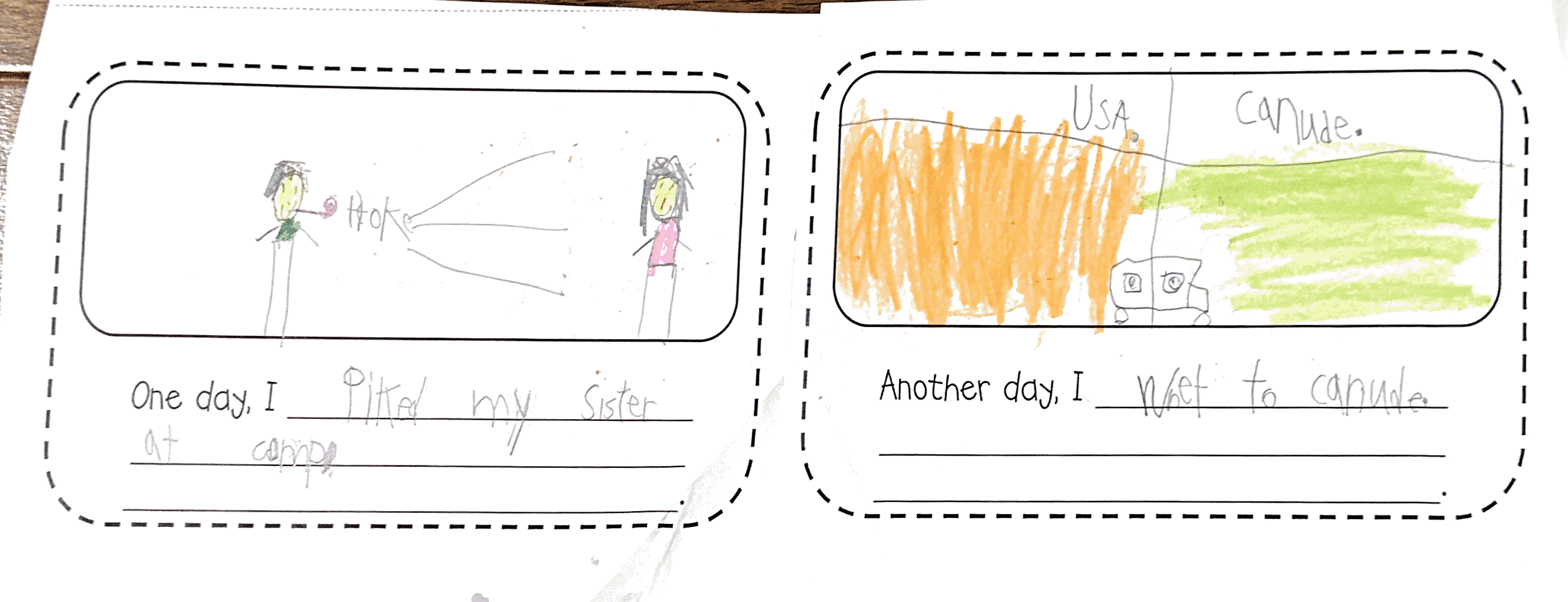
In a vacation journal, we saw several misspellings, but two reflected a need for more care. First, the word horn (labeled in the illustration on the left) was spelled h-o-k-e. We didn’t know what it was until he told us. “There’s no such thing as a hoke, Ari!” Isabelle admonished.
On the facing page, the word went was spelled w-n-e-t. “What’s wnet, Ari? Isabelle asked. Before he could answer, I asked him to separate the phonemes in went. Once he did, I asked him to spell went. “W-e-n-t,” he replied quickly.
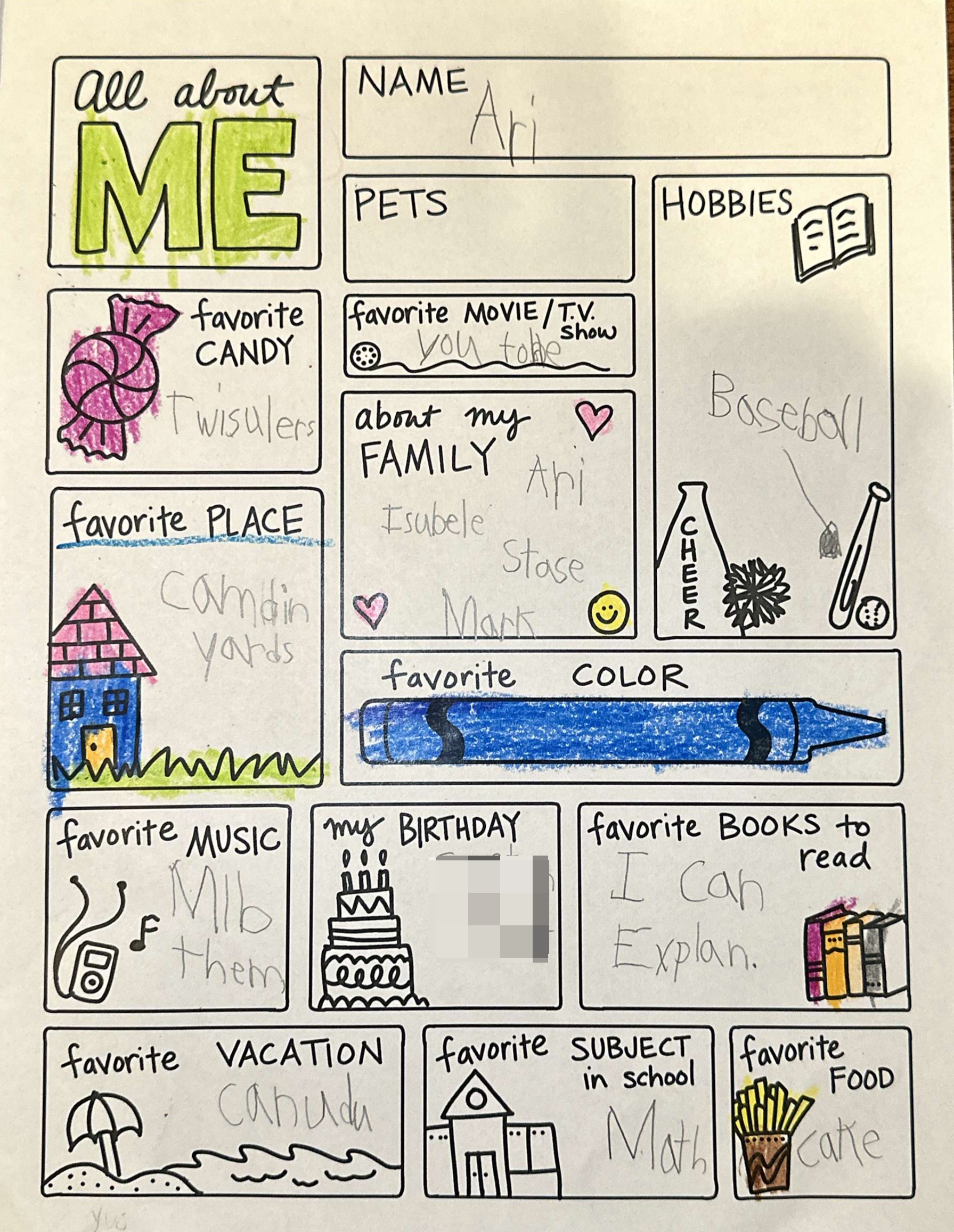
| Things That Show Less Care | Things That Show Thoughtfulness |
| I-s-u-b-e-l-e, S-t-a-s-e, and M-a-r-k should read Isabelle, Stacey, and Marc. These are the names of the people Ari lives with and have been fixed for him in the past. Missing one of Isabelle’s ls and subbing the k for the c in Marc would be reasonable if they weren’t the names of family members. | C-a-m-d-i-n Yards, instead of Camden, in his favorite place is a reasonable substitution since it sounds like the word in at the end of it. |
| T-h-e-m, instead of theme, under favorite music. Them is a pronoun. | Explan, instead of explain, in the book title, makes sense since ai is a tricky vowel team. |
| C-a-n-u-d-u should have read Canada. And while the u could make reasonable sense, we had just returned from vacation and Ari had misspelled it C-a-n-u-d-e in another place. | While YouTube’s logo can be considered environmental print, subbing an o for the u isn’t a big deal. |
| T-w-i-s-u-l-e-r-s instead of Twizzlers shows the representation of most parts of the word. |
You might wonder why Isabelle and I were concerned about Ari’s first day of school assignments. After all, these were low stakes! What concerned both of us (Yes, both of us! Isabelle has had a lot of O-G tutoring and has grown into a speller who takes time to think through words when writing by hand. Thanks to becoming a more proficient reader and using word prediction software, Isabelle presents as a near-perfect speller when she types.) was the fact that Ari rarely thinks through words unless he’s told to segment them. Nearly 90% of the words I noticed him misspelling on paper at the end of first grade were because he didn’t slow down during transcription. While an editing minute is excellent for kids who don’t want to overthink every word, he hasn’t realized the value of fixing up his spelling since he can read it himself. I think it will take Ari having an audience – beyond us and his teachers – for him to want to become a more thoughtful speller.
One Small Shift: I reread Beth Moore’s “Spelling Words for Kids: Resetting Our Workshop Practices” when reflecting on Ari’s first-day-of-school spelling errors. One of the most important takeaways from that piece was:
Model what it looks like to encounter difficulty and work through it. In minilessons, during shared writing, or during small group work–any time I am writing in front of kids– I try to model what I do when I encounter a tricky word. Even during science or social studies, I’ll stop. Think aloud. Say out loud, “I don’t know exactly how to spell this word, but I’m going to use what I know to give it my best try.” Then I continue thinking aloud as I spell the word as best I can and move on.
This is the essence of being a thinking speller. It isn’t about perfection. Instead, it’s about thinking through words thoughtfully.
The Bottom Line: We can help young writers develop into confident, thoughtful spellers by fostering an environment that values creativity and accuracy. The journey from invented to conventional spelling is crucial to literacy development, requiring patience, guidance, and consistent practice. As educators and/or caregivers, we provide the support and tools necessary for children to become not just correct spellers, but thoughtful encoders of language.
Discover more from TWO WRITING TEACHERS
Subscribe to get the latest posts sent to your email.


