
Estimated Reading Time:
4 minutes (821 words)
Primary Audience:
K-8 Classroom Teachers
Why it Matters
I can picture it: a writing workshop where students are busy, engaged, and thoroughly immersed in the joy of craft. Then…there’s reality. Sure, many students hum along, but there are always a few doing whatever they can to avoid writing. Sound familiar? If so, you’re like me and many of my colleagues.
I have to be honest: despite being a full-fledged teacher and writer, I myself struggle through avoidance and negative self-talk, even as I write this article. That struggle allows me to see avoidant behaviors as manifestations of a different beast: perfectionism.
It’s common to peg resistance as a lack of motivation or work habits, and sometimes learning or behavior differences make the task of writing more difficult. But as a teacher of gifted students for over two decades, I’m attuned to the many ways perfectionism rears its head across academic and social contexts.
Today’s article will address certain avoidance tactics, identify what may lie behind them, and offer guidance on helping students reframe or move past them. Who knows? Perhaps some of you or your colleagues may identify these behaviors in your own writing practice.
The Details: Let us Count the Ways
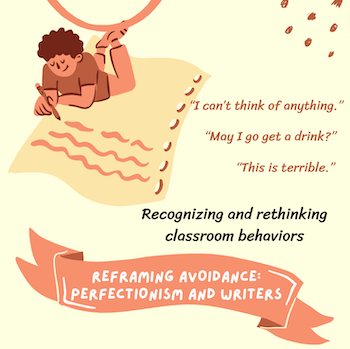
“May I get a drink?”
Looks like: Students find distractions: restroom use, pencil sharpening, and so on. This behavior most often gets interpreted as a lack of motivation or desire to write.
What’s behind it: This procrastination is a result of discomfort with the task of writing, and it is a form of perfectionism. Think: if my work is subpar because I didn’t have time, it’s easier to accept than putting in effort and falling short. It’s a protective mechanism.
How to reframe / move beyond: Our bodies are trained to recognize danger, with the same physical response to difficult tasks as to a snake or a bee: the need to escape. Once we recognize that discomfort, we can train ourselves to explore, name, and sit it. Writers can wonder: What is the source of my discomfort? What strategies might help? The answers will spur a more positive path for self-talk.
“I don’t have anything to write.”
Looks like: Students might sit in front of a blank paper or screen. They may demonstrate signs of frustration or disengagement through posture, physical movements, or handling of materials.
What’s behind it: What happens is not that they don’t have ideas. In fact, it’s the opposite: their brains are so quick that by the time they’ve decided to write something, the thought has gone, only to be replaced by several others.
How to reframe / move beyond: Remind students that the problem may not be a lack of thoughts, but perhaps the presence of too many. The essence of writing is catching a thought long enough to preserve it in the written word. To develop that skill, I’d suggest a scaffolding exercise:
- Sit, think, and listen to our brain’s thoughts. Get used to hearing that “voice.”
- Share those thoughts orally, however random.
- Practice listening to a thought, then writing, typing or dictating it.
The more students practice listening to and “capturing” thoughts, the more confident they will become.
“This is terrible.”
Looks like: Students do a lot of erasing and deleting, sometimes getting rid of whole documents or throwing papers away. They may also resist sharing work with teachers and peers.
What’s behind it: It’s one thing to have the “movie” of a story, and another to translate that into the written word. I know what a person looks like, but that doesn’t mean I have the skill to draw what my mind sees. This is especially true of strong readers, who have a keen awareness of what good writing looks and sounds like. Not being able to match that vision can result in frustration and disappointment.
How to reframe / move beyond: This is tough to work around, and it takes repeated effort to move beyond. I’ve found the most helpful guidance comes from my own experience as a writer:
- Work with students to spend more time watching the “movie” in their head: spending time imagining, capturing one detail at a time, then writing it down. I’ve even done this with students in a way that resembles guided imagery.
- Encourage students to use pen rather than pencil, using single cross-outs instead of erasures to preserve writing as a work-in-progress.
- Remind students we don’t have to love everything we write. As a coach once told me, “In order to have good ideas, you have to have a lot of ideas.”
The Bottom Line
Task-avoidant behavior is as much a part of the writing environment as pencils, sticky notes, and writing journals. Rather than seeing struggles as a lack of motivation or work ethic, students can learn that their behaviors may stem from other causes: namely, the struggles that many writers face. Writers who find themselves distracted, adrift, or discouraged are more likely the rule than the exception. Giving students that knowledge, and the strategies to manage their feelings, goes a long way towards building confidence and self-efficacy in writing.
Discover more from TWO WRITING TEACHERS
Subscribe to get the latest posts sent to your email.


This positive way of looking at avoidant behaviors is so helpful to teachers and ultimately to students. No more blaming students.
LikeLike
Exactly! Hopefully, the act of reframing negative behaviors can lead us to a more compassionate view of of our students – and ourselves.
LikeLike
This is so helpful to think about. I have a lot of avoidant writers this year….thinking about the specific writing struggle they’re avoiding feels like a good way to investigate how to better help them.
LikeLike
Thank you! I’m anxious to hear how it goes!
LikeLike
Spot on. The reframing and practical strategies are so helpful!
LikeLike
Thanks, Vivian. I need to remind myself of the power of reframing – often. I’m glad it resonated!
LikeLike