The pressures that exist in education are practically touchable. Their thickness can be raked in the hallways and classrooms of today in ways that may make teachers uncomfortable to have a unique thought. I am surrounded by loving, caring, and intentionally supportive educators across doorways, roadways, and hyperspace networks and yet this anomaly of measurement hangs on my shoulders pushing me to deliver a number that defines the growth in each of my writers a few times a year. This is not a unique requirement. This is likely your requirement as well.
In some cases, it may feel very adequate and representative of your writers. There may also be this little voice hanging on your earlobe whispering, “Hmm, does that number show every data interpreter the sweat that writer perspired, the mind space, effort, and perseverance required by each pen stroke? I enjoyed this as a reader, yet, on this map of requirements, the destination is a shallow valley far below the peak of proficiency.” Maybe you just feel like there must be a better way. That maybe one way for everyone isn’t the best way for a community and yet you are stuck in this tug-of-war between compliance with accountability measures and the potentially creative thoughtful writers buried under the formulaic strategies of point masters.
Well, now that I got that off my chest, I promise to lighten the mood but I also hope you find some space and time to spend with this book. I knew from the moment I read the first chapter back in March that this book would challenge my current comforts. I knew I would need to let it simmer for a while and I have. I’ve also tried multiple times to dilute my thinking out of fear and concern that I might stir the pot too quickly. It often feels like there is no time, but after reading, simmering, and stirring the ideas provoked by Maja Wilson, I feel like I can begin to think more critically, strike a balance out of necessity, and resist the urge to dilute and instead persist for something better.
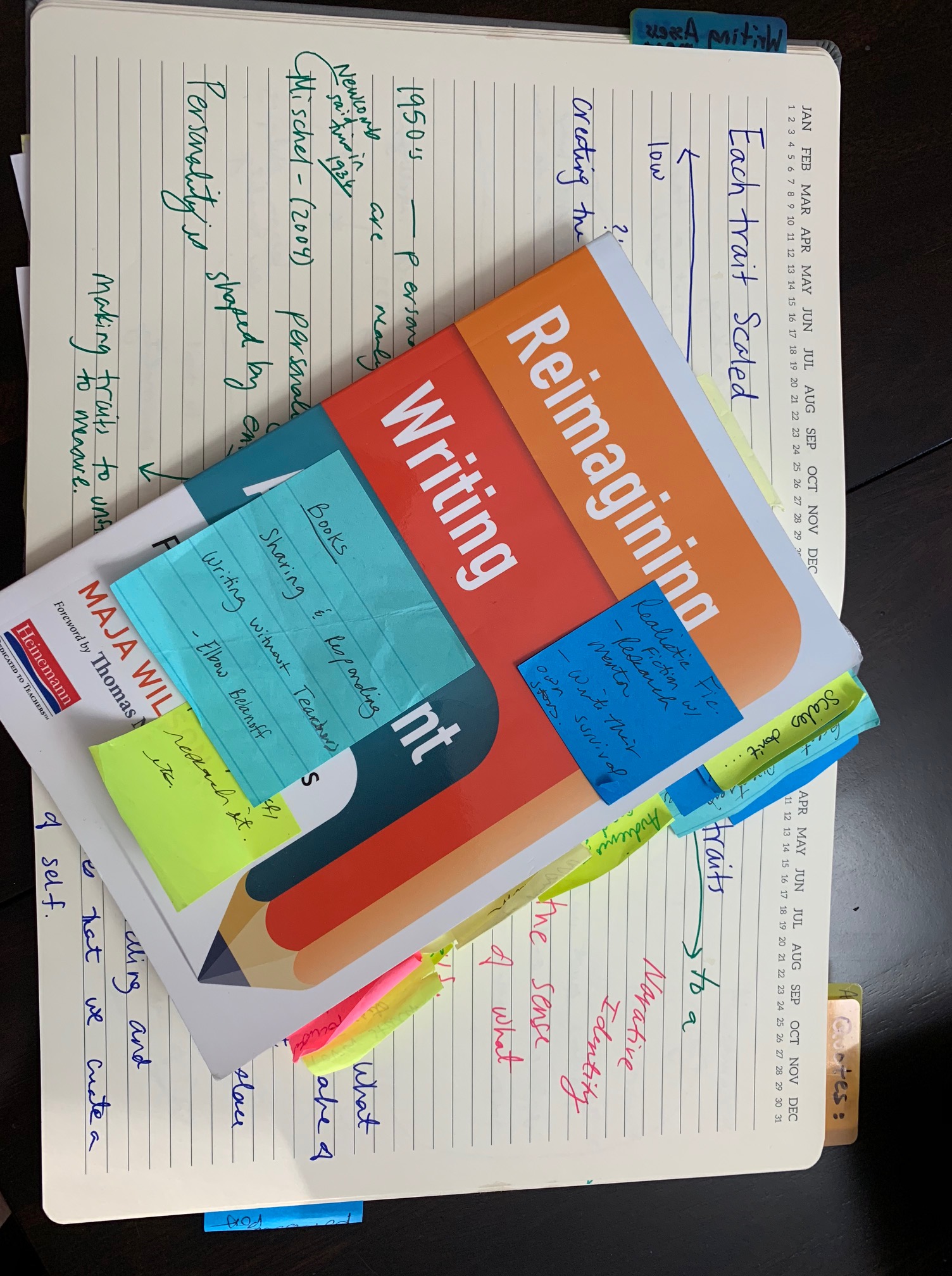
My journey with this book all began back in February when a video popped up in my social media feed. It was titled, What’s Wrong with the Punitive Education Reform Movement and the speaker’s name was Maja Wilson. After listening to this video, I decided to seek out some of her books and found that her most recent was Reimagining Writing Assessment, From Scales to Stories. I quickly got my hands on a copy and read it straight through. Over the summer I began to reread it, this time much slower, reading small sections and taking notes. It took me months. Now my book looks like this:
Then came the question, how do I write a review of a book like this for an audience that is primarily using rubrics as a means to measure growth? The resounding message of this book, stated on the last page of the introduction says this:
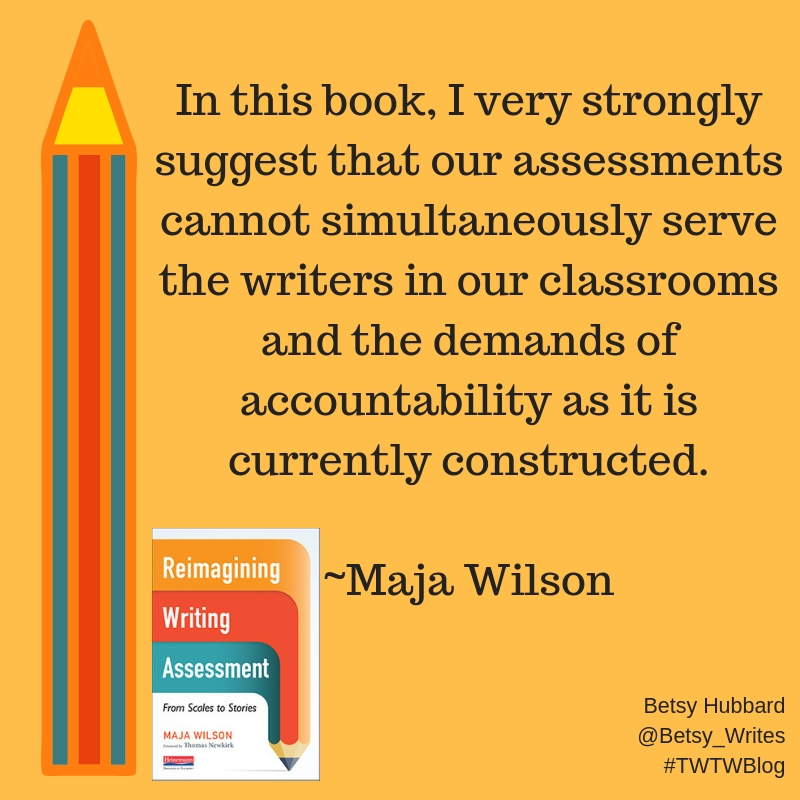
As I began to reread sections for the purpose of this post, this message disrupted me again and made me uncomfortable, and I had to whisper to myself, discomfort is the only way to bring good change. I was just saying it to someone on the phone the other day in fact. We can’t stay cozily captive in our four-walled classrooms and expect the best things to just–happen. They happen when we do something new! I wondered if others were as disrupted as I was and just yesterday I ran across this:
Maja Wilson’s new book, “Reimagining Writing Assessment” captures perfectly why I am moving away from the use of rubrics in my classroom. Highly recommended. @HeinemannPub pic.twitter.com/6hn8kLkAqs
— Kelly Gallagher (@KellyGToGo) December 27, 2017
There are other ways, and Maja forms these ideas of feedback with interpretive lenses toward story and conversation. It’s not necessarily a neatly packaged answer like we may sometimes desire. Authentic writing and organic feedback are never neat and tidy. It’s going to take some thinking. It’s going to take a push to dig and get dirty allowing new undergrowth to emerge.
I could tell you about each part of this book. I could give you my summarization of the best parts and steer you in a direction to find answers that will suit your needs. The fact is, this book is one you just have to read yourself. Your readiness and willingness to interpret the ideas and problems posed by rubrics, a widely used means of assessing students for many, is not something anyone can change in a day. We can’t change it after reading a book either. However, the book can be the catalyst that starts the cogs and gears moving in synchronicity to a point where new energy, excitement, and innovation can begin.
What I found fascinating was the initial shaping behind rubrics and the amount of research Wilson shares within the pages of this book. The idea that foundations of scales were created over a century ago. To realize we are constantly experiencing the world at every moment through senses, memories, emotions, thoughts, and reflections and ultimately this impacts our growth. We may be able to learn certain skills by following a set of rules, but we cannot learn to write in this way. As teachers, we are influenced by what a rubric asks us to evaluate. Take the rubric away, and we would have to ask ourselves, “what do I want to know about this writer and what they have to say?” Just as the writer needs space to think free of organizers, targeted demands, and the “telling as teaching” method madness.
Final thoughts and reflections. I hope that your interest is piqued and you might find a colleague to read this book with so you can have a thought partner to help digest and discuss its many layers. And finally, I’ll leave you with this, a quote from page 49 of the book in response to the question, what is growth in the right direction?

If you are interested in reading this book to push your thinking and open yourself up to new ways of assessing your writers, see the giveaway information below! Also, a reminder, my post from last Thursday has an offer of a Google Hangout to talk more about building independence in our writers. Click here for more information.
GIVEAWAY INFORMATION:
This giveaway is for a copy of Reimagining Writing Assessment, From Scales to Stories by Maja Wilson. Many thanks to Heinemann Publishing for donating a copy for one reader.For a chance to win this copy please leave a comment about this post by Monday, December 17th at 11:59 p.m. EST. I’ll use a random number generator to pick the winner.Please be sure to leave a valid e-mail address when you post your comment so I can contact you to obtain your mailing address if you win. From there, my contact at Heinemann Publishing will ship your book out to you. (NOTE: Your e-mail address will not be published online if you leave it in the e-mail field only.)If you are the winner of the book, I will email you with the subject line of TWO WRITING TEACHERS – Writing Assessment. Please respond to my e-mail with your mailing address within five days of receipt. Unfortunately, a new winner will be chosen if a response isn’t received within five days of the giveaway announcement.
Discover more from TWO WRITING TEACHERS
Subscribe to get the latest posts sent to your email.


I’ve always struggled with the best way to assess writing. Hoping this book will give me the insight I need.
LikeLike
As a teacher just starting to delve into rubric and assessment this may be just what I need to bring clarity!
LikeLike
I am so eager to read this book. It sounds like a great book for some discussion with my colleagues!
LikeLike
As I morph how I approach the assessment parts of my job, this sounds like a book I’m ready to read.
LikeLike
Betsy, thank you for writing this post so that I can disrupt my thinking about assessment. “Reimagining Writing Assessment” sounds like just the book to broaden my perspective.
LikeLike
I love Maja’s work! I never miss her sessions at NCTE.
LikeLike
I cannot wait to learn from this book!
LikeLike
Looking forward to reading this.
LikeLike
“As I began to reread sections for the purpose of this post, this message disrupted me again and made me uncomfortable, and I had to whisper to myself, discomfort is the only way to bring good change.” Yes. Yes! YES!! I’ve written this on a post-it and attached it to my computer screen. But no. No! NO! Discomfort is hard and scary. Especially when it’s a confrontation with perfectly satisfying productivity (though not our real aim, right?). We are in the midst of district writing assessment work – driven by rubric development, no less….but I know that doing right by our children MUST be at the core of our work. It’s clear I need this book.
LikeLike
Determine the ways to expand the assessment of developing writers is perhaps one of the most important tasks we have in front of us. As a teacher of high school newcomers, supporting their ability to express themselves in English — with emphasis on themselves: their ideas, their interests, their passions — is often weighed down by insufficient means for assessment, which in and of itself is often different from the meaningful feedback by teachers give.
LikeLike
The assessment of writing is one of the biggest debates and arousers of negative feelings amongst the teachers I work with; looking forward to digging into this new book!
LikeLike
Wow! I hadn’t heard of this book. I definitely need to read it.
LikeLike
This looks like a must read for me! Perhaps I’ll better understand my complicated relationship with rubrics! Thanks for sharing.
LikeLike
Wow! SOunds like this book has a lot to think about in helping our writers grow! Thanks for the chance to win it.
LikeLike
Teaching writers is such hard work. I love ” what do I want to know about this writer and what they have to say” is such a great mind set as we roll up to conference with writers. I cannot wait to read this book.
LikeLike
Please free me from rubrics!!!!!! Let the revolution begin.
LikeLike
I am intrigued, and will indeed seek this book out! I am on the Design Learning team in my district, (UDL) and this sounds like you are speaking my language. I particularly am making a connection between what you are saying and a statement that keeps coming up for me (for teaching), “It’s about people, not programs” (plus I can already think of examples of student writers for whom the rubric does not do justice)
LikeLike
Rubrics rarely fulfill the needs of all. Some kids find it helpful while others run from it. This book sounds very thought-provoking in a good direction.
LikeLike
This book sounds wonderful. Our work must be based on serving our writers–not on serving the punitive measures that would quash the delicate and vulnerable process that authentic writing really is.
LikeLike
This books looks like a must read. I always struggle with rubrics as I thing we focus on what it says instead of focusing on what our writers are saying.
LikeLike
This sounds like just the thing I need right now. Especially to help in conversations with colleagues, that get stuck on the rubrics, and get caught up in the “checklist” mentality.
LikeLike
Wow! Finally a conversation about assessment which allows educators to focus on the writing and the writers and not a number. Such a timely and thoughtful post. Looking forward to digging into this book. Thank you for the post and sponsoring this giveaway.
LikeLike
Interesting. I struggle with finding rubrics that include the criteria I’m really looking for and would love an alternative!
LikeLike
I am intrigued. I am constantly talking to teachers about the “grayness” of writing. It is a creation, much like art and can’t be summed up as good or bad, right or wrong. I have to get my hands on this one!
LikeLike
This makes so much sense. The question I have is in our age of accountability and report cards, how do you give the kind of feedback you know that writers need to grow as well as the “scores” that the district is asking for – and a way to show that you are “fair” and “unbiased” towards particular students. This book is one I would definitely like to read and discuss with colleagues.
LikeLike
Oh my goodness, how intriguing! Challenging our own thinking certainly pushes us to be the best professionals that we can be. How wonderful that we can experience this growth within our larger professional community! (kweller@discovercompass.org)
LikeLike
Looks intriguing AND informative!
LikeLike
Sounds like a fascinating, thought-provoking read.
LikeLike
I would also love to read the book! As a literacy coach, I work with a lot of folks and I feel the push and pull this seems to address on a regular basis. Msantos@summmit.k12.nj.us
LikeLike
I just finished teaching a course on assessments, and sometimes it seems the rubric got in the way of the thinking and writing for my students. Thus, I suspect, it does for writers of all ages. This would be a good read.
LikeLike
I would love a copy to read! I have always used rubrics and struggled with giving a poor score on a section of the rubric after a 10-year-old has worked so hard and their goals and improved so much in their writing. I hope I win!
stacy_mcbride@southwesternsd.org
LikeLike
I am intrigued to learn more!
LikeLike
lots to think about here!
LikeLike
We encourage teachers to look at student writing holistically, using a rubric and then looking at the piece as a whole and assessing that way as well.
LikeLike
A lot to think about! – Would like a chance to explore further. The book will be a great starting point. dgrohman@somsd.k12.nj.us
LikeLike
This is an intriguing thought! I would love to read about not using rubrics. Thank you.
LikeLike
I think it would also disrupt my thinking, which is always good and wonder how our writers can evaluate and see their growth as writers (hoping that is addressed in the book).
LikeLike
Wow, reading your post and reading Kelly’s tweet makes me realize I need this book. Our district is moving toward MORE rubrics.
LikeLike
I’ve been struggling with the use of rubrics especially this year. This book sounds like what I need to read next as I think more deeply about writers and how to help them reach their potential.
LikeLike
Interesting! You’ve given me lots to think about and have sparked an interest to know more about writing assessment.
LikeLike
Certainly sound interesting. Thanks for the review.
LikeLike
Thank you for introducing me to these ideas that can refocus our instruction on what most matters in writing and to writers. I can’t wait to share with my staff!
LikeLike
This book sounds interesting and would be helpful for teachers. Thanks for sharing. You always have great suggestions for resources.
LikeLike
This looks like an amazing read! I’d love to check it out.
LikeLike
This would make a great CLT book read!
LikeLike
BC has new curriculum – with no standards and no rubrics. Hmmmm. Maybe this book has some answers!
LikeLike
I am interested in reading this book. Assessing writing tends to be an area where I could always use some growth myself.
LikeLike
Sounds so interesting! Would love to win a copy!
LikeLike
Thank you for the opportunity to receive this book. I love that it pushes our thinking about rubrics and gets to the heart of the matter the growth of the writer.
LikeLike
I feel like I’ve been having this conversation for a long time with my colleagues… I’m excited to read your thoughts about it!
LikeLike
Looks interesting! I’d love to read it!
Lyndssy
LikeLike
Perfect timing with so much push and emphasis on rubrics, numbers and scores~ there is so much behind the growth markers if we just peel back a little bit. Than you!
LikeLike
I would love to win this book. We are implementing writer’s workshop in our school and we are looking to form a book club to learn more. This book would be great for our book club. Thanks!
LikeLike
I’d love to be able to read this to consider it for an upcoming course!
LikeLike
Wow! Thanks for sharing all your recent reflection and this title. There’s a lot to think about here, and this sounds like a book that will spark rich conversations.
LikeLike
This book sounds like something we all need to read.
LikeLike