Estimated reading time: 5 minutes. Contains 1009 words.
Primary Audience: Teachers, Coaches, Administrators
Remember When
When I think about my years spent teaching students to write in my own classroom (and many more years coaching teachers in this work), what comes to mind first is the community we built each year. Kids shared their writing and collaborated, we gathered around rich mentor texts, and I used my expertise as a writer and as a teacher of writers to model the qualities of strong writing clearly, explicitly, and intentionally.
The most important moments in writing were not spent telling my students how to construct a strong paragraph or a moving story, but rather showing them. This looked different from day to day, from writing each word of a short piece on the spot in front of my students to sharing pre-written pieces of my own writing and thinking aloud as I revised. No matter the structure, two elements were consistent: I surfaced my thoughts and craft moves in front of students, and the writing was always authentically mine.
I surfaced my thoughts and craft moves in front of students, and the writing was always authentically mine.
As programs and practices have shifted, though, there are fewer opportunities for teachers to model and think aloud with each year that passes. Boxed programs provide their own demonstration texts—pieces that may be crafted to fit the prompt, genre, or unit standards— but seldom create space for modeling and thinking aloud.
As we move forward as teachers of writing, it’s important to ask ourselves: Why does this matter? and Imagine if…?
Why it Matters
Modeling and thinking aloud are not teaching fads or passing practices; they are methodologies that are deeply rooted in research. By weaving together cognitive task analysis, scaffolding, teacher clarity, reflection, and explicit teaching, modeling is the cornerstone of Hattie’s Visible Learning (2011). Modeling is also a critical component of Glass and Marzano’s New Art and Science of Teaching (NASOT) framework, which is structured around “I do, we do, you do” scaffolding to make abstract concepts concrete for students (2018).
Steve Graham also emphasizes modeling and thinking aloud across his wide body of research. As one of the essential components of building a classroom community, Graham consistently discusses the impact of teachers modeling writing strategies as the expert in the writing space, highlighting the importance of teachers “thinking out loud to make the invisible act of composing—which occurs internally for experienced writers—more visible to students” (2018, p. 35).
The significance of these practices is further reinforced by Pratt and Hodges (2024), who draw a direct parallel between modeling and supporting students’ development of the executive functioning skills needed for writing. Echoing Graham, they emphasize that thinking aloud and demonstrating specific writing moves make the process visible and concrete for developing writers.
Imagine If…
- Teachers use professional learning time to think through the demands of an upcoming writing piece, allowing them to plan what to model and how to model to best meet students’ needs.
- Educators take the pre-developed pieces of demonstration writing that are provided with boxed programs and adapt them to their own needs. By mining these pieces for the skills and writing strategies that are critical for students to learn, it is possible to apply those same skills to a piece of personal writing.
- Teachers return to the practice of not only demonstrating writing skills in front of students, but also showcasing the vulnerability and joy that go with being a writer.
- We start small—once per unit or once per week—to incorporate these strategies back into our teaching, one piece of writing at a time.
Next Steps
Wondering where to begin? Here are a few simple steps to get started:
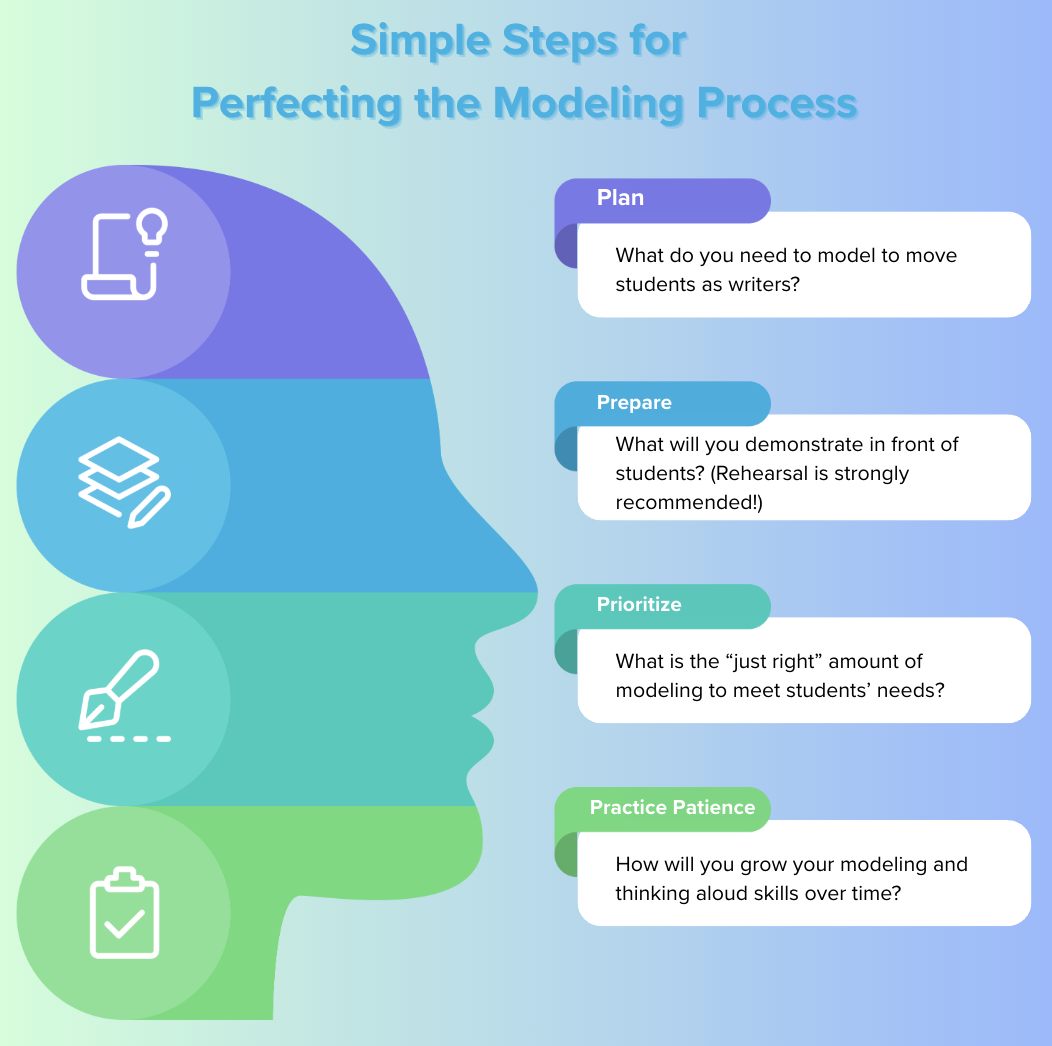
- Plan: What writing moves do your students need to see? Drafting or revising? Crafting a strong lead or embedding dialogue? Knowing exactly what to model ahead of time will keep instruction tight and focused.
- Prepare: Rehearsal is key. Whether the writing is practiced orally or ideas are jotted down in advance, it’s important to have the words planned out ahead of time the first few times you model and think aloud.
- Prioritize: My biggest modeling mistake has always been trying to do too much. Too often I would try to write an entire paragraph or make multiple revisions in front of students, hoping more examples would make my demonstrations more clear. This is the perfect time to remember that less is more. Keep the lesson focus and the attention span and developmental needs of students front and center to make sure modeling is concise and intentional.
- Practice Patience: Modeling and thinking aloud won’t be easy or natural every day, especially if these are new teaching moves. It’s important as teachers that we give ourselves grace, refine our teaching over time, and allow ourselves to model our own writing flaws and vulnerabilities–after all, the goal is to allow students to get a glimpse into the process of writing, not perfection.
Giveaway Information:
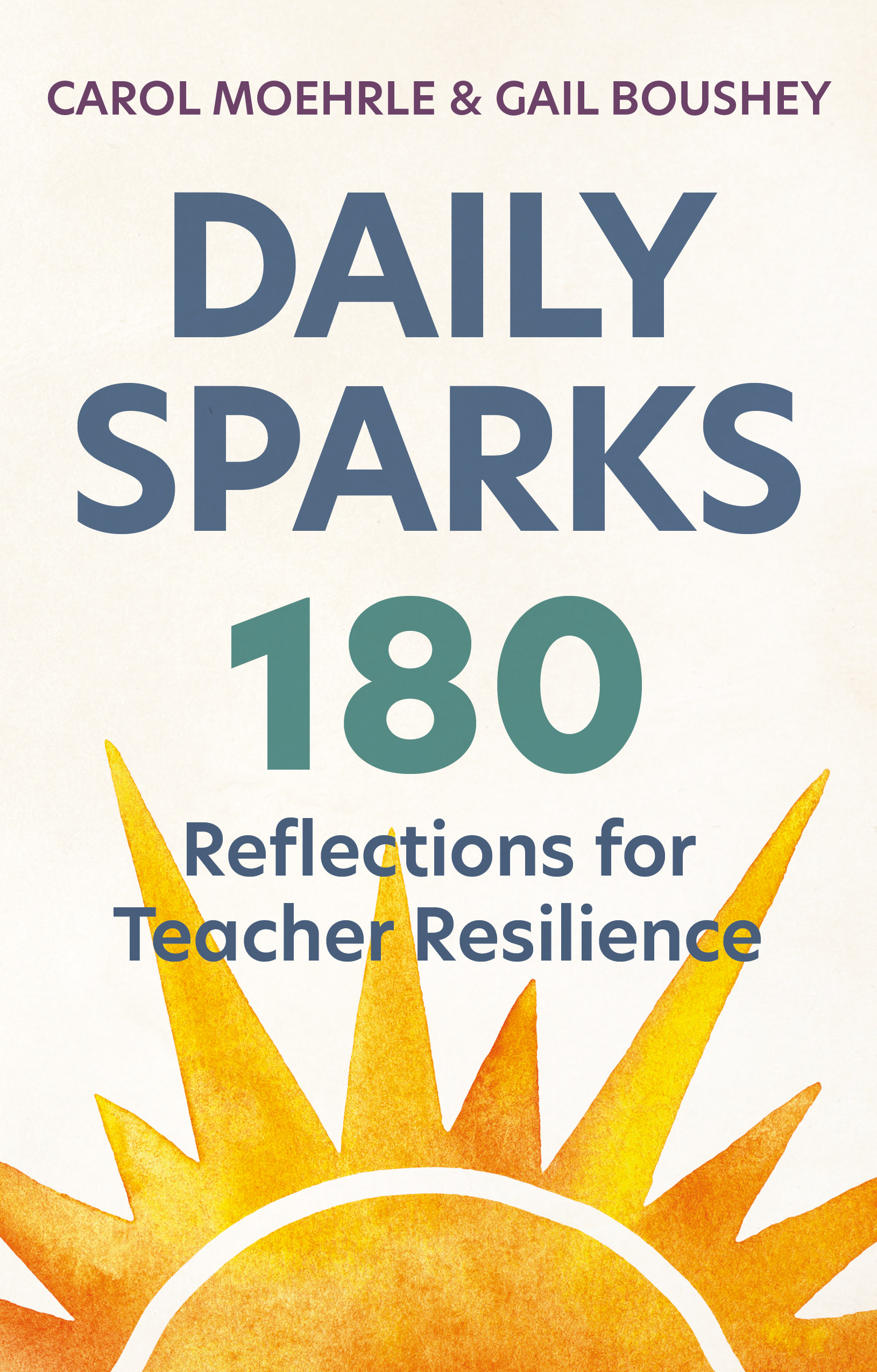
This is a giveaway of Daily Sparks: 180 Reflections for Teacher Resilienceby Gail Boushey and Carol Moehrle, donated by Stenhouse Publishers (Routledge). Three copies will be given away to three separate winners. To enter the giveaway, readers must leave a comment on any Practices of Great Writing Teachers Blog Series post by Tuesday, Feb. 3 at 12:00 PM EST. The winners will be chosen randomly and announced on Thursday, Feb. 5. Each winner must provide their mailing address within 5 days; otherwise, a new winner will be selected. The publisher will ship worldwide so that anyone may enter.
References
Glass, K. T., & Marzano, R. J. (2018). The new art and science of teaching writing. Solution Tree Press.
Graham, S., MacArthur, C. A., & Hebert, M. A. (Eds.). (2018). Best practices in writing instruction (3rd ed.). Guilford Press.
Hattie, J. (2017). 250+ Influences on Student Achievement (Data update). Visible Learning. https://visible-learning.org/wp-content/uploads/2018/03/VLPLUS-252-Influences-Hattie-ranking-DEC-2017.pdf.
Pratt, S. M., & Hodges, T. S. (2024). Building mental models of writers: Writing aloud in writing instruction. The Reading Teacher, 77(6), 937–948. doi.org
Discover more from TWO WRITING TEACHERS
Subscribe to get the latest posts sent to your email.


