Estimated Reading Time: 7 Minutes (1,500 Words)
Primary Audience: Literacy Coaches and K-5 Teachers
The Backstory
“G’s grandfather is coming in to talk about being a journalist,” Karen, a fifth-grade teacher, mentioned to me one day as we passed each other in the hall. “You should try to stop by!” I tucked the day and time away, hoping I’d be able to make it. The day of the visit was a busy one, but I was determined to sneak in for the special visit. I walked into a room where our three fifth-grade classes were gathered. They were all attentively listening. I joined in to listen too. In those few minutes, I was reminded of what it means to be a teacher of writing. As G’s grandfather, Doug, shared about his work as a journalist, he touched on the inverted pyramid our students were already familiar with. He talked about interviewing people and hooking his readers right from the beginning. He also shared that being a journalist was his way of being a citizen, reporting the news to others. He illuminated the real-world connection between what our students were working on in the classroom and a greater purpose.
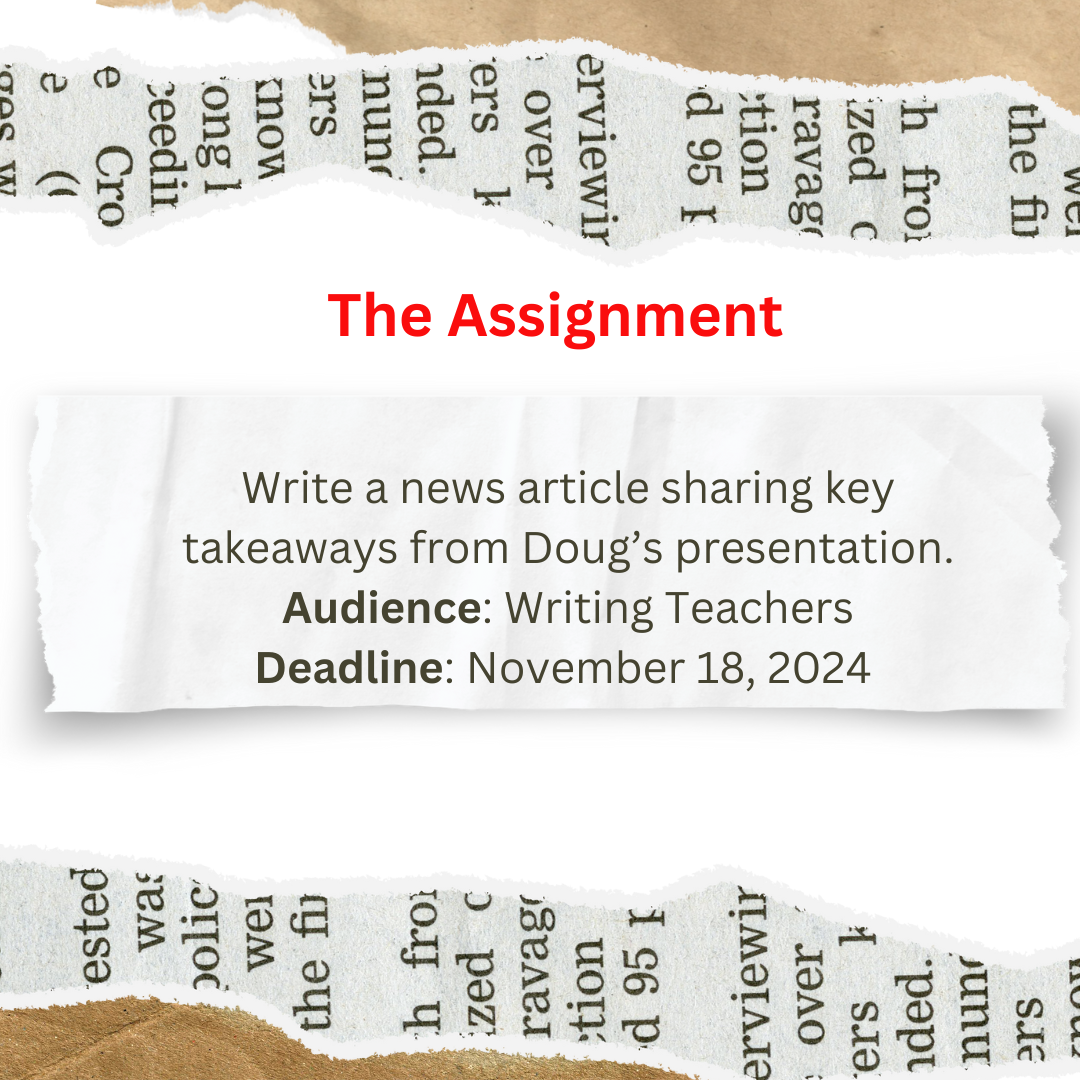
Later, as our fifth-grade teachers reflected on the visit and the students’ engagement in their journalism unit overall, I had an idea. Wouldn’t it be great if we could share the messages our fifth graders heard with other teachers of writing? I approached Karen again, considering some options. We decided on a shared writing experience where her class would report on what they learned from G’s grandfather, Doug.
As Karen and her class got to work, she would text me images and give me updates as we passed each other in the hall. The energy she was reporting and exhibiting was palpable. I asked her if she could share a bit about using shared writing with her class. She kept saying, “I’m not sure I’m doing it right,” to which I replied, “There is no right or wrong!” Karen is a masterful teacher and I always learn from her when I spend time in her classroom. She is thoughtful and responsive and her unwavering belief in all children is inspiring. In the midst of conference week, she graciously crafted the next section of this post, reflecting on her work with her students.
Shared Writing in Fifth Grade: Written by Karen Driscoll
Each day we worked through the writing process with our shared piece. I worked to highlight a tool from our journalism unit that would support our work for the day. We started by planning, using our inverted pyramid tool, which helped us keep the structure of a journalism article in mind. We planned the who, what, when and where that would make up our lead. The how and why, that would make up our middle section and then generated ideas for what background information could be included in our ending.
A big part of our planning process included considering our audience. Knowing that our article would be read by writing teachers raised the stakes and had the students critically thinking about what details would be relevant to writing teachers. They wanted to report on the facts, and also convey the message that hearing from a real-world journalist impacted their learning in a positive way.
Once we finalized our plan, we spent each day cycling through the oral rehearsal, draft, and revise phases of the writing process. I presented them with a tool they had seen in a recent writing lesson and set the focus for the day. For example, one day we looked at a tool that reminded the kids to vary the details they include in their articles, and we worked to do that. As students rehearsed with their partners, I coached, “ Say it like you would write it, and don’t forget to include a variety of details – quotes, mini-stories, examples…try that right now!”
After listening in to their oral rehearsals and hearing how it could go, we would draft, piecing together their best ideas. While revising is their least favorite thing to do in their independent writing, it happened naturally and on the fly during our shared writing time. The kids were eager to try rewriting small sentences or even larger sections of text in a different way. “Try writing the lead with the ‘who’ first.” “Now try it with the ‘when’ first.” “What if we said it like this?” “Don’t forget to keep it in the third person!” Their least favorite part of the writing process was becoming second nature. I found that during this drafting and revising time, typing up all of their ideas on the board was the best way to get everything down quickly for them to see. Once we had made all of our revisions and gotten our word choice just right, we would transfer our final idea to chart paper.
We worked through this oral rehearsal, draft, revise process for each section of our article, referencing our plan and various tools to show our best journalism writing and include the details that would be important to our audience. With our deadline creeping closer, it was time to wrap it up. We used our editing menu and a chart with tips for crafting a powerful headline as our final tools. The kids worked in partnerships with a typed copy of our article to do this editing work. They were looking over our article with a critical eye, hoping to make their piece as polished as it could be. After the edits were made, the headline came easy: Junior Journalists, Learning with Lowenstein. We were finally done and ready to go public!
The Students’ Final Piece (Written Just For You!)
Junior Journalists
Learning with Lowenstein
Westport, CT
On October 28, 2024, at 2:15 pm at Saugatuck Elementary School, the entire fifth grade was jam packed in the learning lab. A quiet came over the normally talkative bunch as retired journalist Doug Lowenstein came into the room. Not only was Doug a retired journalist, but he was also the grandfather of an SES 5th grader. The students had just begun their study of journalism, and Doug was ready to fill their cups with his knowledge and experience.
All eyes were on Doug as he delivered a speech, explaining the basics of journalism writing, such as the 5 Ws (who, what, where, when and why), and the inverted pyramid, a tool to structure your articles with the most important information in the beginning, or lede in journalism lingo. “It’s so interesting to see the tools and strategies we learn in class are used by journalists in the real world!” said an SES 5th grader. After his speech, Doug took questions from the eager students. Eyewitnesses reported that hands were shooting up so fast, Doug could barely keep up.
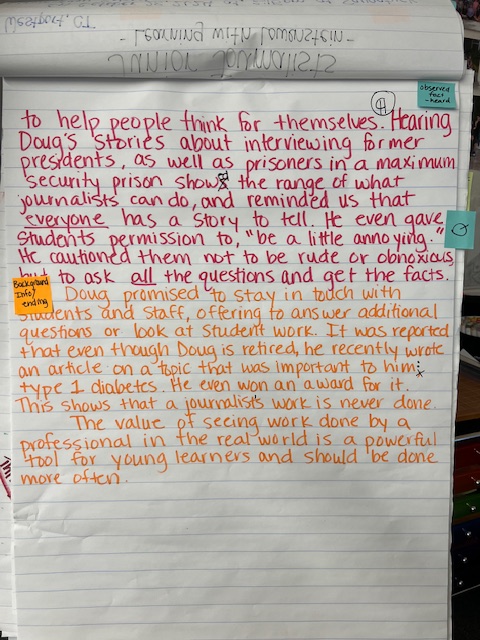
Meeting Doug helped the students see how important journalism is in the real world. Some of his big messages were that journalists give voice to the voiceless, journalists help their community to be more informed places, and journalists should always remember not to tell people what to think, but to give the information to help people think for themselves.
Hearing Doug’s stories about interviewing former presidents as well as prisoners in a maximum security prison showed the range of what journalists can do, and reminded us that everyone has a story to tell. He even gave students permission to, “be a little annoying.” He cautioned them not to be rude or obnoxious, but to ask all the questions and get the facts.
Doug promised to stay in touch with students and staff, offering to answer additional questions or look at student work. It was reported that even though Doug is retired, he recently wrote an article on a topic that was important to him: type 1 diabetes. He even won an award for it! This shows that a journalist’s work is never done.
The value of seeing work done by a professional in the real world is a powerful tool for young learners and should be done more often.

The Impact
Shared writing is a practice that we often associate with the primary grades. Watching and reflecting upon what happened in Karen’s class reiterated the value of writing with purpose and also modeling the process alongside our students. The lessons Karen’s students learned went far beyond the scope and sequence of the curriculum and my guess is, they will remember this shared experience for many years to come. Sitting down with Karen, after the final piece was complete, we reflected and brainstormed all of the benefits of working through a shared piece of writing as a class. Here is what we came up with:
- Scaffolded modeling using the tools students have access to in the unit
- Transfer. Many students tried the work done in shared writing in their own writing pieces.
- Students really came to understand journalistic tone. They offered feedback in the moment while drafted together.
- Opportunities for oral rehearsal. “Say it like you would write it!” Students gave each other feedback in the moment, strengthening partnerships and providing multiple opportunities for practice.
- This process highlighted the power of revision. Often different groups of students would draft a section in the air and together we discussed which option would best fit our piece.
- Students invested more time and care into word choice and how they wanted the piece to sound. There was a shared ownership and investment knowing there would be a real audience reading the piece.
Many thanks to Karen and her students for sharing their work with all of us!
Discover more from TWO WRITING TEACHERS
Subscribe to get the latest posts sent to your email.


This is a fantastic piece. It really shows the power of inviting professional writers to our classrooms and using Shared Writing in the upper grade classroom. There is great work going on at your school!!!
LikeLiked by 1 person
Congratulations to you, the students in your class, and grandfather Doug. Collectively you are now a part of each other’s journeys as writers. I appreciate that you shared your experience through the blogpost on Two Writing Teachers. Now your journey will continue on in those who read the post.
LikeLiked by 1 person
amazing teacher, amazing students, amazing literacy coach leading the charge to make a difference! You should all be so proud!
LikeLiked by 1 person
The kids are SO proud of themselves and the work we put into this. What a special day in 5D. Thank you Jess for encouraging us to take on this special project.
LikeLiked by 1 person
Thank you for taking the bait. We’re all the better for it. It was a special day indeed! Grateful for you! ❤️❤️❤️
LikeLike
Kudos to the writers in 5-D, to G’s grandfather for showing the importance of journalism, and to you and Karen for organizing and expanding on the original presentation. I’ll be interested to hear what previously voiceless voices we get to hear.
Mr. vE
LikeLiked by 1 person
Such a powerful story that highlights the importance of shared writing, modeling, real life, collaboration. Incredible energy from
Kids to adults in and out of school! Well done team!
LikeLiked by 1 person