

Estimated Reading Time: 4 Minutes (853 words, excluding the giveaway text)
Primary Audience: Classroom Teachers; Secondary Audience: Literacy Coaches
The Context: Summer writing loss, a part of the broader issue of summer learning loss, is a concern. It reflects the decline in writing skills among elementary school students during the summer break. While finding ways to address summer writing loss is crucial, most community-based resources available to kids are summer reading programs. In other words, students are most likely reading more than they write in the summertime.
Why It Matters: Many students who didn’t use their writing skills during the summer may experience some degree of regression in their writing abilities. Understanding that most kids will face some level of “summer slide” that affects their writing behaviors and skills helps us adjust our expectations and support students appropriately.
Here’s a Secret: Resist saying any variation of the following:
- “I know you learned this last year.”
- “Didn’t ____ teach this to you?”
- “___ graders should know how to ____.”
Yes, it’s frustrating when kids forget skills they should have mastered. However, saying these things aloud doesn’t help students recover the missing skills or build a teacher-to-writer relationship.
How It Works: Assume most of your students didn’t write much more than lists and text messages over the summer, which do count as writing.
What You Can Do: Many students had experiences over the summer that they could use as fodder for their writing during the first few weeks of school. You can do three big things to get kids excited to write again.
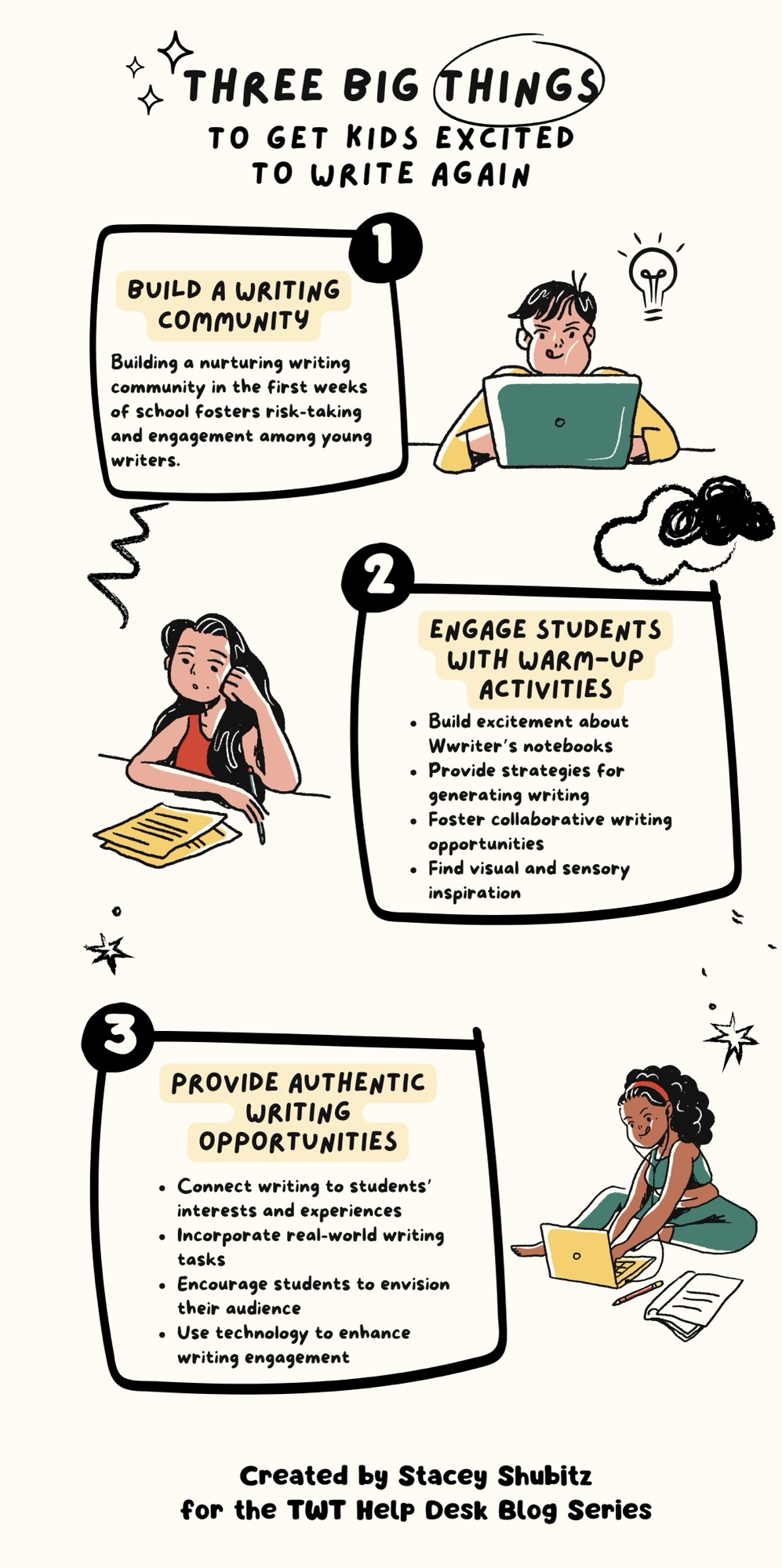
- Build a Writing Community: Writing communities are critical to any writing instruction. If we want kids to take risks as writers, have partnerships to thrive, and live like writers, then it’s incumbent upon us to build a writing community in the first six weeks of the school year and then nurture it all year. All classroom community members, including the teacher, are part of this community of writers who share and learn from each other. Kids who see themselves as members of a writing community will be more engaged than kids who complete assignments to receive a grade from their teacher.
- Engage Students with Warm-Up Activities
- Excitement About Notebooks: Introduce and launch writer’s notebooks with fanfare and provide students with low-stakes writing opportunities during small increments. Students can write on a tablet, in a writer’s notebook, across stapled booklets on appropriate paper, or by voice typing to increase their stamina.
- Strategies for Generating Writing: Many activities (e.g., heart maps, writing territories, lists, sketching activities) can be used in service of writing. (We have lots of them listed in our archives, which you can peruse by clicking on any of the preceding links.) Allocating time for these activities can allow students to get their ideas flowing about future writing possibilities.
- Collaborative Writing: Many students are excited to return to school with friends and classmates. Leverage their social interests by trying collaborative writing, like partner writing or shared writing, for the whole class.
- Visual and Sensory Inspiration: Encourage students to bring in photos from home, ephemera from their summer vacation, or anything else that holds meaning or value to them. Provide opportunities for students to write about these.
- Provide Authentic Writing Opportunities
- Connect writing to students’ interests and experiences: When we build writing communities in classrooms, we invite students into a safe space to share what holds meaning and value to them. We encourage them to write what’s in their hearts or bones by crafting pieces about their lives that are significant to them as learners.
- Incorporate real-world writing tasks: To make writing feel real, we show students mentor texts that reflect the writing they’ll do in the classroom. When students can read articles, essays, and picture books that live in the world, we inspire them to write since they notice the impact of that kind of writing.
- Encourage students to envision their audience: Kids need an audience beyond their teacher. We can ask students who they want to have read their writing and then help them get their writing in front of the people whom they wish to share it with.
- Use technology to enhance writing engagement: Many students’ motivation for writing increases when they can use technology at various points during the writing process. Technology is a tool kids can use when they have a purpose — be it researching, voice typing, or showcasing their final published piece of writing.
One Thing to Remember: Many kids’ summer lives are out of their control. Be patient so you can consistently support your students as they begin to use their writing muscles again.
Real Talk: Be honest with yourself if you haven’t done much writing over the summer. (I abandoned my writing in late June since I had surgery this summer. Therefore, I’ll increase my stamina in the coming weeks since it’s impossible for me to write with the same stamina as I did in the springtime.) If you’re a classroom teacher or literacy coach, modeling how you get back onto the page will help students do the same.
Go Deeper:
- School’s Out: The Role of Summers in Understanding Achievement Disparities
- Summer learning loss: What is it, and what can we do about it?
- Summer learning loss: What we know and what we’re learning
- A PSA (of sorts) About Summer Reading Loss
Giveaway Information:

This is a giveaway for a free, 30-minute virtual professional development session with Kate Roberts and Maggie Beattie Roberts. Readers must leave a comment on any or all of the TWT HELP DESK BLOG SERIES POST by Sun., 8/11 at noon EDT. We will announce the giveaway winner at the bottom of the intro post to this blog series (from 8/2/24) by 8/12/24.
Discover more from TWO WRITING TEACHERS
Subscribe to get the latest posts sent to your email.


Even though I teach my students year to year, there is nothing better than a new notebook to decorate. I always use the first few days of class for my students to design and decorate their marbleized notebook. We will ease back in with some summer reflection and a heart map. This is an exciting writing time together.
LikeLike
Decorating a new notebook is always fun!
You’re so right… those first few days of school are an exciting time. 🙂
LikeLike