I pulled a child-sized chair over to Zach and sat down next to him. “How’s it going?” I asked.
“Not good,” was his reply.
“What seems to be the trouble?”
Zach explained that he was trying to add dialogue to his story, but his story was about falling asleep on the couch with his puppy, and neither of them had said a word.
“So, why do you need to add dialogue?” I asked.
“Because the teacher said so,” Zach answered.
Now, I was a visitor in Zach’s classroom, but I went ahead and said these words, because I knew his teacher agreed:
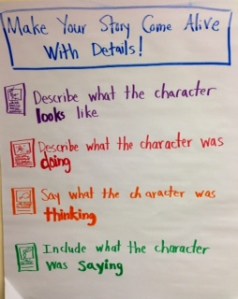
“I think it is really important to try out what your teacher has taught, and I can tell that you really want to try everything in this story. But, the minilesson is a choice. It is not required. See our charts that list all the strategies you’ve been taught? You could use any of those strategies–not just the one that was taught today.”
A look of relief washed over Zach’s face.
“It’s okay if your story doesn’t have dialogue,” I said, “You only need to use it if you think it will make your story better.” Next, I asked Zach to reread his work, with a general checklist for narrative writing next to him. I asked him what he thought he might do to improve his story. One of the items on the checklist was I wrote in ways that help the reader picture what was happening and brought my story to life. Within a minute or two Zach decided that he could probably do more of that. I suggested that he could describe the setting with more detail to help us picture his story better.
“So, Zach, each day, after the minilesson, remember to look over all the charts in our classroom and your narrative checklist, and choose for yourself which strategies you think will help make your writing the best it can be. We all want to write stories that come alive, but each of us can do it in our own way.”
Discover more from TWO WRITING TEACHERS
Subscribe to get the latest posts sent to your email.


That is one reason why we have charts in the classroom! Great conference. I will definitely share with my teachers.
LikeLike
Child-centered and so effective. Love it Beth!
LikeLike
This is a great example of putting the responsiblility back on the student and making him responsible for his own learning!
Thanks for sharing:)
LikeLike
Very observant. An excellent example of what great teaching looks and sounds like.
LikeLike
So totally about choices! One day Zach will be able to “add dialogue; but not today! Great advice! Wise teacher! Wise Zach . . . it doesn’t fit in this story!
LikeLike
So simple!
LikeLike