
What is your writing routine with workshop? This is a good question to ask yourself. Do you have a routine? Is it kind of hap-hazard or do the students know what to expect each day?
I didn’t used to have a routine. I modeled. Sometimes I didn’t. Students wrote for different amounts of time. I squeezed it in somewhere. Writing wasn’t something I planned for as diligently as I do now. I thought, “Writing is writing.” I had them writing. That was important enough, right? WRONG! It was a starting point, one of many that has gotten me to this latest phase in my development as a writing teacher.
I have a routine now and it has made such a difference in my teaching and the quality of my students’ work. Here is what it looks like in my first grade classroom this year:
Minilesson and Modeling—10 minutes
- This is when I take a small strategy or piece of text and demonstrate to students how it is a tool and can be useful to them as writers.
- Modeling doesn’t always have to be done by me; sometimes I have a students model their writing. They can demonstrate their use of a speech bubble or the way they added a detail to expand on an important part within their story.
Talking-Drawing-Writing—50 minutes
- Talking—Usually 10 minutes is enough. I let the students decide how much talk time they need. We call it Knees and Noses (knees together and noses toward each other).
- Drawing—10-15 minutes. Again, the students decide how much of a drawing plan they need and adjust for themselves. You may also have students who flex in and out of this planning phase when you lay a lot of groundwork. I am beginning to see some students who only need a quick sketch, a sticky note plan or a writing plan as their starting point.
- Writing—25-40 minutes. This may include some additional planning time in between parts depending on the student and his or her piece of writing. Stamina is also a factor during the writing time. Some students stay engaged for 25 minutes while others can continue on with a story or start something new without needing direction.
Again, these elements are in place because of my routine with my writers. They understand how to flow through each phase independently. This didn’t happen overnight. It takes a lot of time, modeling and patience. It is a worthwhile process.
Sharing—5-10 minutes
- This happens as a whole group, a small group or a single student shares with the class. Often, sharing can be partners talking with compliments and suggestions.
When I was a kindergarten teacher I found that having visuals was extremely helpful to assist students in smoothly transitioning through these phases of the workshop. A lot of practice, modeling and time were needed to get to this point. Having students with special needs also pushed me to develop these visual tools.

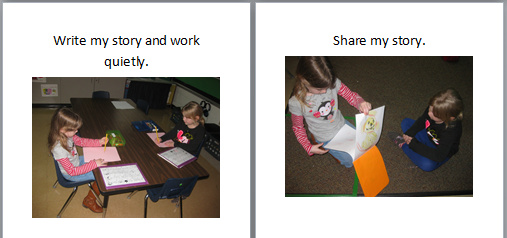
Why are these elements so important? It is a progression and a lead into a transition. Students need processing time. We can’t just tell them to write and expect miracles to happen. We have to give them the time to let things marinate. Letting them talk allows them to expand on an idea before they hit the paper. Sharing afterward allows them to transition out of the workshop. We can’t just say, “Stop writing,” and move on to math. We need to close out the workshop.
It is important to remember that developing a routine takes time. I would love to know what elements of this routine readers would like expanded. I have used many resources, experience and kid watching to get to a point in my teaching that flows and works for me. I am sure it will develop and change as these elements in my learning expand and grow.
Discover more from TWO WRITING TEACHERS
Subscribe to get the latest posts sent to your email.


Thanks for revisiting the importance of a writing routine… so the children know what to expect… and they get into the habit of the routine.
LikeLike
I love your use of photographs for your charts/reminders for kids. I think kids really connect to the charts that are made especially for them – photos especially!
LikeLike
The years when I have been most committed to a WW routine have been the most successful. I don’t think kids like surprises during their work time. They want to know! (“Do we have gym today?” How many times have we all answered that question?) I really like the picture prompts, especially for the youngest learners. Can you give some details (maybe in a future post) about how long it takes to build their stamina? I have had grade 3 students arrive in my class unable to write for 25 minutes! I am curious about how a person makes this happen in grade 1.
LikeLike
I would be happy to share more about stamina. It is definitely it’s own post! Hopefully sometime in December or early January. Thanks Lisa!
LikeLike
Establishing routines is so, so important and helps so much with independence. It almost seems like a paradox, but it really is true that the more structured our teaching is, the more independent our writers can be. And it’s never too early to put these foundations in place. Thanks for a beautiful post Betsy!
LikeLike
This is great, Betsy. Such a powerful reminder of the importance of routine. You’re so explicit here in how you made it work in your classroom! Thanks for sharing with us!
LikeLike
Reblogged this on Sandwich Literacy and commented:
PreK – 2nd grade teachers…some great reminders about routines for Writer’s Workshop
LikeLike
Thank you litteachers2013!
LikeLike
This is the first year that I have had much of a routine and it has made such a big difference! I still need to work on the sharing part, but we are making progress.
LikeLike
So glad to see the time built in for talk. This is so important, especially for primary students. It can make all the difference for a reluctant or struggling writer (really all writers!), but it takes time to establish just that piece of the routine as well.
LikeLike
“We have to give them the time to let things marinate.” This is one of the most important insights my own writing has given me into teaching writers. Thanks for sharing!
LikeLike