
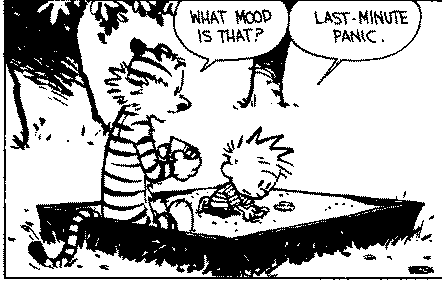
- copyright: Bill Watterson – Calvin and Hobbes
This is pretty much how Josh felt when I pulled my conferring stool up next to his desk yesterday and asked, “So, how’s it going?” He had been working on his memoir for the past week, and making very slow progress. Most of our writing workshop class were revising for the last time and getting ready to publish their writing pieces , but Josh was still struggling with his first draft. In fact, Josh has struggled in Writing Workshop ever since we began the school year.
He was pretty upfront about his attitude in his writing survey – “I hate writing” – so I knew that my work with him this year would focus on developing a more positive view about the writing process. The early days showed promise – he responded to mentor texts, and shared experiences as we filled in our heart maps and writing lists. His early Writer’s Notebook entries were brief, and when the time came to choose a piece to develop into a memoir he had a difficult time choosing something to write about. When the class shared their topic selections, Josh was the only one less than enthusiastic about the prospect.
I have each of my students write a purpose statement before they begin a writing piece: “I am writing about……; I want my reader to know…….” I feel that this allows my kids to keep track of their topic, and helps me in the conferring process: are they staying on course? veering off-track? Josh shifted his focus quite a few times, changing his purpose statement to reflect his new story line four times. By Friday, his writing piece had a sustained focus…but little else to speak for it as an interesting piece of writing.
We scanned his yellow writing pad together, and I noticed how many times he had begun sentences only to put a line through them. I noticed the post its with sketches and webs filled out – vestiges of our conferences through the past two weeks, as I tried this and that technique to expand scenes, describe them, lend voice to his writing. My question still hung in the air and Josh was ready, finally, to respond: “I think I’m done, Mrs. Smith.” I realized that, actually, he was. There was no more that we could do with this particular piece, Josh needed to move on as a writer. True, there were many things I could suggest to make this a better memoir, but Josh was simply done – it was time to move on.
- punctuating dialogue
- creating paragraphs
- choosing more specific nouns and verbs
And…we have the rest of the year to accomplish the rest .
Josh was so relieved to hear that come Monday he could begin to type up his piece! As I moved on to the next student on my conferring list I thought back to my early days of teaching writing workshop. Then, I think I wore my kids down with revision. I felt that I had failed as a writing teacher unless I had squeezed every bit of “improvement” out of a student’s writing. Now, I know that you can only go so far with a particular piece of writing. Goodness knows that I have begun many a writing project of my own that has fizzled out. I learned something new with each effort, but not every effort was “finished.” Likewise, my kids move forward a bit with each piece of writing they tackle. Some will be much better than others, and some they will feel strongly enough about to happily revise many times until they feel it is truly “done”.
Discover more from TWO WRITING TEACHERS
Subscribe to get the latest posts sent to your email.


I have worked so hard this year on improving my writing workshop. Your post is an area that I still struggle with. I think it is the thought that everything has to perfect or complete in order to publish or move on that makes it so hard to just let go of a piece. Thanks for the advice.
LikeLike
Thank you for this. I think we have to know when pushing for more is actually getting less from our students. There are those you just know have more and yet they don’t. Sometimes they have had enough and we have to acknowledge the work they did do. That is why the reflection you did was so important. Josh had grown. Next time more.
LikeLike
I agree wholeheartedly, Tara. Sometimes they are just done, and we have to let that be ok. It’s hard, but I think it’s the right decision.
LikeLike
I think your post applies to all of us. Sometimes it is just time to put the writing piece to bed and move on. Thanks, Tara and Happy Thanksgiving.
Bernadette
LikeLike
You shared this point well, Tara. It’s something I needed consider in all of our assignments in class. Sometimes a project, writing, art or another type, just needed to be done. In a process-oriented classroom it’s very good advice! Thanks for this!
LikeLike
I think this is my hardest part of being a teacher of writers…sometimes we just have to let enough be enough. Love the Calvin and Hobbes by the way…going to print it off and share with my kids today
LikeLike
I have a “Josh.” It is so difficult for me to let go. Sometimes we get into big arguments. We are both hard headed. He does not want to revise or elaborate while I won’t accept that that is all he has to give. I try to let go and allow him to move on, and then on the next piece of writing, he’s at it again, just doing the minimum. My student is a prolific reader, so I think perhaps he has a perfectionist issue. I don’t know. We have been struggling for a few years now because I teach him every year in his gifted class. I wish you could come for a visit and give us both some of your positive energy.
LikeLike