
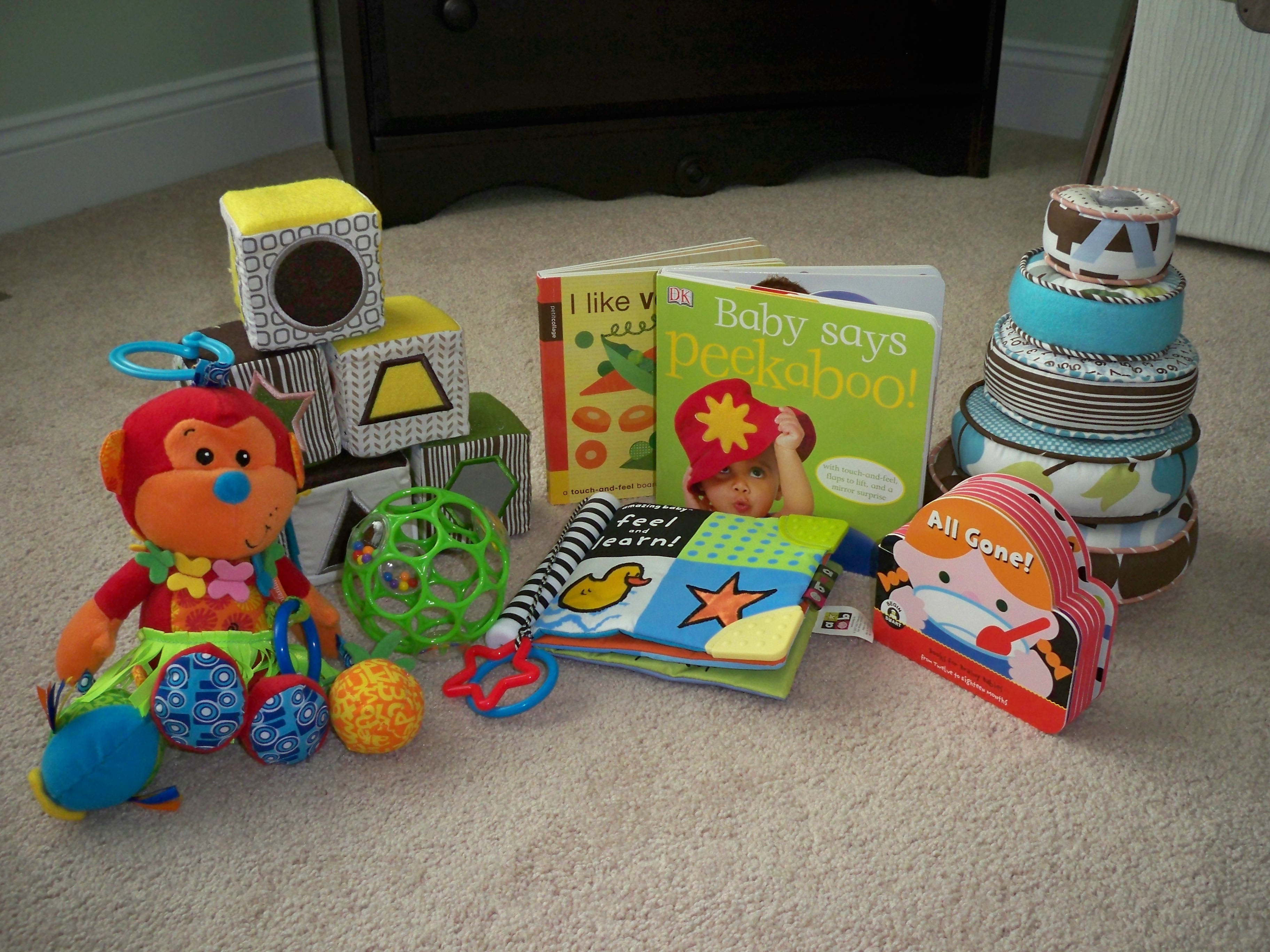
This past weekend I needed to pick up a few feeding-related items for my daughter at Buy Buy Baby. Since Isabelle was sleeping, I found myself weaving through the brightly-lit aisles of the store a little longer than I had planned. I found my way to the toy section, which was incredible. I found myself picking up and inspecting lots of infant toys, many of which claim to have educational benefits. I was amazed to find a whole section of infant flash cards. As intriguing as these flash cards seemed, I passed them by and settled on a neon green ball that makes a rattling sound when the baby shakes it (see bottom left of the photo). After all, Isabelle played with a similar ball at a friend’s house last week and enjoyed the sounds it made when she moved it around in her hands.
I didn’t think much of passing by the infant flash cards until I read Fast-Tracking to Kindergarten, by Kate Zernike, which appeared in this past Sunday’s New York Times. The article is about Junior Kumon Programs which are gaining popularity in places like New York City. Junior Kumon is a place where three to five year-old children go to “build the fundamental skills necessary to succeed throughout their educational experience” (Retrieved from http://www.kumon.com/WhyJrKumon.aspx on 5/16/11). From what I learned by reading the article in the Times, it seems like Junior Kumon is about a lot of worksheets and excessive drilling in the name of helping children build their math and reading skills.
Zernike’s article also stated:
PARENTS pay $200 to $300 a month for their 2-, 3-, 4- or 5-year-old to spend up to an hour twice weekly being tutored at a Junior Kumon center — 20 to 30 minutes each on reading and math. Children are then expected to do 20 minutes of homework on each subject every day, with their parents guiding and grading them. Recommended reading lists start in preschool with “Goodnight Moon” and “Each Peach Pear Plum.”
To me, Junior Kumon seems like a lot of money in the name of trying to get one’s child ahead of other kids in school. Childhood is supposed to be about exploration… about getting messy, problem-solving, playing, and discovery. Obviously, there are lots of things children need to know before they arrive at the school door, but “academic enrichment” like Junior Kumon seems too stifling for a young child.
If my daughter starts putting her board books in her mouth by six months of age and pointing to things in picture books by a year old, I’ll know she’s on-track with her literacy development. By singing with my daughter and talking to her constantly, I know I will encourage her language skills. Through everyday living and authentic activities she will learn the basics of math. I don’t think she will need a program like Kumon to help her succeed. And quite frankly, I’m not going to let myself get pressured into believing that she won’t do well in school if she doesn’t attend an academic enrichment program, be it Junior Kumon or something else.
What do you think?
Discover more from TWO WRITING TEACHERS
Subscribe to get the latest posts sent to your email.


Wow, I cannot imagine sending my 2 year old for tutoring. Why would I want to do that? I would much rather her color, play in the sandbox, have a tea party, etc. I fully believe that authentic learning experiences are far, far more valuable that any type of drill and practice program. I can also say that as an upper elementary teacher their classmates will catch up with them, because I see it every year.
LikeLike
What’s the hurry? Why do so many people seem to think there is some extraordinary value to learning faster or earlier or younger or sooner? Bragging rights? I don’t get it. I certainly want my son to be well educated, but I also want him to be a kid.
LikeLike
I agree with you 100% Andrea!
LikeLike
In light of the fact that my colleagues have lost their jobs due to layoffs in our district, I am thinking that if parents want Kumon, perhaps high-quality teachers can find viable job alternatives there. Regardless of how we teachers think, the world is spinning at a mind-spinning pace and we’ve got to keep up or …be left behind. So if the race to nowhere is landing up at Kumon, better that certified professionals are doing the teaching there.
LikeLike
I definitely would not send my toddler to Junior Kumon but I think I would consider it if they were school-age and needed more support. I was terrible at math as a child and I never had anyone patient enough to sit with me to go over it. Drill and kill math exercises would’ve worked well with me! But like I said on FB, this article reminded me of The Battle Hymn of The Tiger Mother. Did you read that? While I didn’t agree with the author’s narrow focus on her children’s acadmics, I did see her point that we shouldn’t be afraid to hold our children to high standards of performance.
LikeLike
I have The Battle Hymn of The Tiger Mother, but haven’t read it yet. I’m working my way through The Blessing of a Skinned Knee: Using Jewish Teachings to Raise Self-Reliant Children first. However, I definitely am going to get to Battle Hymn soon!
LikeLike
I just imagine how different your photo would look if you were one of “those” parents who valued drilling skills into the head of your little one. More important than any skill is the ability to exist in the world as a thinking, feeling human being. Flash cards can’t teach that. What an interesting juxtaposition to read Ruth’s post, then yours. No child who was worksheeted between the ages of 3 and 5 would say the sun “winked” at him; that’s for sure!
LikeLike
A colleague sent that NYT article to me yesterday, knowing I would scream in reaction. I suggest one more option on your poll: Sad. Isn’t it sad that we are not respecting young children and allowing them to explore the world in a developmentally correct way? Why are we getting so anxious about our children? Why can’t we be more present with our children? Sad. Sad. Sad. That’s all I can say!
LikeLike
I work with many students who attend Kumon classes and although they can decode high level books, the overwhelming majority of those students can’t answer comprehension questions.
Sometimes parents forget that children also need to learn how to tie their shoes, interact with other children, and have interests that don’t relate to academics. Whatever happened to pre-school children playing dress-up, or blocks, painting or creating with playdough?
LikeLike
I think I am lucky that my sons came before preschool seemed so mandatory. We read every day. Learned to recognize numbers by the aisle numbers at the grocery store. Socialized by playing with the neighbor kids. Let kids be kids–most of the time, they will do just fine.
LikeLike
Just leave it all alone, & as you said, do the things you know are important as a teacher: read aloud, have grand conversations, explore the world inside and out, have a lot of fun!
LikeLike
I guess I should be glad my students come from families so poor private school would never be an option. I think the preschool education I provide is as rich an experience as I can make it – considering the lack of field trips and equipment replacement due to rough handling.
LikeLike
Hi, I know that as a new parent all of these gimmicks and gadgets can be enticing and appealing: they seem so sure of what they’re promising! And, what do you know, really? Everything you believed in as a teacher of OTHER children is put to the test when it comes to your own child. My best advice: resist it all with a vengeance! Even to believe that children need to start kinder knowing certain things is a mistake. What things? Who decides? Why? This mind set will get you into trouble as a parent AND as a teacher.
LikeLike