Estimated Reading Time: 3 minutes, 581 words
Primary Audience: K-5 teachers, literacy coaches
What’s Happening: Have you ever had a student who just couldn’t think of a story to write about? Or a language learner who needed targeted language support in order to write their story? Have you had reluctant writers requiring extensive prompting to get their stories onto the paper? Maybe even had trouble yourself thinking about what story to write as a model text? If you’ve spent any time teaching writing, my guess is that you answered yes to all of the above. Whenever I find myself in any of these situations, my go-to writing topic is a shared experience.
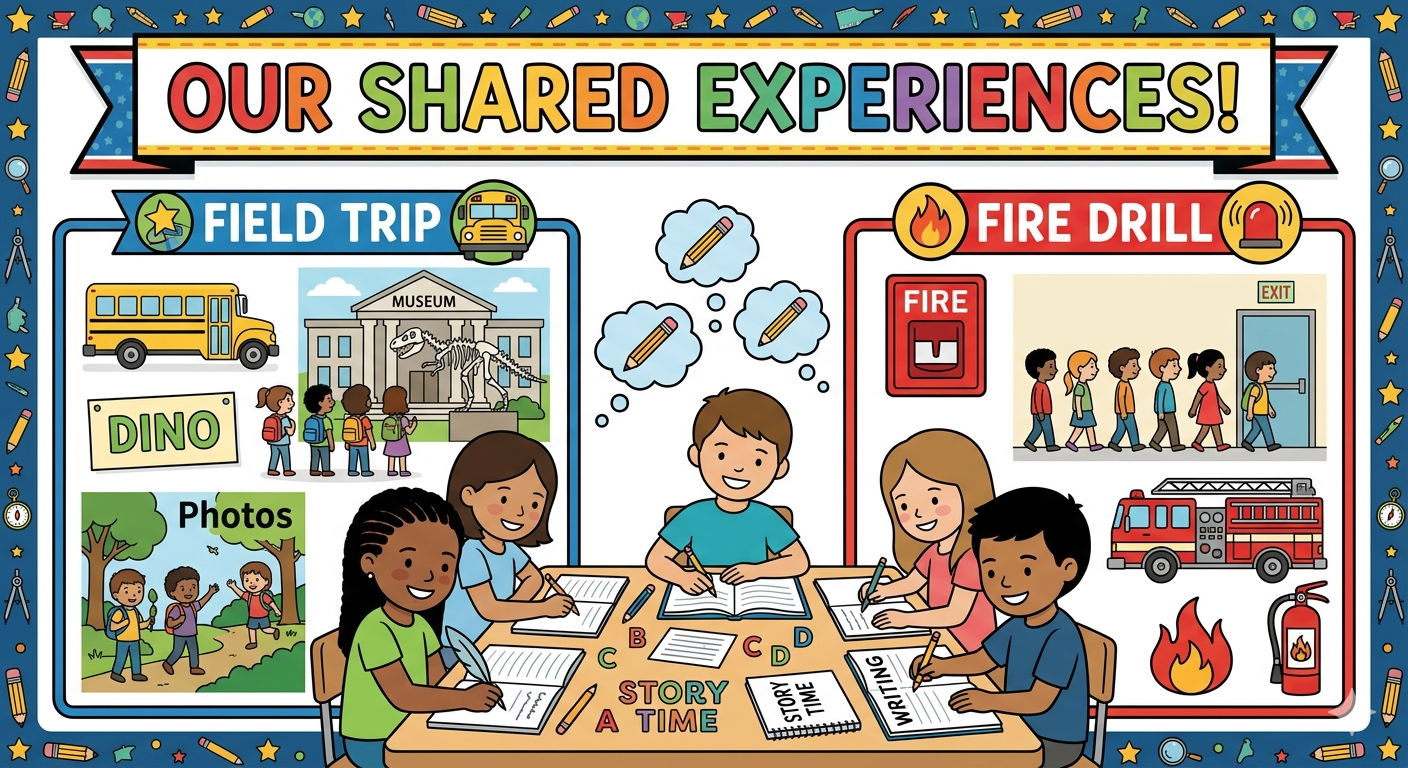
What is a shared experience? Any experience that you and your students experienced together. My favorite shared experiences to write about are:
- Special events like an assembly or field trip
- Surprising events, like when the butterflies escaped from their habitat or the fire alarm went off unexpectedly
- Emotional events, like when something especially funny, sad, or scary happened to the class
Here’s Why: When the topic is a shared experience, it makes my job of supporting writers much easier. Here’s some ways writing about a shared topic can support different types of students:
- Students who struggle with generating ideas often struggle with making a plan as well. If a student is stuck at coming up with an idea, I will suggest a few different shared experiences. When they choose one to write about, I can provide heavier support with making a plan for how their story will go since I was there when it happened. Once they have a plan, I have found they are much more likely to be successful in putting pencil to paper.
- Writing is the most difficult language domain for most language learners, so it’s understandable that they need more support to express themselves in writing. When language learners are writing a story I am familiar with, we can orally rehearse how the story will go, I can teach the vocabulary they need (as simple as jotting key words on a sticky note they keep next to them as they write), and provide sentence stems and transition words to scaffold their writing. I can provide the specific language they need to tell their story because I know the story.
- Reluctant writers need a lot of prompting and encouragement to keep going. When reluctant writers write about a shared experience, I can provide specific prompts that help them write what happens next, add description, use dialogue, etc. because I know what happened in the story they are writing. Plus, shared experiences are highly engaging for students to write about because they represent highlights of the school year.
- Using shared experiences for the texts I write as models means my students can practice writing strategies by helping me with those texts. During a minilesson, after modeling a strategy with the first part of the story, I then invite students to try on the strategy with the next part of the story. For example, if my minilesson is about adding dialogue, I can ask students, “What else did people say? What other dialogue should I add?” because they experienced the story I am writing.
The Bottom Line: I love writing about shared experiences because it is a no-prep scaffold. The experience has already happened, but using that experience allows me to provide more specific and targeted supports for my students. Try it next time you find yourself in one of the situations above and see how it supports your writers’ success!
Discover more from TWO WRITING TEACHERS
Subscribe to get the latest posts sent to your email.


