Estimated Reading Time: 5 minutes (962 words)
Primary Audience: Early Childhood Educators
A Backstory
A handful of years ago, I wrote about a creative writing experiment I conducted with my then-kindergarten class. I wondered, what would happen if I gave kids some random cardboard scraps, glue, and paint, and told them to build an animal character “puppet”? What would happen if I told them to name their character, think of some character traits, play with their character alongside their classmates’ characters, and then write imaginative stories about them? I found that when I made the process hands-on and personal, the children became so committed to their characters that they began thinking about and talking about them during non-writing parts of the day. The stories they wrote about them were detailed and expansive, and the audience we created within our class community was supportive and invested.
The Details
Fast forward to today, and my pre-k class —a group of imaginative four- and five-year-olds. They are not yet “writing,” but they are already dynamic storytellers. They can turn a block into a cement pourer, a piece of fabric into a bed for a kitty, and a popsicle stick into a magic wand. Surely they could turn some scraps of paper and loose parts into a character and a setting!
I began by introducing the concept of a character. What did my students already know about characters? Most children referred to characters in shows or movies like Spiderman and Bluey. I wanted to make sure they remembered that characters are in books, too! There’s Max and Ruby! Peter and Susie! Trixie and Knuffle Bunny! Little Blue and Little Yellow! We talked about how characters can be people, animals, imaginary creatures, or even inanimate objects. Children understand this intuitively because they frequently personify things in their environment, making them “do” and “say” things with a human quality.
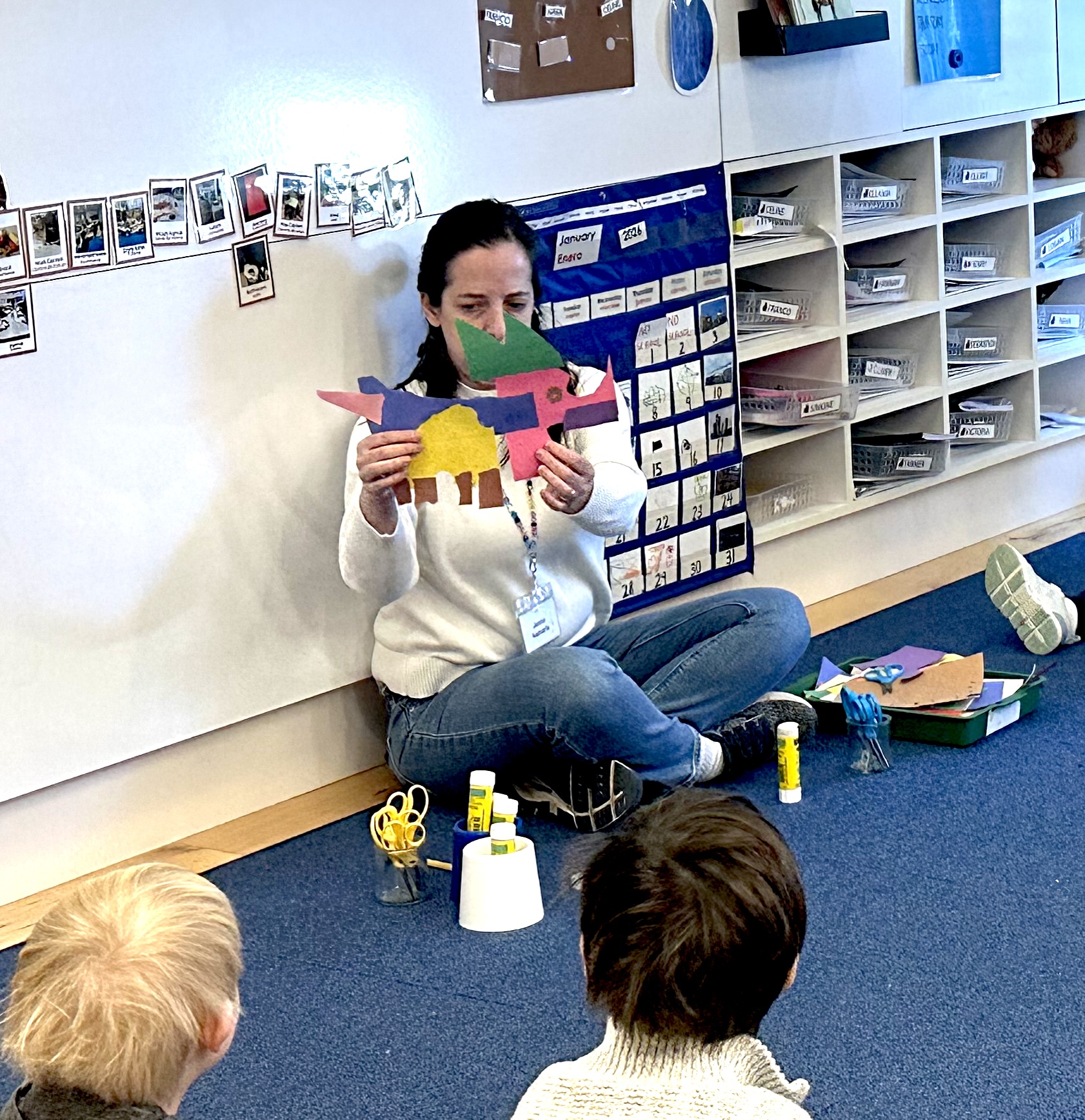
Then, I modeled how to make a character by attaching together various pieces of scrap paper with glue. I explained that I did not know what kind of character I was making — that I wanted to see what it reminded me of before deciding. Soon enough, the pointy piece of paper attached to the oblong paper started to look like something–it was a rhinosaurus! I kept going and even added a hat and a mustache. Drawing was not part of this exercise; only attaching paper to paper and abstract shape to abstract shape.
After each child created a character this way, I asked everyone to make a home for their character. I wanted to use open-ended materials for this process because it felt the most natural to me. At this developmental stage, four- and five-year-olds can create detailed, representational images using loose parts much more readily than with drawing. So I gathered a variety of materials for the children to use, and after modeling the process of making a home for my character, I set them off to work. I asked them to place their character in their home and tell me the whole story of where their character lives. The following are several examples of student work from this stage of the process:
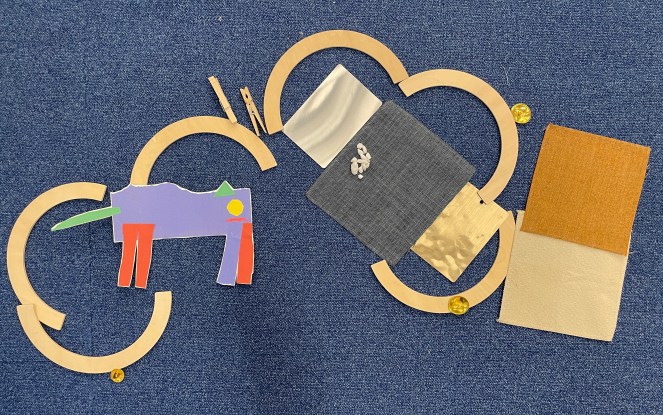
SF: “My character is a crocodile named Crocky and he likes to bite people. Not me, but other people. He lives in the sea. That is the bed. This is the security. That’s where he likes to nap his babies. And those are the two babies.”
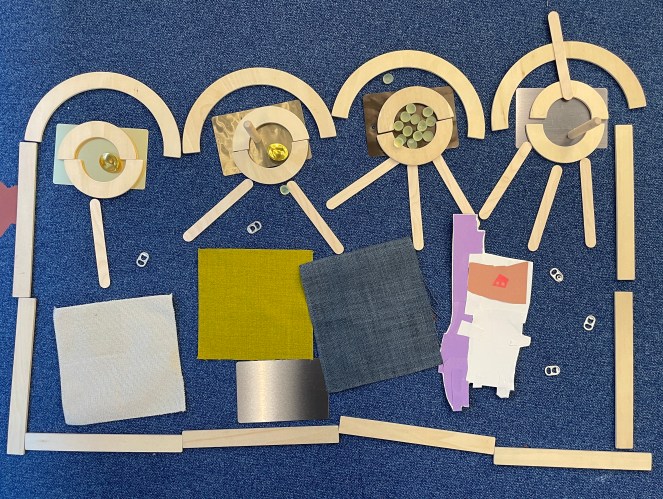
EB: “I made a Minecraft skeleton. He has a lot of things in his house. He has a hot tub, a warm tub, an airport, and a plane. He has soft carpet. The silver bottle caps are the chests. There’s candy inside. These are the fire sticks. And I also have two chocolate golden coins. He usually opens his chests or he opens his chocolate coins when he gets hungry.”
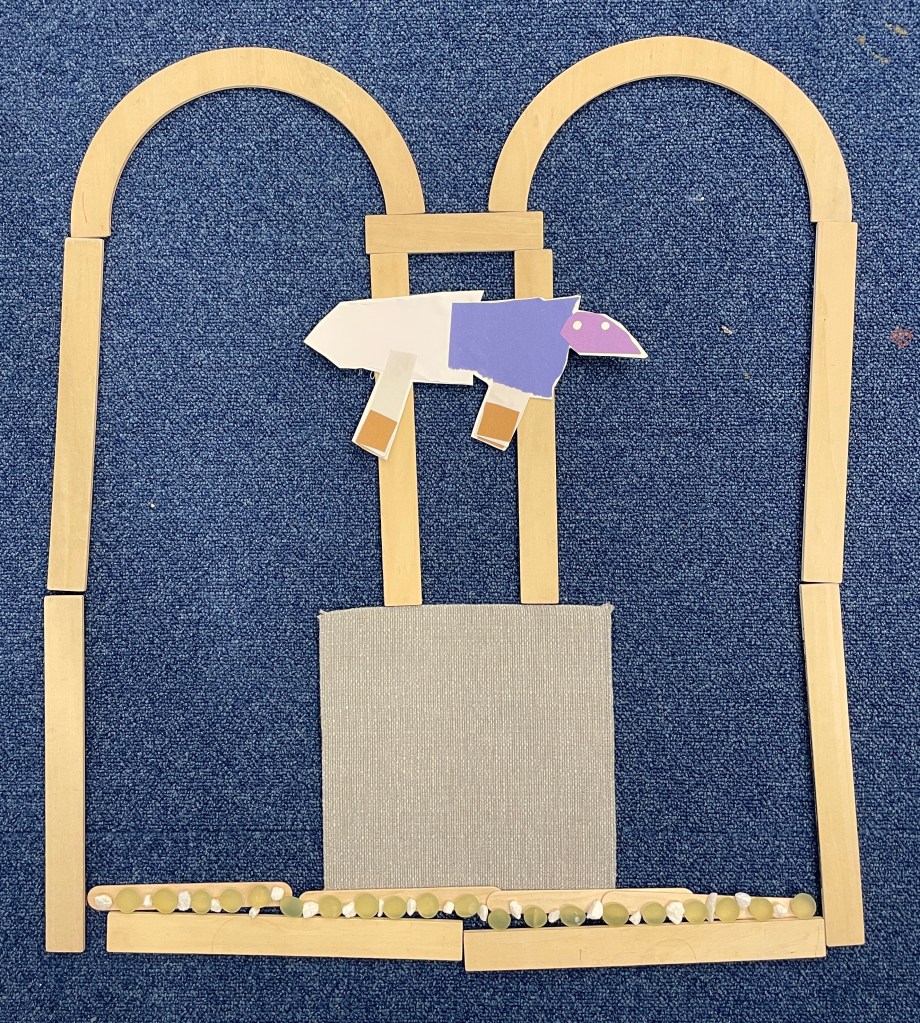
CD: “My character is a dinosaur. I mean…it’s a mountain goat. It’s name is Cece. It’s a girl. She lives in this house and these are little pebbles for her to step on pretending to climb. And this is a castle, so these things lift up and this is the door and she walks in and she just takes a nap every time. And she has lots of fur. This is the mountain but you can’t see it.”
What’s Next
Now that my students have created a character and their character’s home, I want them to begin developing a personality for their character. One way I will do this is by having the children go on “character playdates,” in which I invite two children to play together with their characters. I want to see and hear what kinds of stories or scenarios they can come up with together. To further deepen their character’s identity, I will also interview each child to ask them questions such as, “Does your character have a family? What does your character like to do? What makes your character feel happy? What makes them feel sad?” From there, I will work with each child to have them tell a story with their character as the starting point. Since pre-k students are not yet “writing,” I want to focus on language production and oral storytelling.
I hope that this creative process will give each child the opportunity to strengthen their understanding of character, setting, and narrative as an important precurser to the work they will be doing next year in kindgergarten. I also believe that by making the writing process hands-on and tangible, children will know they can make a story come to life from just about anything — even from a few pieces of scrap paper, a handful of pebbles, and a some silver bottle caps.
Discover more from TWO WRITING TEACHERS
Subscribe to get the latest posts sent to your email.


This is so much about what Angela Stockman embraces for all writers. Writing is a Maker-space, and your work with these youngest writers shows that!
LikeLiked by 1 person
Thank you for your comment! I love a good maker space!
LikeLike