
Estimated Reading Time: 2 minutes Contains 392 words
Audience: Instructional Coaches and Classroom Teachers K-8
How We Got Here
The progression from opinion to persuasive writing and, later, to argument can be one that students struggle to connect. In my years teaching kindergarten up to third grade, I remember watching students make these subtle shifts and struggle with their purpose and understanding. Now, as a seventh-grade ELA teacher, I face significant challenges in helping students construct complex written arguments, particularly in using evidence to support them.
Students often struggle with:
- Selecting appropriate evidence
- Distinguishing between strong and weak evidence
- Explaining evidence connections to claims
- Moving beyond simple evidence recall to justification
The Context
Five critical cognitive abilities are essential for developing strong argumentative writing:
1. Working Memory: Holding a claim, text evidence, and reasoning simultaneously
2. Inference-Making: Connecting text evidence to claims strategically
3. Comparison and Evaluation: Recognizing and comparing argument evidence
4. Monitoring Metacognition: Reflecting on evidence sufficiency
5. Abstract Reasoning: Interpreting implicit textual meanings
Why it Matters
Creating a sequence of questions that builds from basic recall through to a complex argument not only prepares the teacher for potential roadblocks when supporting students but also establishes where the student is on a continuum of gradually more complex thinking. Below are examples of questions used to determine where the student is within the understanding of this particular challenge, selecting strong evidence. Partnered with this is a sequence of scaffolded suggestions of what to try when bridging connections toward critical thinking within the argument writing process.
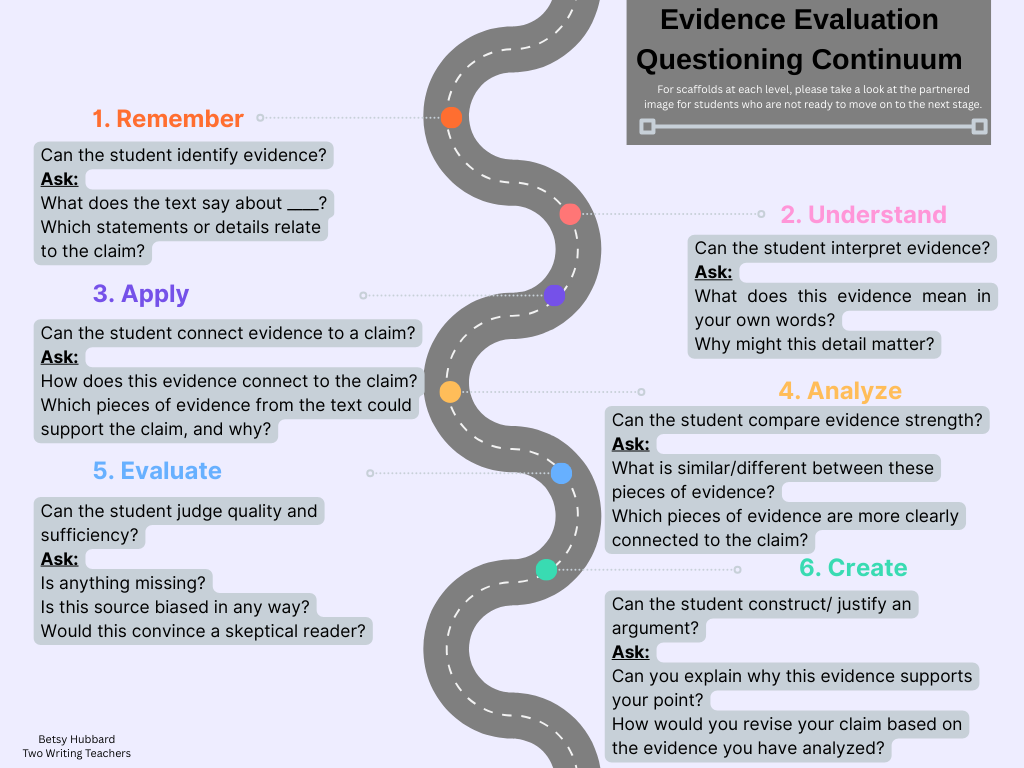

Supporting students in argument construction requires explicit structures that deepen understanding through scaffolded questioning. By aligning instructional approaches with principles of cognitive development, teachers can help students progress from basic evidence identification to independent critical thinking.
Go Deeper
These resources can support your thinking as you determine how to set up question sequences for common and predictable problems for your writing students.
Ennis, R. (2013). Critical thinking across the curriculum: The Wisdom CTAC Program. Inquiry: Critical thinking across the disciplines, 28(2), 25-45.
Manalo, E. (2019). Deeper learning, dialogic learning, and critical thinking: Research-based strategies for the classroom (p. 386). Taylor & Francis.
Sweller, J. (2011). Cognitive load theory. In Psychology of learning and motivation (Vol. 55, pp. 37-76). Academic Press.
Willingham, D. T. (2020). Ask the Cognitive Scientist: How Can Educators Teach Critical Thinking?. American Educator, 44(3), 41.
Discover more from TWO WRITING TEACHERS
Subscribe to get the latest posts sent to your email.


