Estimated Reading Time: 4 Minutes (740 words)
Audience: K-5 Classroom Teachers
WHAT’S HAPPENING: You make thousands of decisions daily, which can often feel overwhelming. There is a way to DECREASE the number of decisions you make while also increasing student growth as writers.
THE CONTEXT: No doubt you can recall many instances when you have learned how to do something by doing it. You may have already seen someone perform the same task or heard directions on how to accomplish it before trying it yourself, but the act of moving through the process, most likely several times, is what solidified your learning.
WHY IT MATTERS: The same applies to student writers. Writing skills, from simple transcribing and punctuation to complex tasks like structuring, revising with a lens, or using craft moves, develop through practice. Making these decisions fosters student growth as writers.
AS A TEACHER: Teachers often decide for their writers, fixing issues with good intentions to help produce the best work. However, this decision-making adds to your daily decision-making and inhibits your writers’ growth.
BEHIND THE SCENES: Here are two classroom scenarios that show how teachers allowed more student agency.
- A first-grade teacher noticed that one of her writers had written a piece of her narrative out of order. The teacher was unsure how to proceed with the writer. She felt as though she needed to provide the solution. However, if this writer were to learn how and when to make revisions, she would need to be involved in devising a solution. Instead of the teacher telling her writer how to move forward, she reviewed with the student the importance of telling stories in sequential order and then asked the student to reflect on this with her own piece. Once the writer realized this part of her piece was out of place, we asked her what she would like to do next. She decided to cut off that piece of the story and save it in case it could be used later on in her piece.
- A fourth-grade student working on informational books kept abandoning them after one or two chapters. His teacher told him to finish one before starting another. The teacher and I discussed the issue, and it became clear that the student wasn’t involved in the solution. When asked why he didn’t complete his books, he said he didn’t know what else to write. We learned that poor topic choice, not stamina, was the problem. We then asked him what he could do to fix this. We followed up this discovery by asking the writer what he thinks he could do to help this problem.
THE IMPACT: When you hand over the decision-making, you not only lessen your mental load but empower your writers. They will learn a great deal about being a writer as they think through everything on their own. Another benefit of allowing more student agency is that you can assess and understand your writers more thoroughly. With every thought they share, you will be able to see what they understand about writing and which strategies they have mastered. The more you know about what they are thinking, the more you will be able to identify their needs and target your instruction.
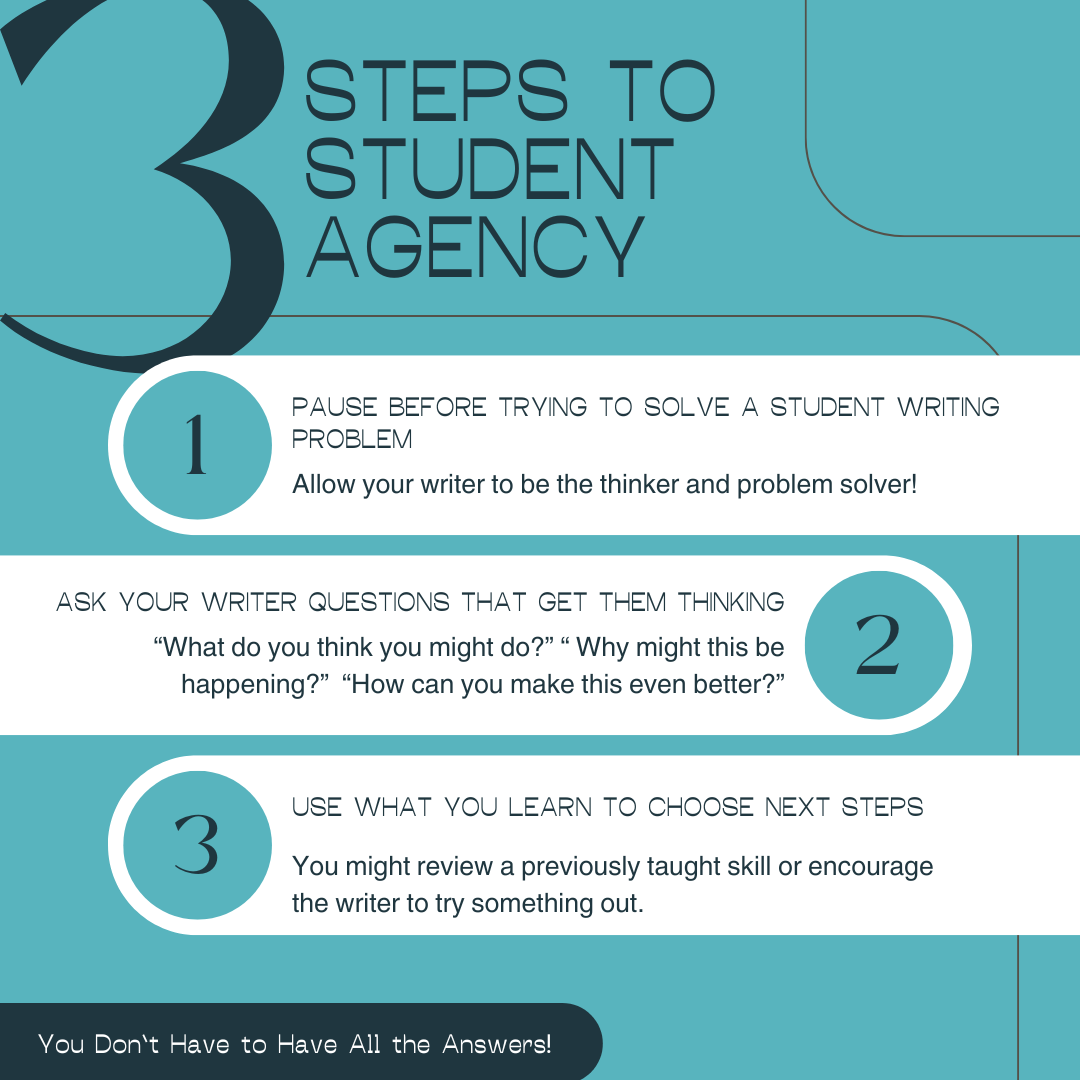
HOW IT WORKS: Placing agency in your writers’ hands does not have to be difficult. Here are the steps to doing just that:
- Pause when you find yourself looking for answers
- Ask your writer a question that gets THEM thinking
- What do you think you might do?
- Why might this be happening?
- How can you make this even better?
- Use the information gained about your writer to choose the next steps
- Review a previously taught skill
- Ask more questions
- Encourage the writer to try something out
THE NEXT STEP: Next time you’re contemplating a decision for your writers, don’t! Pass that responsibility over to them and let them learn by doing. They often surprise you with their insight, skills, and creativity.
Melissa Morrison is an enthusiastic educator with over 19 years in education. Her passion and expertise are transforming writing programs in schools by ensuring authentic instruction that focuses on the writer. In addition to owning her consulting business, Teaching to Transform, LLC, Melissa hosts the podcast, Getting Students to Write: Helping elementary and middle school teachers transform writing instruction and grow writers who thrive! You can find her on LinkedIn or find out more from her website and blog www.teaching-to-transform.com.
Discover more from TWO WRITING TEACHERS
Subscribe to get the latest posts sent to your email.


