Estimated Reading Time: 3 Minutes and 43 Seconds (744 words)
Primary Audience: Instructional Coaches and Classroom Teachers
The Backstory
This year, our school community welcomed several new teachers, some brand new and others new to our district. Part of my work as a literacy coach is to support these teachers in acclimating to our district’s curriculum. As I began building relationships and trust with these teachers, I wanted to get their input on how they viewed their workshops to establish next steps together. I adapted a checklist from Lucy Calkins’ A Guide to the Writing Workshop, 3-5 (2025, p. 33). that I used as a starting point with teachers.

While our district initiative focused on small group work, I quickly noticed a trend: Teachers were finding small groups tricky to get to because the students could not transition from the mini-lesson to working independently. Many students required additional support.
After spending some time in classrooms and reflecting with teachers, we recognized a need to get back to the basics of workshop instruction. To move forward with small groups, we had to go back to focus on some of the fundamentals of Writing Workshop. I asked, “What happens when we plan to be more clear and intentional in our instruction?” I wondered if we would see the impact on students, perhaps being able to be more independent and even more motivated. I knew this inquiry had to start at the beginning with planning and the architecture of a mini-lesson.
The Details
I often share the template below with teachers new to workshop teaching. It clearly outlines the architecture of a mini-lesson, and even when using a curricular resource or more scripted program, it allows teachers to make the work their own while also being responsive to their students.
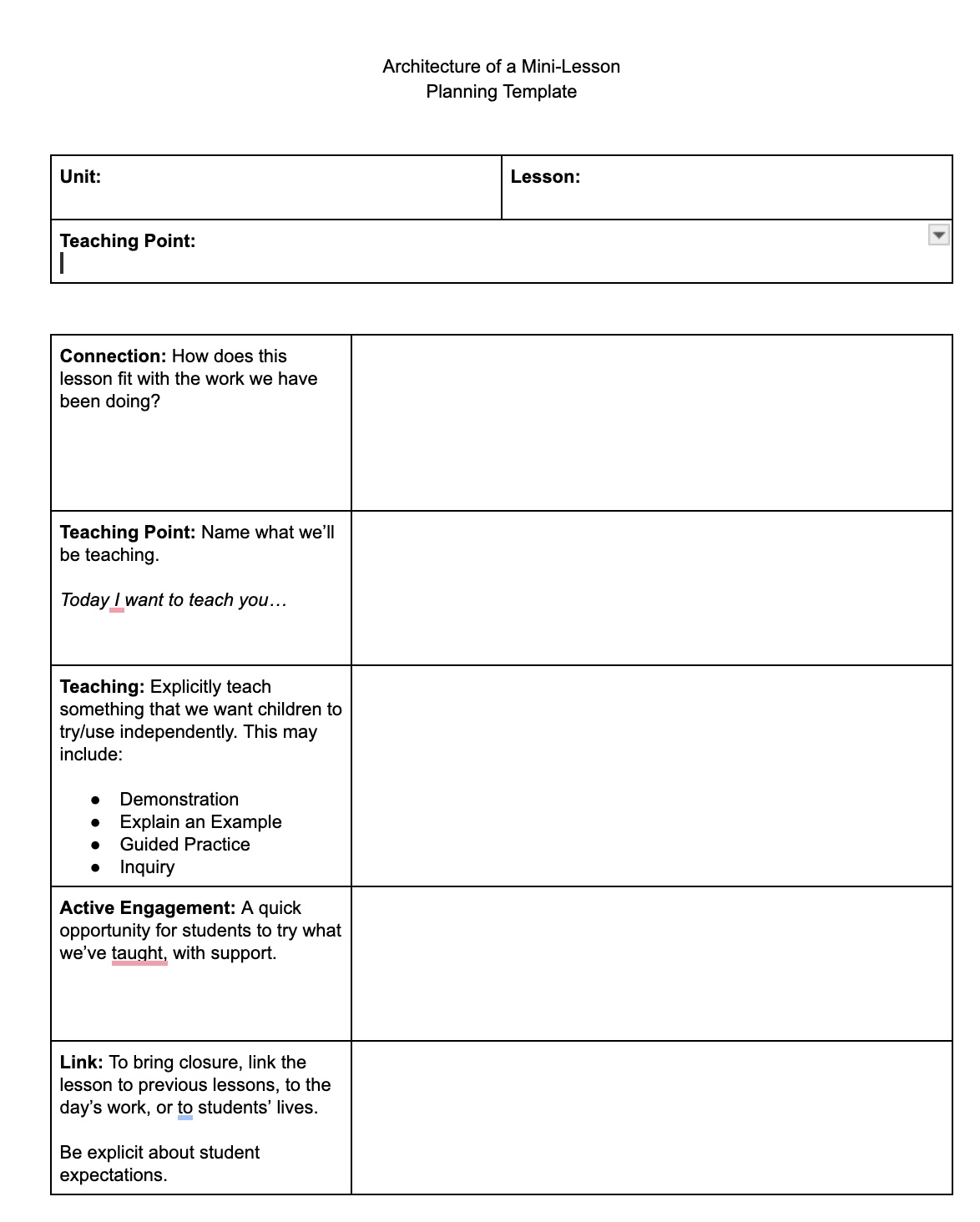
Begin with the Link: To tackle the issue of independence, I coached teachers to begin the planning process by considering the lessons’ links. What do you want students to be able to do at the end of the lesson? I’ve often watched lessons where teachers tell students what to go off and do at the end of a mini-lesson, only to see students unclear and confused. If we begin by thinking about the work students will do, we can work backward to ensure that the teaching part of the mini-lesson is explicit. We can make sure that we are modeling and providing a clear vision of the work we want students to be able to do on their own.
Example in Action
When planning a revision lesson, I might envision students transitioning to working independently, rereading their pieces, and using various revision tools, such as colored pens and different-sized sticky notes, to make changes to their pieces. With these expectations in mind, I can think through what my modeling will look like. During the teaching portion of my lesson, I would want to model rereading my piece and thinking aloud about revisions. I might show students how I use colored pens to make changes at the word level, choosing more precise language or crossing out unnecessary words. I may use small sticky notes to make changes at the sentence level, adding sentences or revising whole sentences. Larger sticky notes might be used to show bigger revisions, such as rewriting an entire section or testing out a new lead. This explicit modeling will give students a vision of what their work might look like.
For the active engagement, I might have students reread their pieces with a partner, beginning to think about places they might make revisions. That way, when they went off to work, they would already have some places in mind to get right to work. I may ask them to think about what tools might help them to make those revisions.
Then, for my link, I would remind students of the work they could do for the day and outline the steps I modeled during the lesson.

The Impact
Returning to the fundamentals of mini-lesson structure has sparked invaluable coaching conversations and deepened our focus on instructional clarity. By slowing down and prioritizing clear instructional goals, teachers are seeing immediate, tangible benefits in their classrooms. Students are more engaged, transitioning to independent work with greater confidence and agency. Perhaps most importantly, this clarity fosters a sense of calm—creating a learning environment where both teachers and students can thrive. Fourth-grade teacher Marcus Wright captured this idea perfectly, reflecting on our recent coaching work: “The link is everything. It’s the glue.” When we take the time to refine our instructional practices, the impact extends far beyond the lesson itself.
Discover more from TWO WRITING TEACHERS
Subscribe to get the latest posts sent to your email.


The link IS the glue! I love it!
LikeLiked by 1 person