
Estimated Reading Time: 4 minutes (785 words)
Primary Audience: Teachers who attend conferences with student parents and guardians.
Last week, I hosted twenty conferences with adults who care for the writers in my classroom. We discussed their students’ strengths, areas of growth, learning behaviors, and academic skills. Afterwards, I met virtually with Melanie Meehan to record a Two Writing Teachers Podcast episode about caregiver conferences. We had so much to say that we decided to collaborate on two blog posts to support teachers during this busy, anxiety-inducing time.
On Monday, Melanie shared some handouts to offer families at conferences. Today, I’ll share everything I bring to these meetings:
Assessment results: Consider the assessments you use in class and how they could help inform your conference with caregivers. Phonics screeners, sentence dictations, district-level screeners, and on-demand assessments all offer different perspectives of writers’ abilities. Sometimes, I bring the actual assessment, completed by the student. Other times, I may just have the scores on-hand in case I need to reference them during our discussion. For example, in my school, caregivers receive our universal screener scores and often have questions. It’s helpful for me to share more about how the assessment is administered in that instance.
- Avoid focusing too much on scores at conferences. Families already get a report card. I’ve found that it’s more effective to share my big ideas about student learning, with assessment results to support my stance as needed.
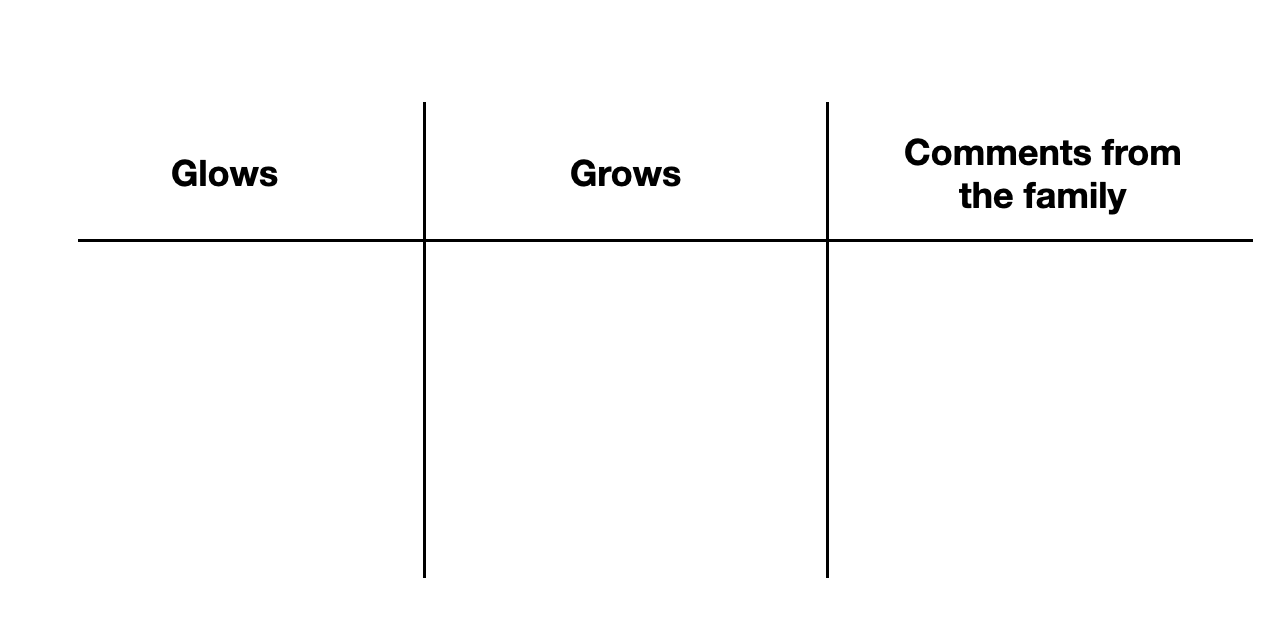
A way to take notes: I used to prepare meticulous notes for conference night. I’d write out every students’ various assessment scores on individual note-taking sheets and spend hours preparing my thoughts. The result was a one-page portrait of a student with, I now believe, too much information. Instead, I’ve opted for a much simpler three-part note-taking sheet: Glows, grows, and caregiver comments. Before the conference, I jot down a few strengths (glows) and areas to grow. However, I don’t pressure myself to write too much before the conference. I’ve found I don’t have time to read all of my notes in the moment, and the conversation flows more naturally without it.
Questions: To prevent awkward silences, I bring a notepad with a few questions for caregivers. Having this in front of me as an option helps guide the conversation, but in some meetings, it’s not needed. My notepad might say:
- Who are their friends in the class?
- What conditions help your student learn?
- What motivates your child? What upsets them?
- What are their interests? What do they do outside of school? Tell me about their family and pets. (File these notes away for story ideas!)
- What do they share when they come home about school?
Writing samples: Melanie and I talked a lot on the podcast about the pros and cons of sharing different kinds of writing samples at conferences. Here are some examples of what I’ve presented to caregivers in the past:
- A letter to caregivers, from students
- I like this because the adults love to hear how the year is going in their kid’s words. The short-format of a letter offers a quick chance for me to point out spelling, handwriting, and conventions.
- On-demand assessments
- An on-demand assessment is a piece of writing in a given genre that students create in one sitting. I think this is effective to share at conferences when you have a pre- and post- test to show growth. However, a piece of writing with time constraints isn’t always the best picture of a students’ abilities.
- A “polished” piece
- If conferences fall around the completion of a unit, you can share a finished, polished piece with caregivers. This is a great opportunity for caregivers to see how their writer sticks with a piece over time to revise and publish the best story they can.
- The student’s writing folder
- I like looking through the student’s writing folder (or writer’s notebook) with caregivers. They can learn a lot about their student’s writing process, stamina, and writing volume. It’s interesting to see the different topics and genres students choose. Often, if you have a behavior concern to address with guardians, the daily work (or lack of work) in a writing folder could support your concerns.
Information: I like to have a further information on hand to send home with caregivers if they ask for something. I avoid sending them home with an overwhelming stack, but I keep these items nearby in case it comes up in our conversations:
- Ways to read with your child at home
- Children’s literature recommendations
- Parent letters from curriculum resources
- Educational app log-in instructions
- Melanie’s brilliant new handouts!
A to-do list: As I converse with families at conferences, my to-do list grows and grows! I like to mark action items on a separate list to make sure it gets done. The to-do list is handy when caregivers ask for support from counselors, literacy specialists, or additional resources. I make an effort to complete these to-dos the next morning.
Melanie and I hope these two blog posts help as you prepare for conferences this year. Look out for our episode of the Two Writing Teachers podcast later this month on October 27th.
Discover more from TWO WRITING TEACHERS
Subscribe to get the latest posts sent to your email.


The Writing Rope by Joan Sedita is a helpful visual to prepare for conferences about writing. When a student is struggling with written expression, this graphic helps to identify areas of strengths and weakness.
LikeLike
The Writing Rope by Joan Sedita is a helpful visual to prepare for conferences about writing. When a student is struggling with written expression, this graphic helps to identify areas of strengths and weakness.
LikeLike