Estimated Reading Time: 3 minutes (659 words)
Primary Audience: PreK-12 teachers
When I first started teaching, I was horrified at the writing topics some students chose. After all, my demonstration text was a beautiful narrative about seeing a swan on a morning walk. So why on earth did a young writer craft a violent war story with a graphic drawing of a bloody soldier?!
I’m sure the same story has played out in your classroom, and it’s a sticky situation as a writing teacher. Maybe you’re peering over the shoulder of a reluctant writer who is finally writing, but… you wish it wasn’t about Minecraft. However, my ideas have changed. I DO let students write about poop, video games, guns, and more.
How I Got Here: Many of my beliefs about uncomfortable topic choices in writing workshop are inspired by Ralph Fletcher’s (2006) Boy Writers: Reclaiming Their Voices. Fletcher (2006) states that “how we respond to and evaluate student writing often has as much to do with us (our individual tastes and preferences) as what’s on paper” (p. 23). This made me stop and think about how I was imposing my interests on the authors in my class.
How It Works: While I won’t tell a writer they can’t write about a topic, I often engage in a conversation about who their audience is. If a piece is really sad, violent, or mature, I’ll chat with the writer about whether they think it’s appropriate to share with peers. I’ve found that students make great decisions in these conferences, possibly because they’re simply shocked they’re allowed to keep writing the piece. Writing for an audience is a critical skill for writers, and this is a meaningful opportunity to teach into that.
Yes, and: Of course there’s a limit. If a student wrote something about wanting to act on violence, my concern is more about involving the school counselor than censoring his or her work. But when you consider what some kids do in their free time- hunting, Fortnite, or playfighting- it’s important to honor their interests and experiences.
What do your mentor texts look like? At the 2024 CCIRA Literacy Conference, the authors of Trusting Readers (Hannah Schneewind and Jennifer Scogggin) challenged my thinking by asking: “What kinds of books do you choose to read aloud?” They asserted that exclusively sharing advanced literary texts communicates to students that important learning only happens in books like that. “Read aloud Dogman!” they cheered as my jaw dropped.
I believe the same philosophy holds true for the books teachers highlight as mentor texts. We want every student to see themselves as writers, and if I use the same swan story year after year, I’m excluding a group of writers who don’t relate.
Example in Action: A few years ago, I prepared to launch my first unit with second graders. After two successful weeks of building workshop routines and “freewriting,” it was time to shift the group to a narrative genre study. When I announced that we would begin crafting true stories about our lives, there was a quiet but noticeable sigh of disappointment. If I could read minds, I bet I would’ve heard, “Ugh… here we go again.” Clearly, they remembered narrative writing from first grade and weren’t excited to be limited to this genre.
Thinking on my feet, I ditched my planned demonstration text. (And yes, it was my swan story.) In front of the class, I brainstormed and planned a narrative about the time a student puked on my feet. BOOM! I had them. They screamed, stuck their tongues out, and asked a million questions. I described the smells, textures, and sounds, sparing no detail. They couldn’t wait to get to work on their own narratives, many of them retelling their own nasty stories.
Try It: Give it a go. You might be surprised how your writing environment changes. To get you started, here are some “innapropriate” books students at my school have created. Feel free to use them to inspire unengaged writers.
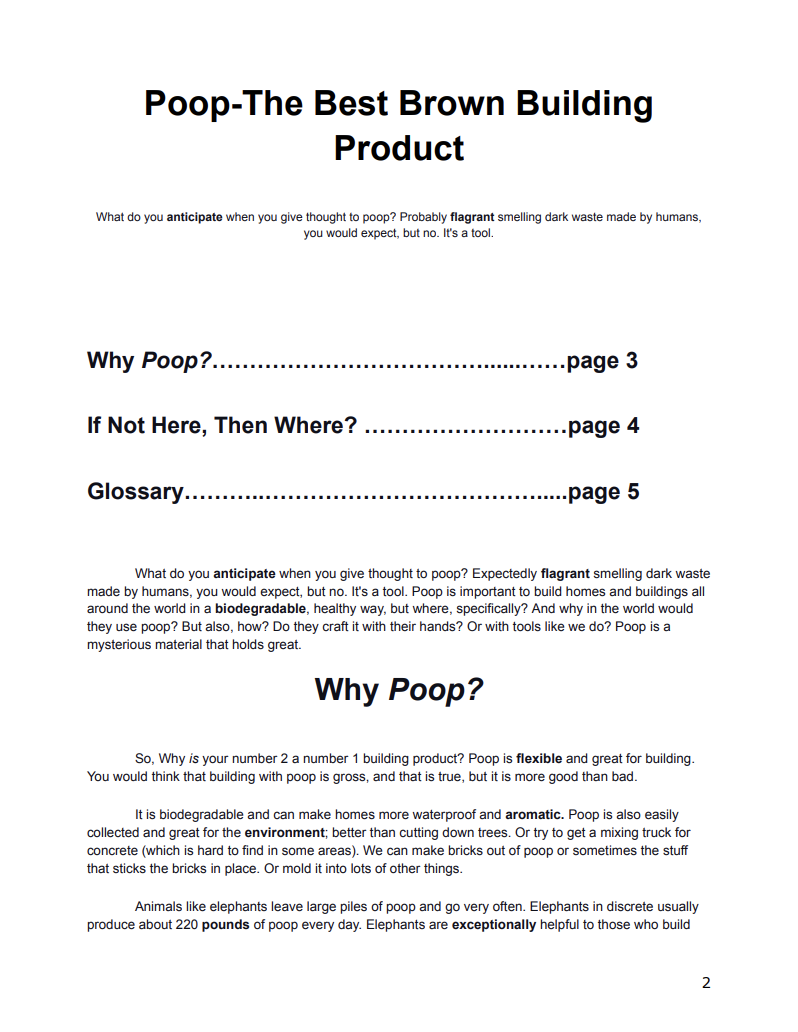
Building With Poop
A fifth grader at my school wrote an informational piece called, “Poop: The Best Brown Building Product. Her piece exemplifies word choice, text features, and engaging leads. Here’s a snapshot of the first page:
Dragon City
Three second graders worked together on this informational comic about a favorite video game. Yes, they spent a lot of time drawing. But look at how effectively the interesting illustrations teach how to navigate the game, shop, and battle. The level of detail in their facts make this an excellent nonfiction mentor text.
Mr. Pickle Goes to Mars
Believe it or not, this story was written during our second grade realistic fiction unit. When I asked the writer how this was realistic, he changed the pickle into a robot and argued the story took place 100 years in the future. I didn’t argue any further, and I’m glad I didn’t. This writer experimented with writing in the second person point-of-view and artfully described Mr. Pickle’s physical characteristics. (P.S: These cool images were created using the Artificial Intelligence platform Novodia.)
What If K-9s Killed?
Warning: This second grade story (part of a series) depicts a violent battle between a canine and a cougar, and one of the characters dies. Despite the scary material, the writer elaborately described the battle on page 3 with some interesting sensory details and artful word choice. (Once again, the images were created by A.I., which make the story even scarier).
Go Deeper
For more mentor texts, check out Boy Writers: Reclaiming Their Voices. Ralph begins each chapter with a piece about an uncomfortable topic.
Beth Moore wrote about uncomfortable topic choices in 2018. She offers tips for conferring with students.
Beth also interviewed Ralph in 2014 about what happens when we ban students from writing about certain topics.
References
Fletcher, R. J. (2006). Boy writers: Reclaiming their voices. Stenhouse Publishers.
Discover more from TWO WRITING TEACHERS
Subscribe to get the latest posts sent to your email.


“Boy Writers” is one of my favorite books about teaching writing! It made me a better writing teacher, and helped me understand my son as a writer, better, too. Thanks for these great examples to use as mentor texts.
LikeLike
This is really at the heart of this piece:
“If a student wrote something about wanting to act on violence, my concern is more about involving the school counselor than censoring his or her work. But when you consider what some kids do in their free time- hunting, Fortnite, or playfighting- it’s important to honor their interests and experiences.”
Just as we provide choice, we don’t provide unlimited choice. Same goes for violence.
Thanks for this important piece, Leah.
LikeLiked by 1 person