Estimated Reading Time: 6 minutes (1184 words)
Primary Audience: Teachers or caregivers of young writers

If yoo kan red fis yor probuble a riteen teechr, and spelling like this is a common sight in your writing workshop if you teach in the primary grades. Yet caregivers (and even some colleagues) see a problem and say things like, “Her spelling is terrible!” They may even write a “translation” under the students’ sentence, a personal pet peeve that destroys confidence and independence in young writers. (Melanie Meehan wrote about writing on students’ writing here). Some caregivers and educators think that invented spelling may prevent students from eventually learning the correct spelling, but research reveals this claim is not true (Oullette & Senechal, 2017).
Teachers of writing know that invented spelling is a crucial component of literacy development for young learners. Today, build your expertise around the research that supports invented spelling and provides recommendations for moving from invented to conventional spelling, an important goal for all writers.
What is invented spelling?
Invented spelling describes a child’s beginning attempts at guessing how a word is spelled. Some other terms you may have heard include creative spelling, child spelling, sound spelling, or developmental spelling. In essence, invented spelling is when children use all they know to spell a word they can’t accurately spell yet.
Let’s define a few more terms related to invented spelling.
- Phonemic awareness describes the skills you need to hear, segment, blend, and manipulate phonemes, the smallest units of sound in a word.
- Phonics is the teaching of letter-sound correspondences.
- The alphabetic principle is “the understanding that each letter or in some cases, group of letters (graphemes), must map to a sound (phoneme). Children who understand the alphabetic principle know that letters represent sounds that form spoken words.” (Gentry & Oullette, 2019)
- Students demonstrate transfer when they can independently use a skill taught in isolation in their own reading or writing. Transfer is the ultimate goal of spelling and phonics instruction.
What The Research Says
- Oullette and Senechal’s (2017) landmark study tracked students from Kindergarten to first grade, analyzing the sophistication of their invented spelling. They found that the Kindergarteners’ invented spelling positively influenced conventional spelling and reading ability once the kids reached first grade.
- Schrodt, Fitzpatrick, and Elleman (2020) found that encouraging invented spelling positively impacts students’ independence, confidence, and identities as writers.
- A prominent researcher in the spelling field, Richard Gentry, developed the five phases of spelling development, found in the infographic below. (Gentry, 1982). When teachers identify these stages, they can more effectively assess and determine student ability to determine instructional needs (Gentry & Oullette, 2019.)

Invented spelling and writing workshop go hand-in-hand. Gentry (1982) states that “purposeful writing is the key to cognitive growth in spelling” (p. 198). Writing workshop is the perfect opportunity for students to grapple with word spelling in an authentic environment where writers are motivated to spell as accurately as possible so others can read their important words.
Some reasons invented spelling matters include:
- Invented spelling permits all students to write independently (Schrodt et. al, 2020), a crucial component of writing workshop. When kids can work without a teacher sitting next to them, they become more engaged, confident, and successful writers. Conversely, when students think they must spell every word “right,” they constantly ask the teacher for confirmation. Most primary learners have not learned enough phonics to spell most words correctly, so if we expect them to use accurate spelling, they will constantly experience failure.
- Invented spelling is a chance to practice phonemic awareness (Grassmeyer, 2018). When students engage in invented spelling, they have to segment words into individual sounds and then attempt to match each sound to a grapheme. That first step, segmenting a word, is a critical foundational skill for reading and writing.
- Invented spelling provides an opportunity for transfer. While explicit phonics teaching is crucial, it shouldn’t be the sole spelling practice for learners. When kids engage in invented spelling, they apply the phonics patterns they’ve learned. For instance, if a student, after learning consonant blends but not r-controlled vowels, spells “monster” as “monstr,” it indicates mastery of a blend in a two-syllable word – a clear demonstration of transfer, even if the word isn’t yet “correct.”
- Invented spelling serves as a diagnostic tool for teachers (Gentry & Ouellette, 2019). In the two points above, I provided examples of students successfully transferring phonemic and phonic skills to their writing. But, if the student above wrote “mostr” instead of “monstr,” it signals a need for more practice with consonant blends. Despite mastering the skill in phonics lessons or assessments, independent transfer to writing proves more challenging.
- Using the five phases of spelling to monitor student writing is called phase observation (Gentry & Oullette, 2019). This research-based assessment strategy helps teachers determine students’ areas of need.
- Invented spelling improves reading proficiency. Writers demonstrate phonemic and phonological awareness while they’re grappling with invented spelling. Thus, research reveals that invented spelling builds stronger readers, too (Oullette & Senechal, 2008; Gentry, 2019; Grassmeyer, 2018).
Implications for Practice
- Encourage Invented Spelling: Eventually, all writers are expected to use conventional spelling, but until students have learned all of the phonics rules they need to spell a word, invented spelling is best. When students ask, “Did I spell this right?” teachers who encourage invented spelling will respond with answers like:
- “Great spelling! You wrote a letter for every sound in the word, even that tricky blend at the end!”
- “I love how you remembered that the “long a” sound at the end of a word is spelled ‘ay.’”
- “Hmm… Let me hear you segment the sounds again. Oops- hear that? You missed one! Can you add it in?”
- Offer Frequent Feedback: Invented spelling is most effective when students receive feedback about how they’re spelling words (Grassmeyer, 2018; Oullette & Senechal, 2018). Providing feedback involves correcting errors in phonics transfer, with Grassmeyer (2018) suggesting that instructors accept students’ spellings and utilize them as opportunities for personalized instruction.
- Support Transfer: Use charts, sound walls, and word walls so students can independently transfer explicit phonics instruction to implicit practice in writing workshop.
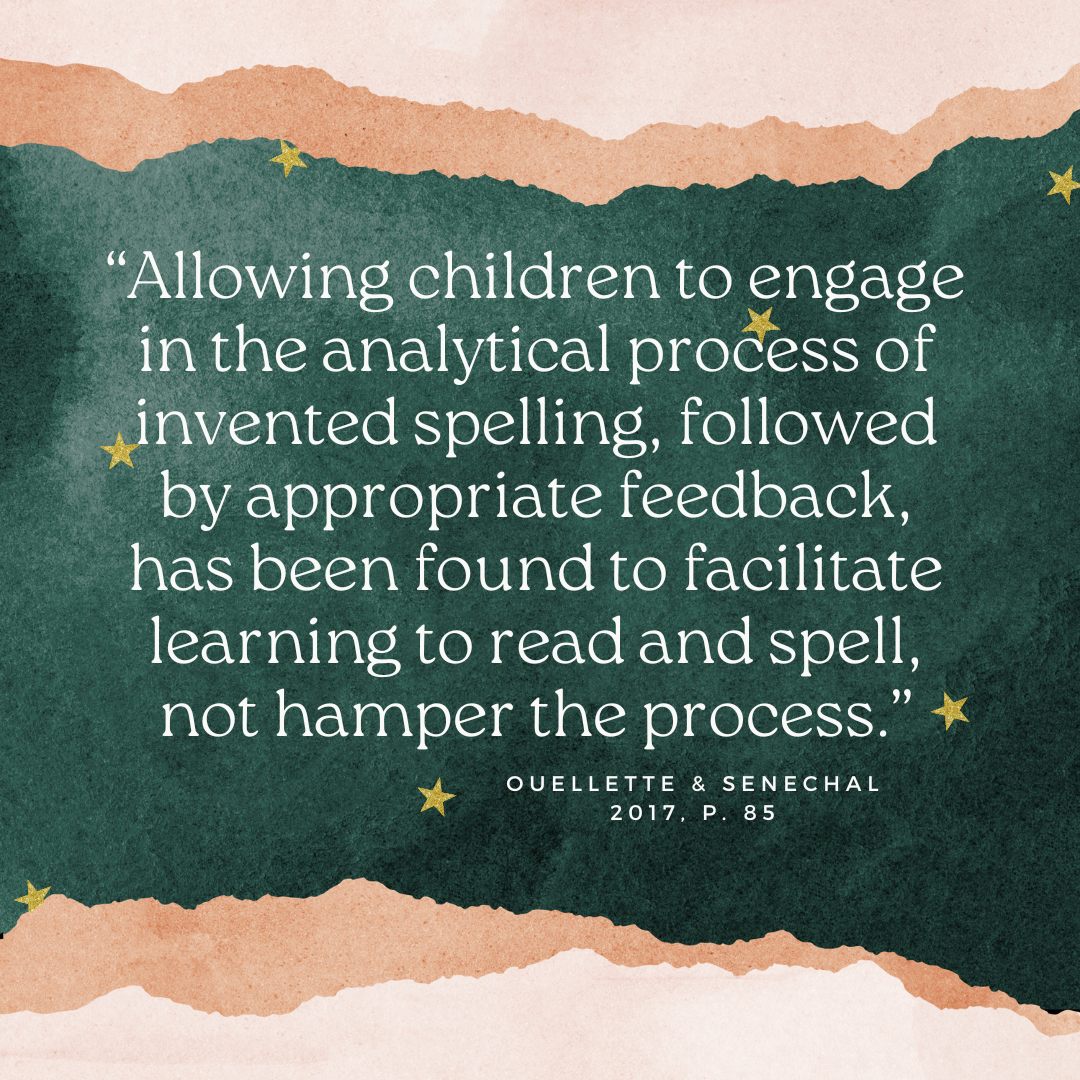
Alternate Viewpoints: Invented spelling is a hot topic. Some educators insist that invented spelling is a barrier, and teachers should correct anything that isn’t conventional spelling. Conversely, other teachers believe that explicitly teaching spelling rules is boring, and will make kids hate writing. They prefer for students to learn writing naturally, through exposure. The problem with these two conflicting views is that neither is supported by research. Invented spelling is a bridge, rather than a barrier, to conventional spelling (Oullette & Senechal, 2017), and correcting every word leads to decreased motivation and confidence for learners (Schrodt, Fitzpatrick, & Elleman, 2020). And while spelling rules may seem boring or tedious to teachers who already know the rules, it’s actually not boring for kids. “The brain is a natural puzzle solver and releases endorphins when we solve a problem,” so teaching kids the tools they need to unlock words can be an exciting and engaging activity (Burkins & Yates 2021, p. 74). Research reveals that invented spelling is a critical step in learning to read and write. Teachers should encourage developmentally appropriate invented spelling in purposeful writing and provide appropriate feedback as students learn and grow.
Go Deeper:
- Brain Words: How the Science of Reading Informs Teaching by J. Richard Gentry and Gene P. Ouellette
- Dive into the five phases of spelling development on this episode of the Triple R Teaching Podcast, where Anna Geiger interviews Richard Gentry.
- I Used to Spell Words For Kids by Beth Moore for the Two Writing Teachers Blog
- Building Word Superheroes by Deb Frazier for the Two Writing Teachers Blog
- Why Invented Spelling Matters by Stacey Shubitz for the We Are Teachers Blog

This is a giveaway of How to Become a Better Writing Teacher by Carl Anderson and Matt Glover, donated by Heinemann. To enter the giveaway, readers must leave a comment on any BUILD YOUR EXPERTISE BLOG SERIES POST by Sun., 2/18 at 12:00 PM EST. The winner will be chosen randomly and announced on February 19. The winner must provide their mailing address within five days, or a new winner will be chosen. TWT readers from around the globe are welcome to enter this contest!
References:
Burkins, J., & Yates, K. (2021). Shifting the balance: 6 ways to bring the science of reading into the balanced literacy classroom. Stenhouse Publishers.
Gentry, J. R., & Oullette, G. P. (2019). Brain words. Stenhouse Publishers.
Gentry, J. R. (1982). An Analysis of Developmental Spelling in “GNYS AT WRK.” The Reading Teacher, 36(2), 192–200.
Grassmeyer, C. (2018). EXPLORING LANGUAGE AND LITERACY The benefits of invented spelling with our youngest learners. Literacy Today, 14–16.
Ouellette, G., & Senechal, M. (2008). Pathways to Literacy: A Study of Invented Spelling and Its Role in Learning to Read. Child Development, 79(4), 899–913.
Ouellette, G., & Senechal, M. (2017). Invented Spelling in Kindergarten as a Predictor of Reading and Spelling in Grade 1: A New Pathway to Literacy, or Just the Same Road, Less Known? Developmental Psychology, 53(1), 77–88.
Schrodt, K., Fitzpatrick, E., & Elleman, A. (2020). Becoming Brave Spellers. The Reading Teacher, 74(2), 208–214.
Discover more from TWO WRITING TEACHERS
Subscribe to get the latest posts sent to your email.


As a teacher of over 20 years in NYC public schools, I am honestly horrified that “invented spelling” is being pushed to our students. The standards keep becoming lowered, and I’ve been seeing a decline in my students even prior to the pandemic as a result. Spelling matters across the board because it is the key to being able to read and to learning. We are setting our students up for failure in college and beyond if we do not count proper spelling earlier rather than later.
LikeLike
Thank you for sharing your opinion. I agree that older students need to know how to spell conventionally. I feel that the research speaks for itself about how invented spelling helps students develop conventional spelling.
LikeLike
This was a great article. As a kindergarten teacher, I think it is so important to celebrate children’s approximations when they write. That belief has guided my teaching and I have seen such growth in writing identity and skill. They become risk takers which really makes it easier to teach and help them grow as readers and writers. Knowing the phases, knowing your students- yes, so much all a part of responsive teaching! Thanks for this article and the research that will be good to share with others.
LikeLike
Thank you! It’s fun to see students grapple with words and grow through invented spelling.
LikeLike
Invented spelling is always a struggle trying to convince primary grade teachers that it’s ok for their kids to use what the know to help them spell. I constantly walk into classrooms & teachers are still spelling every word. This blog post & others in the series have been very helpful in convincing teachers or giving them permission to hand it off to their kids.
LikeLike
With all of the conversations and research surrounding structured literacy, spelling does seem to be under even more scrutiny now. Thank you for this timely article that supports an instructional practice supported by research and that makes sense for kids. While I never want to write on a student’s paper as that does take the ownership away from them, I always struggle with a few students who can’t read back what they wrote and I can’t decipher when I confer with them during writer’s workshop.
LikeLike
I teach gifted kids. They write every day. But often in their perfectionistic tendencies they will ask if a word is spelled right. I usually answer with “How do you think it is spelled?” At what point in their grade level progression do I give them the answer? Ever? I want to be better about this after reading your post, especially with my younger students. Thanks for your suggested responses.
LikeLike
It’s hard when kids are perfectionists. You could even tell them about the research that this strategy helps them improve.
LikeLike
Spelling has always been and will continue to be a topic under the microscope. As a teacher, there is nothing better than witnessing a young child fearlessly putting letters on a page and realizing those letters make words others can read. Invented spelling is such a natural way for children to explore the written word. The logical transition is teaching spelling patterns, not disjointed spelling lists. While this may seem daunting to the student and the teacher, offering continuous support without using a red pen builds confidence. Is there anything more empowering to students?
LikeLike