
Estimated Reading Time: 4 mins, 35 seconds (919 words)
Primary Audience: Classroom Teachers (Grades 3+), Instructional Coaches
It doesn’t seem to matter what grade level you teach or what content area the work is tied to, supporting students in developing research skills as part of the writing process is a challenge.
Why This Matters: We, the teachers who support this process, must know how to clearly teach these skills every step of the way. With so many balls in the air, it’s no wonder research writing often leaves us feeling fatigued and frustrated. We have high expectations for the product students will create, but somewhere between choosing a topic and sitting down to draft, the process can quickly become messy and overwhelming.
The cognitive load of research is a heavy one: students need to identify a topic; generate questions; find resources and locate information within them; evaluate sources’ accuracy and authenticity; and organize the information they find in a way that is both clear and original.
In many classrooms, we anticipate–or respond to–the messiness of research by providing scaffolds for students. However, sometimes the scaffolds we choose take away from students’ autonomy, independence, and even the skills we want them to learn as budding researchers.
A Word of Caution: Overscaffolding begins with good intentions. We provide a set of resources for students to research. We structure graphic organizers with exactly the content we expect students to find. We directly tell students which sources are reliable.
We may even identify the topic we want students to research because it gives us control over all of these variables: locating information, evaluating sources, and organizing notes and ideas.
But at what point have we controlled so many variables that we’ve stripped our unit of the exact learning experiences we want students to have as we teach research skills?
Here’s a Secret: We can provide rich, authentic research experiences for our writers while also scaffolding to control the “messiness.” The answer lies in adjusting the parameters of our expectations–much like a DJ using a soundboard–to tailor our teaching to what students need.
Our control over each variable of research writing (locating information, evaluating sources, and organizing notes and ideas) can range anywhere from tight to flexible to loose. It’s up to us–and the needs our students demonstrate–to determine what is “just right” for the learners in front of us.
Breaking It Down: Each aspect of research writing can be scaffolded across a continuum of support:
| Skill | Tight Control | Flexible Control | Loose Control |
| Finding Information Students locate information from one or more text sources (print or online) to support and grow their knowledge about a topic. | Students work with a limited number of specific texts or websites to gather information. | Students are provided a collection of resources, typically curated by a teacher or team, to find information. This might include resources such as a library database or pre-created Padlet/ document with a variety of sources. | Students conduct open searches in the library and on search engines (i.e. Google). |
| Evaluating Information Students recognize false information or unreliable sources, particularly online. | Students are directly told which sources are reliable (i.e. library books) and unreliable (i.e. banning Wikipedia). | Students are taught to use a checklist of qualities to help them evaluate the resources they locate. | Students are mostly independent in evaluating resources, guided only by reminders to “make sure your sources are reliable and accurate.” |
| Organizing Notes and Ideas Students record and organize information taken from multiple sources to make it their own/prepare to draft. | All students are expected to fill out one common graphic organizer while they research. | Students have been taught over time to use many different types of graphic organizers and have the opportunity to select the type of organizer that will best support the way they want to keep and sort their notes. | Graphic organizers may be available but not required. Students have independence in how they choose to collect and organize information. |
Of Note: There isn’t one right or wrong way to approach the way we scaffold and support students’ learning throughout the research process. Unlike the Goldilocks story, we can’t just select the middle ground (flexible control) for all aspects of research and expect it to go well. Instead, just like the soundboard analogy, we have to find the right mix of approaches to best serve students at that given time in the year.
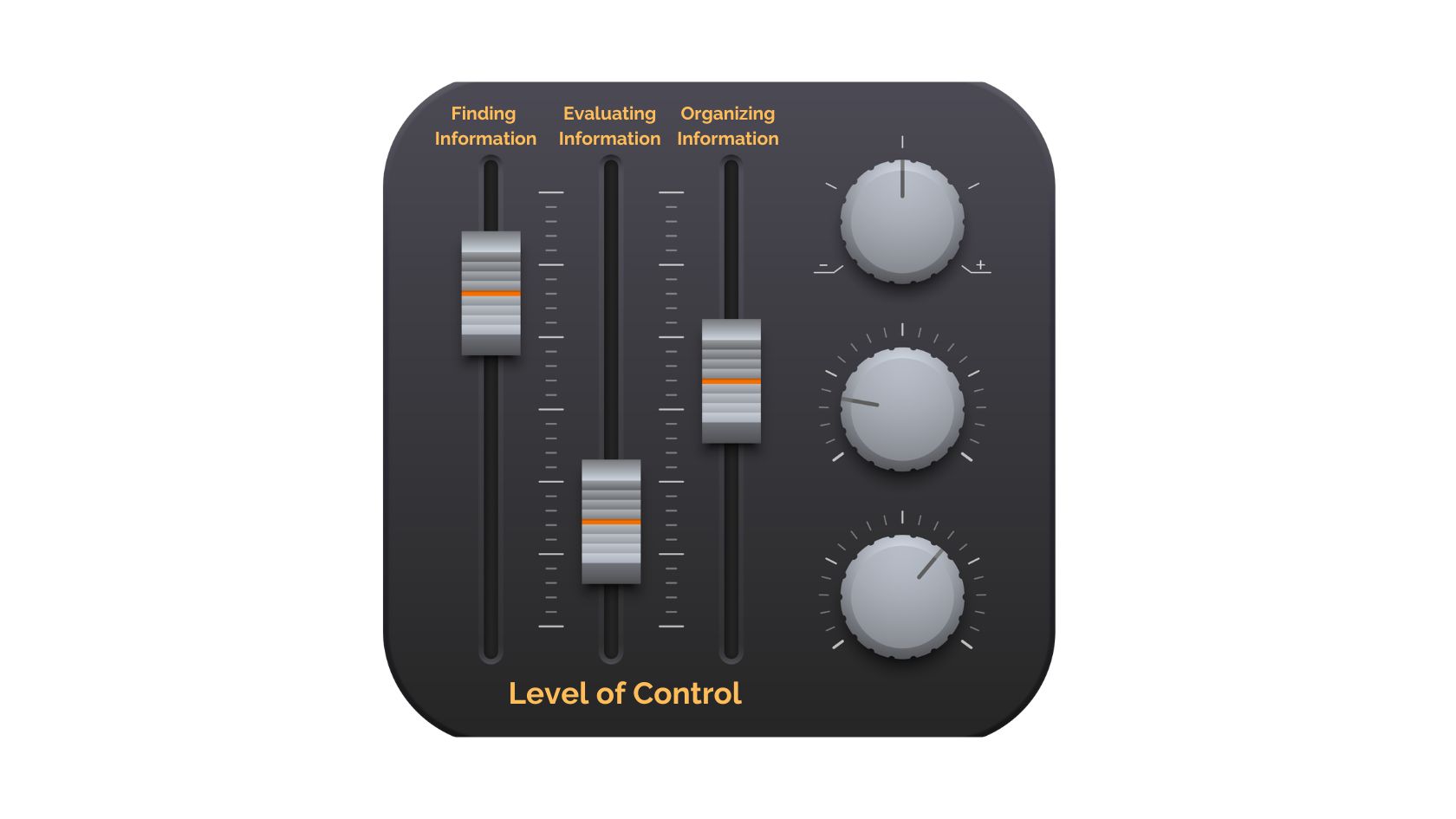
Example in Action: Some of the teachers with whom I work are currently teaching a writing unit in which students must research a problem in society and how they think the government should respond to this issue. Here is one way scaffolding might go:
- Finding Information = Loose control. Students have a wide range of topics and ideas, so teachers are introducing them to strategies for Googling to find information. (Hint: “Loose” control does not equal “no instruction.” It means that these kids have the widest range of resources available to them with teacher support and instruction on how to locate what they are trying to find.)
- Evaluating Sources = Flexible control. As teachers instruct around finding information using a search engine, kids are directly taught how to analyze resources for reliability, accuracy, and authenticity using a step-by-step checklist.
- Organizing Notes and Ideas = Tight control. This is the first time students have researched in this way, so building their capacity for organizing information is critical. Knowing that there are more research opportunities later in the year, teachers are requiring students to use a specific two-column graphic organizer as they collect notes and ideas.
The Bottom Line: Research writing doesn’t have to be stressful for teachers or for students. By being clear and intentional in our scaffolding, we can design learning opportunities that will meet our writers where they are and fully support their growth as researchers.
Discover more from TWO WRITING TEACHERS
Subscribe to get the latest posts sent to your email.


