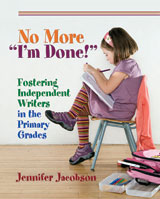
 No More “I’m Done!” Fostering Independent Writers in the Primary Grades is a new book out this month from Jennifer Jacobson. Since I consult with primary grade teachers, as well as upper elementary teachers, I started reading this book as soon as I received the review copy from Stenhouse. Quite frankly, any elementary school teacher who wants to help their students become more independent during Writing Workshop should read this book! While the focus of No More “I’m Done!” is K-2, there are many ideas and lessons that one can take away and apply with third and fourth graders as well.
I had the opportunity to pose several questions to Jacobson after reading her book. While some were things I was wondering about after closing the back cover of the text, others focused on her writing life since she’s also the author of fourteen children’s books. Here are the extremely thoughtful answers Jennifer gave me to the questions I asked.
SAS: Why this book, this topic?
JRJ: I wrote this book to help teachers set up the classroom and create routines that promote student independence. Primary teachers are often eager to try writer’s workshop, but become overwhelmed. So many students! Such an enormous range of abilities! Everyone needing the teacher at the same time! I wanted to be the voice on their shoulders calling out, “You can do this! Truly!”
I absolutely believe that independent engagement is the key to a successful writer’s workshop at any grade level. Unfortunately, we inadvertently train our youngest students to be dependent, rather than independent writers. This book shows how to foster the independence that leads to success.
SAS: How do you suggest teachers go about implementing month-by-month plans? (That is, how do you recommend they craft new lesson topics/plan ahead with the structure you put into place with the month-by-month themes in your book?)
JRJ: There is a year of lessons in the book, which spiral through five traits of writing: quality details, organization, voice, sentence fluency, and word choice. But (and this is essential), they provide room for teachers to include their own lessons based on interest (both theirs and their students) and students’ needs. So you might be teaching students about quality details and in addition to my lessons, you toss in your favorite tried-and-true lesson, a lesson using a brand new mentor text you’ve just fallen in love with, a lesson (based on observations of your students’ writing) that helps your writers understand that the sentence, “I love my mom,” does not have quality details, and a few lessons on conventions (which are woven in regularly throughout the year). I guess you might say that I provide a flexible structure — a resource more than anything.
I also provide a series of mini-lessons to help teachers to get writer’s workshop up and running smoothly.
SAS: You provide teachers with lots of examples of “the kids will do this or tell you something,” but “this would be better,” in your book. I found this effective. Why did you set up so many of the minilessons with this structure?
JRJ: I do believe in giving students comparisons. For example, I ask students to examine one writing sample without voice (my own or by a writer outside our class), and then one with voice so they can recognize – and articulate – the differences between the two. In this way, they develop a clear vision of what makes good writing. It is profoundly effective.
SAS: What are some secrets for making the author’s chair effective at the beginning of the school year when students are reluctant to share?
JRJ: The structure of author’s chair is important. I recommend that only three writers read each day. This guarantees each and every student an alert, engaged audience (very motivating). Also the procedure I use (Pointing and Questioning) helps to create a very supportive community experience. However, if students are still reluctant to share, I will find something that the student is doing well and then ask him or her to co-teach the mini-lesson with me the next day. Young children love being co-teachers (a method I use on a regular basis) and almost never decline. Once they have experienced co-teaching in front of their peers, they bravely sign up for author’s chair.
SAS: You’re very clear about not spelling words for students throughout the book. What kind of spelling program did you use when you were teaching? Why was it effective/how did it help students become independent and better spellers over time?
JRJ: I began the day, as so many teachers do, with a Morning Message in which we focused on phonics and the spelling of frequently used words. We built word walls and memorized word lists. But, I didn’t provide spellings during writer’s workshop. This was my time to confer with students and provide quality writing instruction, and the students’ time to practice what they knew.
Here again, it’s all about helping students to become effective editors of their own work. If we provide spellings, if we correct their mistakes, we train them to look to us. If however, we do things like place a dot on the line in which a frequently-used-word is spelled incorrectly (each student has a copy of our word list on their folder – I circle the words they have mastered during spelling) than the child develops an editor’s eye.
SAS: Chapter Six No More “I’m Done!” contains your answers to some of the most pertinent questions teachers have about certain situations that arise in Writing Workshop. Have there been any questions you’ve received, since the book came out, that you wish you had included a response to? If so, what was the question and how did you answer it?
JRJ: Ah, yes! There are so many times that I’ve thought, “I wish I had thought to include that!” One of the questions I’m frequently asked is, “Do students need to be finished with a piece before coming to a conference or signing up for author’s chair?”
The answer is a resounding, “No!” It’s so valuable to catch a writer midstream, when talking about a piece can bring insight, focus, and direction. However, sometimes young writers will think that if they’ve answered your question during a conference or while in author’s chair, the work has been done! So I’m always careful to say, “How are you going to add that information?”
SAS: How did you make time to write (the books you published) when you were teaching?
JRJ: Truthfully? I wrote for the first ten minutes of every day with my students. That kept me engaged in my work so that when I had time in the evening or on weekends, I could plunge right in. As I’m sure you’ve experienced as a writer, disengaging for an extended period of time often requires Herculean effort to re-engage. Fortunately, I was writing children’s books at the time (one chapter book that will never see a publisher’s desk), and so I had lots of work to use as models during mini-lessons!
Most importantly, writing these ten minutes with my students each day helped create a collegial atmosphere. I realized just how hard, but amazingly rewarding, the writing process can be!
Click here to watch a video podcast of Jacobson. Click here to preview No More “I’m Done!” Fostering Independent Writers in the Primary Grades online.
Discover more from TWO WRITING TEACHERS
Subscribe to get the latest posts sent to your email.


@ Lisa:
Yes, After the End is by Barry Lane. The biggest difference between the two books, Lane’s and Jacobson’s, is that Jacobson focus on primary kids and Lane has more of an upper grade focus. I find both of them are worth the read.
LikeLike
WHAT? A writing book you have never read? I am shocked! 🙂
I think I am going to get this book.
LikeLike
Lisa:
I hate to admit it, but I haven’t read that book. (I think Ruth has.)
Jacobson’s book is great… she often tells you when something is more appropriate for second graders than kids in K.
SAS
LikeLike
Sounds like a great book! How does it compare to “After The End” (I can’t find my book right now but I think Barry lane is the author.) I love that book, but find some of the techniques a little too advanced for my younger students.
LikeLike
Hi Kelly,
I am going to be at the Writing Institute this summer. What about you?
I haven’t viewed the new Units of Study for Reading yet. I can’t wait to do so!
Best,
Stacey
LikeLike
Thank You! Thank You! Stacey your recommendation was spot on. I just handed out 27 copies this week to our K-2 teachers. I’m already getting positive feedback. They are loving the book and how user friendly it is. Open the book to Chapter 6 to be motivated. Love the comments on pgs. 140-41 about spelling. Love, love, and love so many more pages! Stacey, thank you for your committment to writing instruction…I’ll be first in line for your book (and Ruth’s). I’m cleaning and organizing my office because of Ruth’s pictures! Will you be in NYC this year for any of the institutes? Also, have you read any of the books in the Units of Study for Reading?
LikeLike