“The worst thing about new books is that they keep us from reading the old ones.” — Joseph Joubert
When I was at NCTE less than three months I was captivated with the bilingual picture book, Si, Se Puede! / Yes We Can!: Janitor Strike in L.A., written by Diana Cohn and illustrated by Francisco Delgado. It’s a book based on the successful 2000 Janitorial Strike in Los Angeles. It was published in 2002, yet I had never seen or heard of the book. As I flipped through the pages I was impressed with the way Cohn and Delgado’s prose and artwork, respectively, worked together to tell the story.
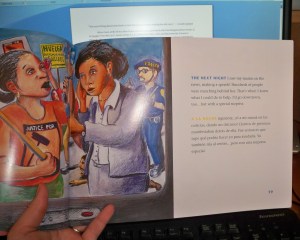
- On this page of Si, Se Puede! / Yes, We Can!: Janitor Strike in L.A., the English text is at the top of the page and the Spanish follows beneath it.
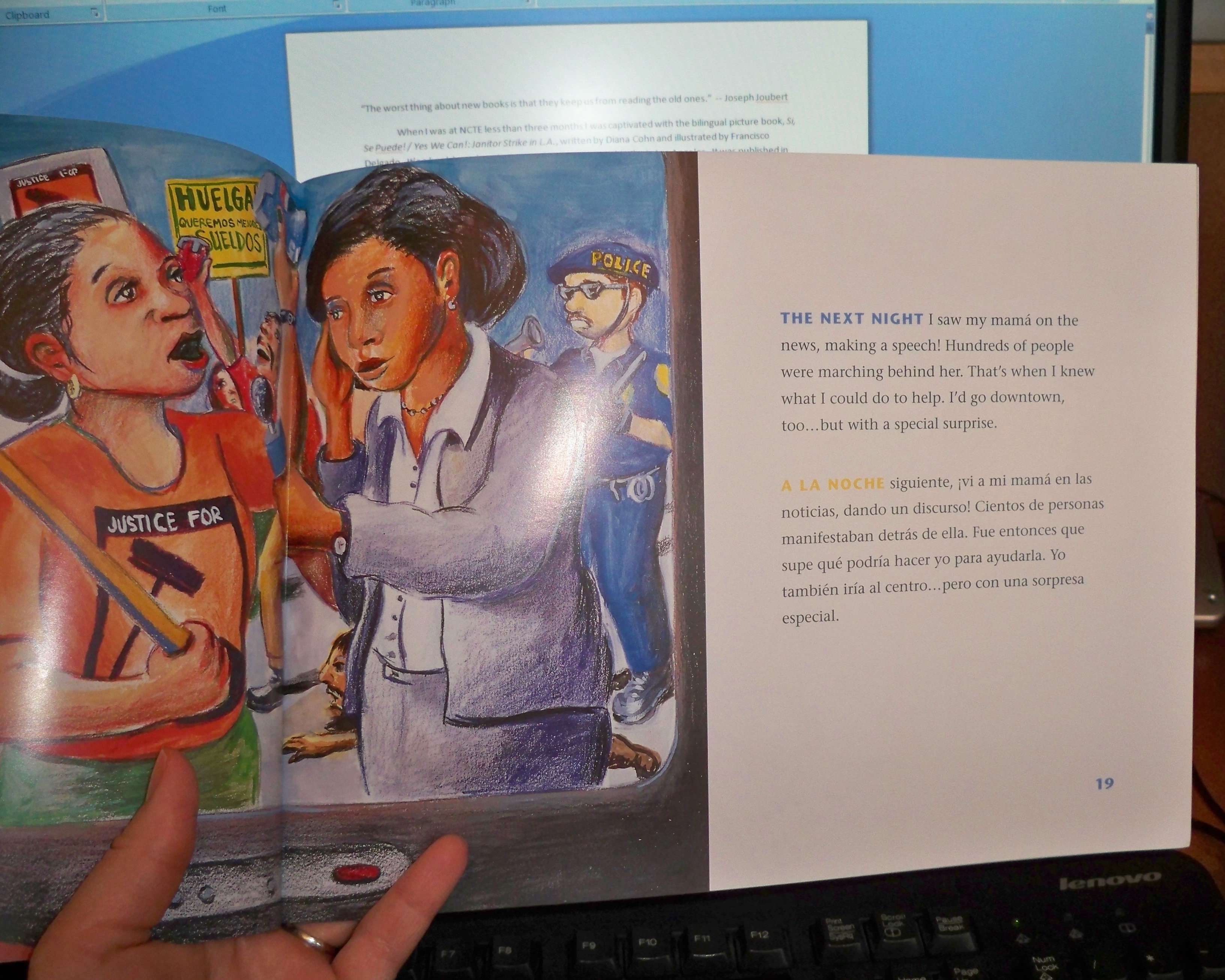
Si, Se Puede! / Yes We Can!: Janitor Strike in L.A., is written with English and Spanish on the same page (see photograph). This made me think beyond the idea of code-switching, which is something I’ve encouraged my former students to do. When I saw this book, as well as other books from Cinco Puntos Press, who provided me with a review copy of Si, Se Puede! / Yes We Can!, I thought this book would be a dynamic mentor for bilingual children hoping to write in two languages. Clearly, a student who is going to take this on as s/he is publishing a piece of writing, needs to be adept with English and their native language. However, for students who thought they had to publish in English-only, books like Si, Se Puede! / Yes We Can! show them that it’s possible to tell one story, in two languages, so that even more people will be able to read it.
Discover more from TWO WRITING TEACHERS
Subscribe to get the latest posts sent to your email.


This was a great post. Even though I work in dual immersion and I have my students working in the same genre in both languages, I had not thought of having them write the same exact piece and translate it to the other language. This could be really fun.
LikeLike
I think it’s important for children in monolingual classrooms to see the value in their ability to use two languages. I try to do this with my students (I teach a fifth-grade self-contained ESL class), but I find it particularly challenging with the languages I don’t know in my classroom (which is most of them, minus Spanish). Even though it’s fifth grade, I’ve taught them how to tell the story with pictures and then, together we try to piece together what it might say – simply – in English, while they write in their language.
This is my first year teaching a class with so many different first languages, and languages I don’t speak, so I’ve had to try things out as I go. I have started doing this for my charts, too, since 6 of my students speak only Chinese and no English. I add Chinese characters (written by a student using a dictionary) for key words to help them use the charts. It’s tricky but I think it has shown them that I respect what they already know and bring to the classroom. They don’t feel like everything they learned before, or their first language, are no longer valuable. It makes me really happy to see other teachers doing this — so thanks for the uplifting post!
LikeLike
Interesting points you made throughout this post. I’ve never really thought about it like that.
LikeLike
First, thank you for your astute post. I really like your website and find it fantastically educational. I like your aptitude of pointing out (by blogging) tiny things that others will not take time to say. I found it by doing a quest on Bing as a consequence I definitely will come back here when I have more time.Thanks
LikeLike