A Conversation between Orit Magia (illustrator) and Mel Rosenberg (author)
“Knock, knock! Hi Orit, it’s Mel, the author. “What extraordinary illustrations! How did you do it?”
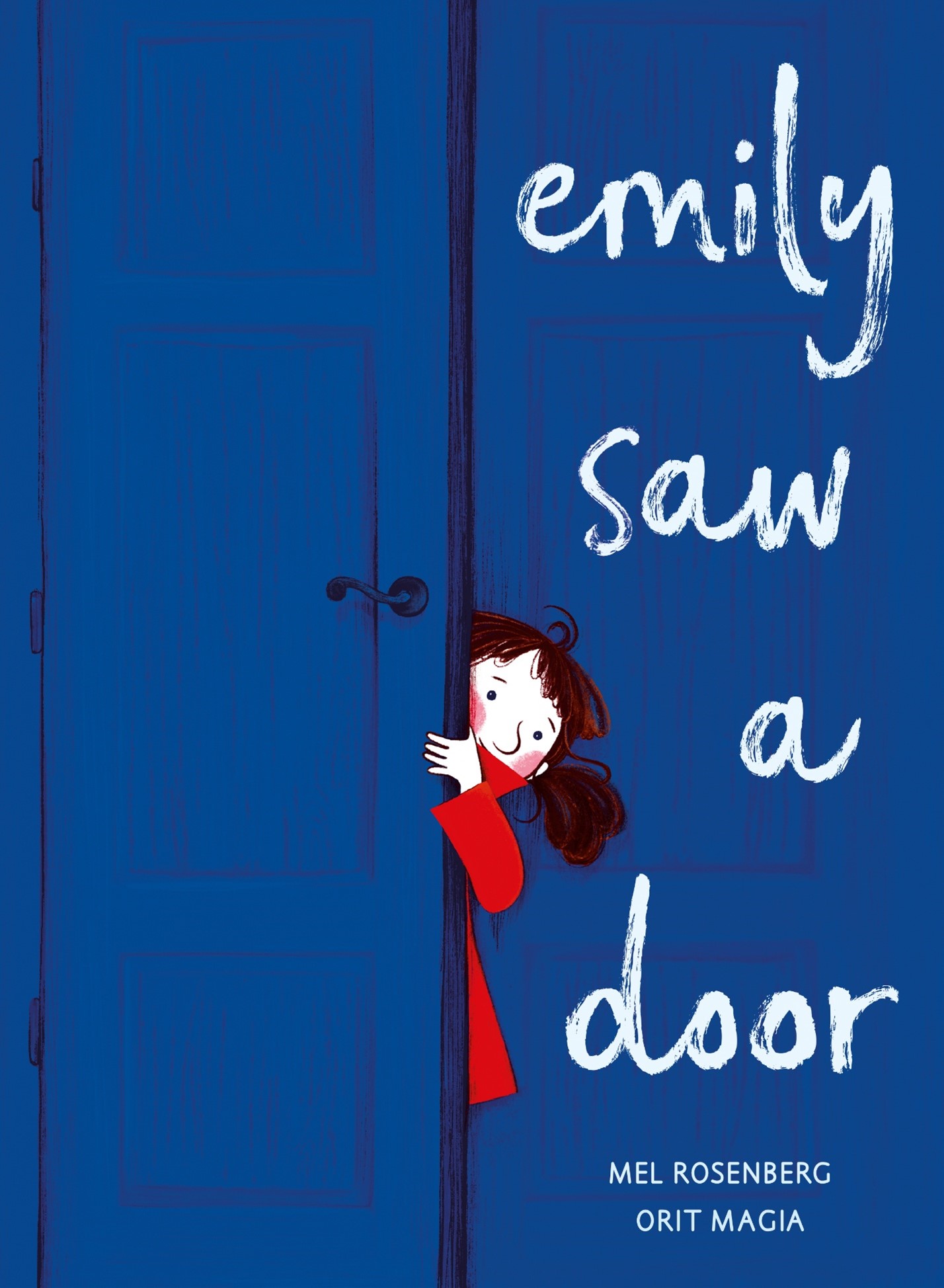
Mel: When Yotam Shwimmer (chief editor of Tal-May) asked you to illustrate my manuscript, “Emily Saw a Door,” I was already familiar with your lovely award-winning artwork, but I had no idea how you would react to this specific story. I admit being both a little nervous -and very excited.
Orit: When I first received the text, I felt the immediate connection. With enough years of experience behind me, I’ve learned that such instant and genuine identification is rare, and certainly worth trusting.
Mel: That’s very kind. What was your process in illustrating it?
Orit: My process felt almost automatic – highly intuitive. It was quite the opposite of the journey Emily goes through in the book. From the first reading, I felt I already knew Emily; it was as if the visual solution had already formed in my mind. From that point, the path to the pencil was very short.
Mel: Yes, when you first showed me sketches of Emily, I was ecstatic. She is such an empathy magnet.
The manuscript went through several key revisions before it reached you. In particular, Yotam asked me to pare it down to less than 350 words. I think he envisioned a story that left a lot of space for the imagination, and your illustrations seem to echo that perfectly.
Orit: From a visual point of view: I immediately felt that this was a story that didn’t need more details, but rather more space. I knew the illustrations had to remain open and minimal, allowing young readers to step into the gaps between the text and the images, evoking their own interpretations and emotions.
Mel: Who is Emily to you? And how did that perception affect the artwork?
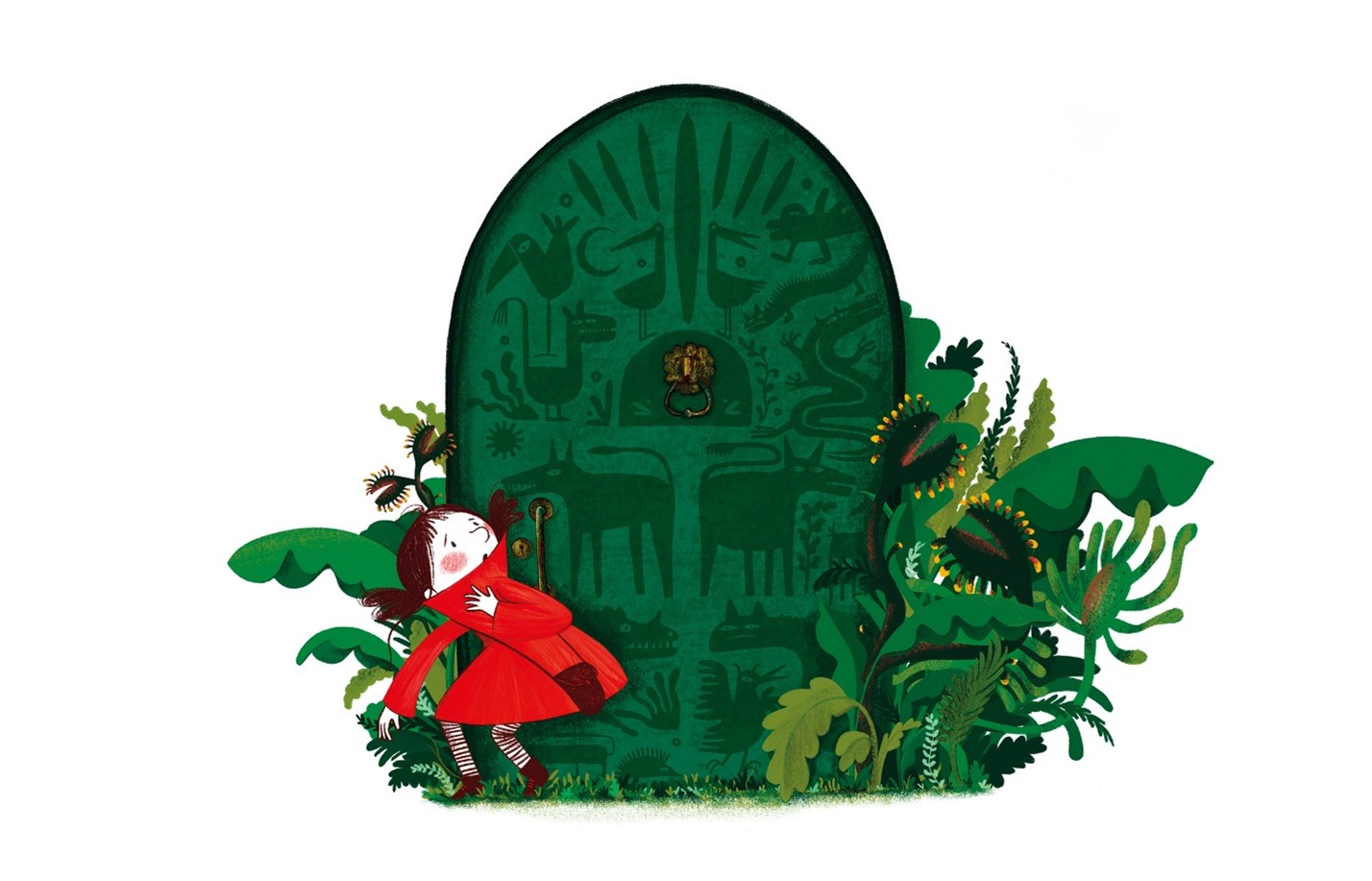
Orit: Emily is an outsider- someone searching for a sense of belonging. I tried to express her feeling of being a stranger through small, deliberate visual choices. I dressed her in a heavy coat unsuited to our warm local climate.
At times, the coat even hides her mouth, suggesting her difficulty in finding her voice. I gave her a small bag- her only possession, her sole belonging. She has a distinctive hairstyle. (when she eventually draws her own door, its shape subtly echoes her hair, hinting at a growing sense of ownership and self-identity).
Mel: I love how you capture Emily’s growing disappointment when door after door turns out to be ‘not right’ for her.
Orit: Each time Emily knocks on a door, she is slightly different. The inner process she undergoes is reflected in her body language- in small details.
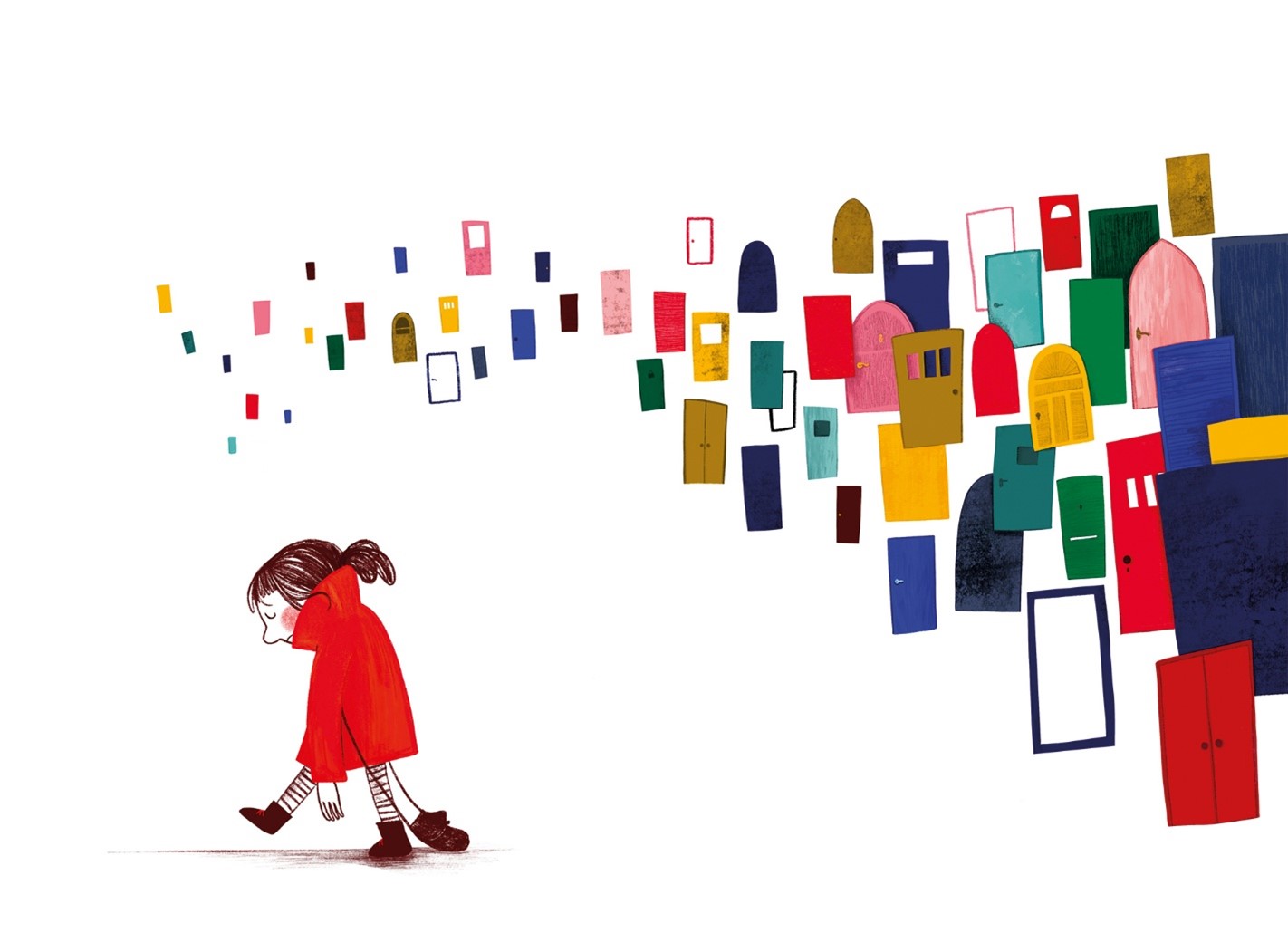
Mel: I wondered how you were going to portray the goings-on behind each and every door. In the end, you didn’t. I love that choice.
Orit: The doors themselves were designed to express the personality or presence that “speaks” to Emily from behind them. I could have shown other characters or built entire environments around each door, but I chose the minimum necessary.
Each door has its own distinct design and color both to help children remember and retell the story, and to suggest something of the door’s nature.
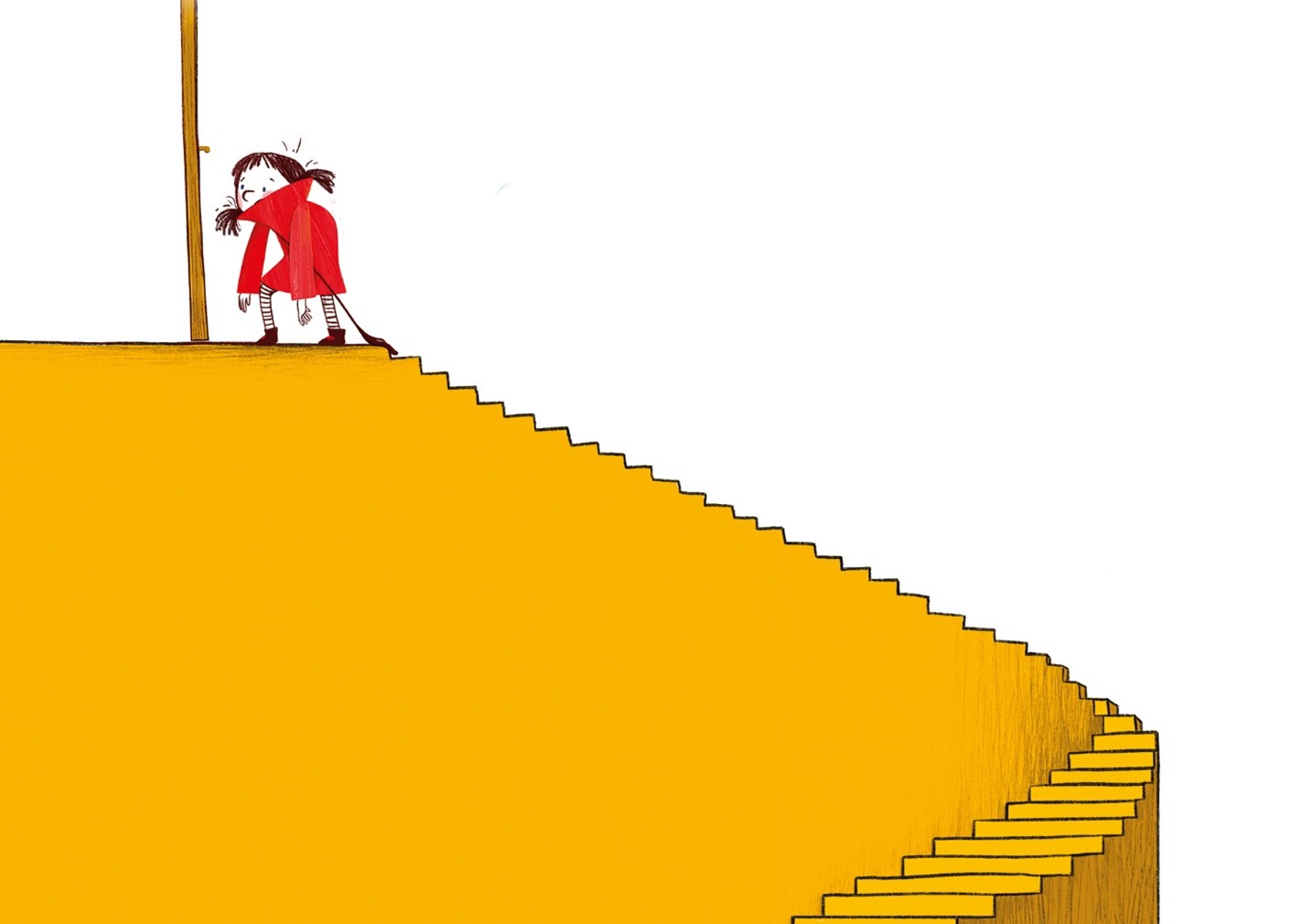
Mel: The whole visual story unfolds from Emily’s viewpoint. We see what she does. This adds so much- precisely by leaving things out.
Orit: Whenever Emily arrives at a new door it’s first presented in a flat, two-dimensional manner. It is as enigmatic for the reader as it is for Emily. Coming from industrial design, I tend to think of books as three-dimensional objects. Only when a page is turned do we discover the truth- at the exact moment she does. That way, the readers’ emotional journey unfolds in sync with Emily’s. I believe this deepens the impact and makes the reading experience more vivid.
Mel: I agree. The text is sparse. You could have taken the opposite tack and created rich, lavish illustrations. Instead, you opted for bold colors and white. Lots of white. Emily almost seems to be floating from door to door.
Orit: White plays a central role in the book. It represents emptiness and uncertainty, reflecting Emily’s lack of a stable sense of place. The white background becomes a visual void.
When Emily finally finds her voice, the white is gradually replaced by her own colorful painting spreading across the pages.
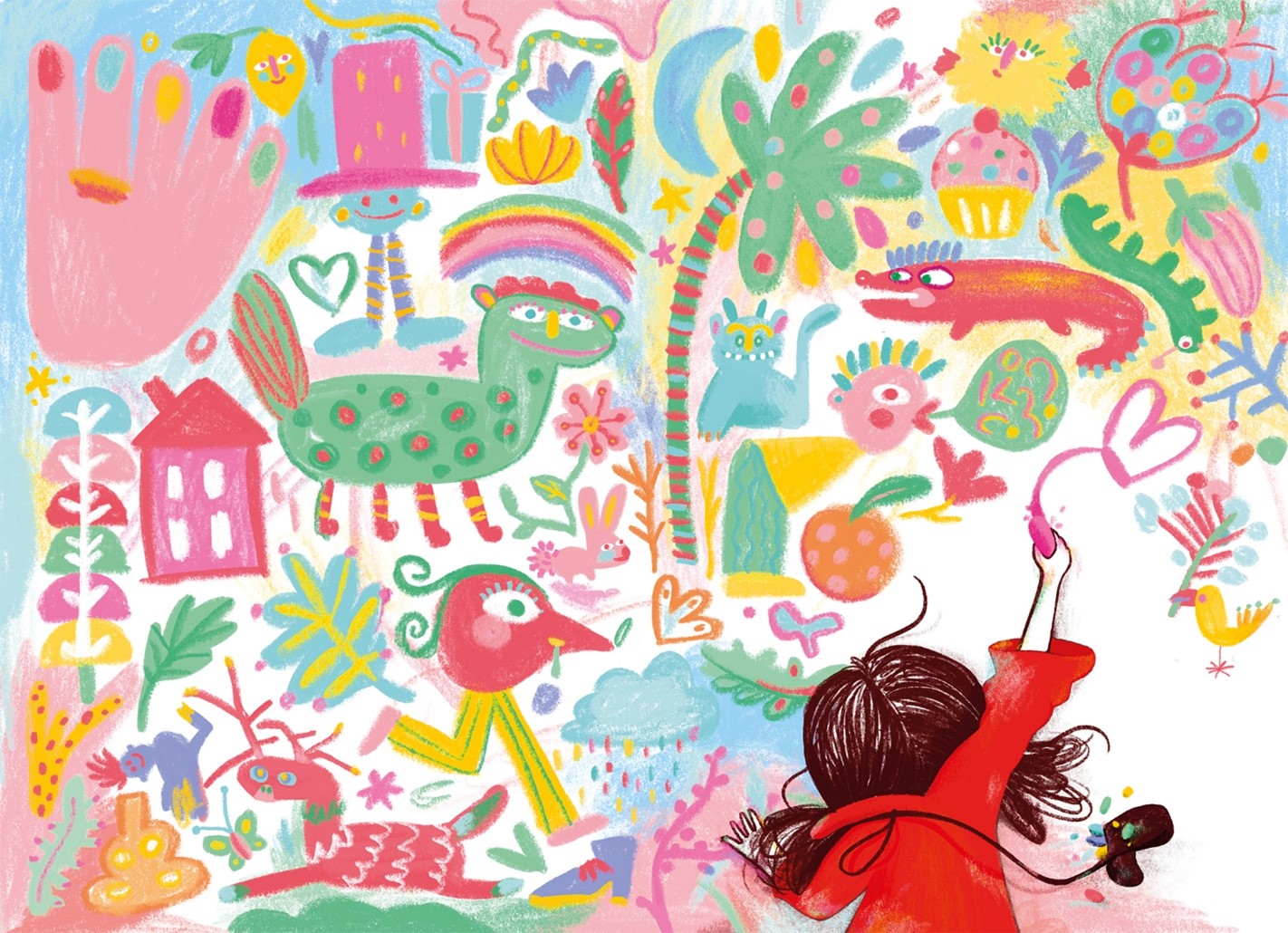
Mel: Yes! That gorgeous double-spread of Emily stretching and creating her own world is my favorite illustration in the whole book. And it was completely your idea- I’m so delighted you were inspired to do it!
Orit: I truly believe you were the perfect person to write this story. Shall we do it again someday?
Mel: Someday soon!

Mel Rosenberg is a Canadian-born author, scientist and inventor. He hosts the Children’s Literature channel of the New Books Network. Emily Saw a Door is his first North American picture book release. He is represented by Liza Royce Associates.

Orit Magia is an acclaimed children’s books author and illustrator, as well as an industrial designer and co-owner of SHULAB- an international studio for design. She applies her multiple talents to visual storytelling, her works are praised for their masterful use of color and movement, as well as their minimalist expression in both words and images.
GIVEAWAY INFORMATION: You can win a 20-minute virtual author visit with Mel Rosenberg, and a copy of Emily Saw a Door by Orit Magia and Mel Rosenberg, donated by Penguin Random House. To enter the giveaway, leave a comment about this post by Wed., May 13, at 6:00 p.m. EDT. The winner will be randomly selected by Stacey Shubitz and announced at the bottom of the preview post by Monday, May 18. You must have a U.S. mailing address and provide a valid e-mail address when you post your comment. If you win, Stacey will email you for your mailing address. She will choose a new winner if you do not respond with your mailing address within five days.
Discover more from TWO WRITING TEACHERS
Subscribe to get the latest posts sent to your email.


So, I saw this book in a local bookstore the other day and fell in love with Emily, the “empathy magnet.” Much of my reading and book buying these days is with/for my young grandchildren who are all working through the process of living in a complex world where the emotional challenges are enormous. Some of my grands might be characterized as somewhat reluctant risk takers, or at least approach new/unfamiliar doors as if they were “flat.” I purchased the book and then found this TWT post and smiled big time! I cannot wait to share this book and talk about Emily and her feelings. Thank you, sincerely.
Anita
LikeLike
I am going to have to find this book now! You’ve given such a tantalizing glimpse that now I need to know the whole story. I want to know about the doors Emily knocks on and study the details in the illustrations that I probably wouldn’t have noticed if I hadn’t read this piece. (The insight that the door Emily draws mimics the shape of her hair is so fascinating. It makes me wonder what other subtle details I’ve been missing in picture books.) I also loved this line: “allowing young readers to step into the gaps between the text and the images, evoking their own interpretations and emotions.” I often encourage my students to add more details. I appreciate the nudge to consider when their stories DON’T need more details. Thank you!
LikeLike
The term “empathy magnet” caught my attention, as did your conversation.
LikeLike
I love the messages of empathy and inclusion that you both created in this lovely book. It reminds me of my childhood, and I think it will resonate with students of all ages. I also like how it can lend itself to teaching theme, inference, and a variety of SEL strategies. I enjoyed reading this chat very much!
LikeLike
Oh, this was so lovely to see the conversation between with author and illustrator. How warm and enlightening to learn about Emily’s story through them both. They make me want to get a copy!
LikeLike