
Estimated Reading Time: 3 minutes (650 words)
Target Audience: Classroom Teachers, Instructional Coaches, Administrators, Interventionists
The world of education is full of vocabulary, terms, and acronyms, as well as systems and structures. Because this world shapes a school’s daily life, it’s easy to forget how challenging it could be for someone to enter and understand; but that’s exactly what many caregivers must do when a child receives an IEP and enters the special education system.
Stacey Shubitz’s most recent book, Make the School System Work for Your Child With Disabilities: Empowering Kids for the Future (Guilford Press, 2026), is a brilliant compilation of exactly what the title suggests; she leads with how the process may begin, and then, with compassion and wisdom, walks readers through what could follow.
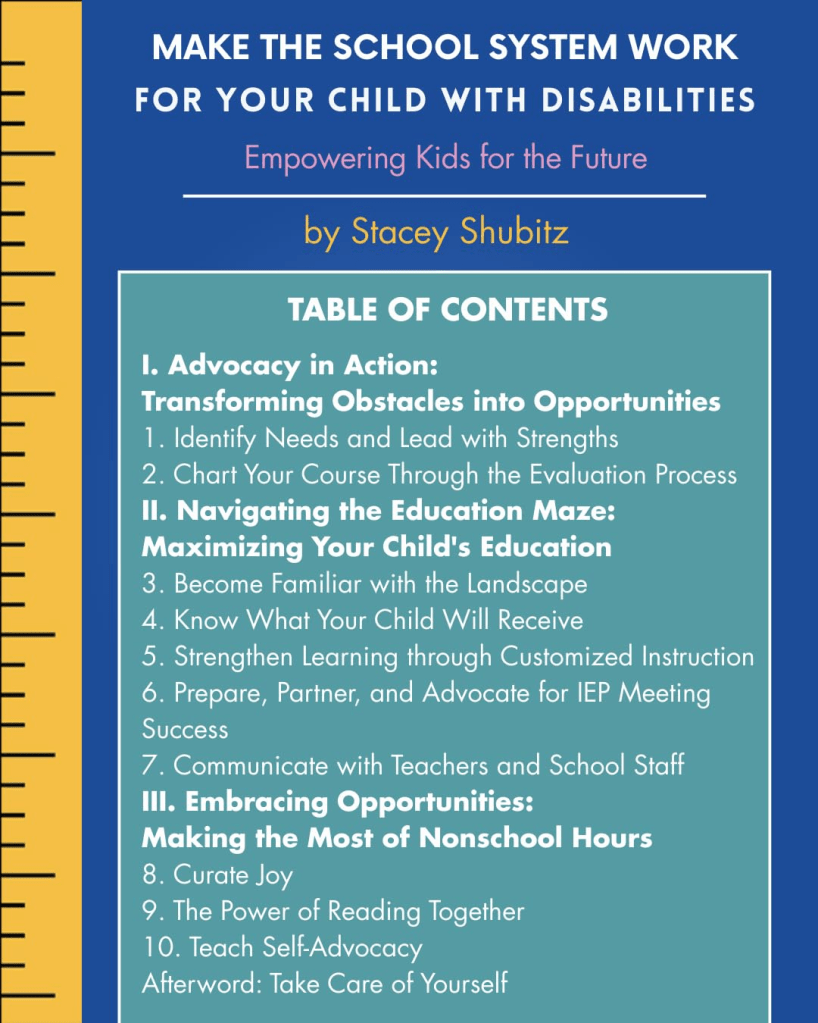
The table of contents, pictured below, provides the trajectory of the book. Studying the chapter flow, you might pick up on Stacey’s deep commitment to asset-based approaches, positive collaborations, and empowering preparation. You might also notice the emphasis on celebrations and joy. In every chapter, she has tips for cultivating joy and taking care of ourselves.
And it’s so much more than that.
In many ways, the title of this book is evocative rather than exact. While it suggests that it’s a resource for caregivers, this book is a goldmine of information for both caregivers and educators. Yes, it’s important for caregivers to learn, know, and understand language and acronyms; processes and frameworks; the components of an IEP; and the differences between 504’s and IEP’s, accommodations and modifications, and various models of service. However, many classroom teachers receive minimal training and coursework about the systems and structures that support and serve students with disabilities. Stacey’s book empowers caregivers, and it also strengthens educators’ understanding of strength-based approaches, language that supports students, strategies to build collaborative partnerships, and resources that mirror and celebrate students.
As an example, one of Stacey’s chapters addresses how caregivers should prepare for IEP meetings. For a caregiver, this chapter is critically important, but it could also provide a checklist for what educators should provide for parents. How collaborative it would be to provide– ahead of time– an IEP glossary, a checklist of what to bring to a meeting, a parent vision statement, the flow of a meeting, and an annotated copy of procedural safeguards! If you’re a caregiver reading this book, you’ll find possible questions to ask, as well as supportive templates for communicating with educators. And, if you’re an educator reading this book, you could be inspired to create a welcoming resource that exemplifies a collaborative partnership between school and home, ultimately benefiting everyone– especially the child.
In addition to caregivers of children with disabilities, there are secondary and tertiary audiences who will benefit from this book. Stacey’s chapter about self-agency offers language, templates, checklists and more to shift the responsibility of communication from adult to student. I guarantee that the language she provides will empower many, most, and maybe all students in classrooms to become stronger participants in their own learning process.
Ultimately, Stacey’s book empowers children with disabilities. As she brilliantly writes, “Not only does passing this torch relieve us of problem solving for our kids all the time, but it also gives our children the gift of self-determination, the power of authority over their current circumstances and future aspirations” (170). Whether you use this book as a caregiver, as an educator wanting to provide resources to partner with caregivers, or as a teacher wanting to increase or review your understanding of specialized instruction, Make the School System Work for Your Child With Disabilities is likely to become a book that you reach for over and over.
Discover more from TWO WRITING TEACHERS
Subscribe to get the latest posts sent to your email.


