Estimated Reading Time: 3 minutes (648 words)
Audience: Teachers and Coaches, Grades K-8
A Backstory
Lately, I’ve been in an exercise rut. The other day, I gave myself a pep talk, filled a water bottle, pulled on workout clothes, and finally made my way downstairs to the treadmill. When I got there, my sneakers were nowhere to be found. Inconvenient? Yes. A perfect excuse not to run? Also yes.
That small obstacle was enough to derail my entire plan. The motivation I had worked so hard to summon disappeared the moment I couldn’t find what I needed.
This is the same thing that happens to our writers when they can’t access the tools they need for success.
The Importance of Writing Centers
When writers have easy access to tools, they stay in the flow of their thinking. They don’t get thrown off course when materials are hard to find. Instead, they can make quick decisions—grabbing a different paper choice, pulling a revision checklist, or rereading a favorite mentor text for craft inspiration. This autonomy matters, especially for young writers who are still developing stamina and confidence.
A thoughtfully designed writing center also reduces cognitive load. Rather than holding everything in their heads—process, structure, craft moves, conventions, and more—students can rely on tools to support them. A writing cycle chart, a mentor text, or a demonstration piece that’s readily available can make the difference between feeling paralyzed and feeling empowered.
Writing centers have long been a staple of writing workshop communities. Traditionally, they include paper choices, revision tools, mentor texts, a variety of pens, dictionaries, and other supplies writers need to move their work forward. But at their best, writing centers are more than a supply station. They send a clear message to students: Everything you need to be a writer lives here.
Perhaps most importantly, writing centers normalize the messiness of writing. They make revision visible. They say, Writers don’t just draft once and move on—they revisit, rethink, and refine. And they do so not from memory alone, but with carefully crafted supports.
A Push for Digital Writing Centers
While I still prefer pen and paper for developing writers, I can’t deny that classrooms are evolving. Many students are drafting digitally, collaborating online, and publishing in multimodal ways. Along the way, we need to ensure they have access to digital writing centers, too.
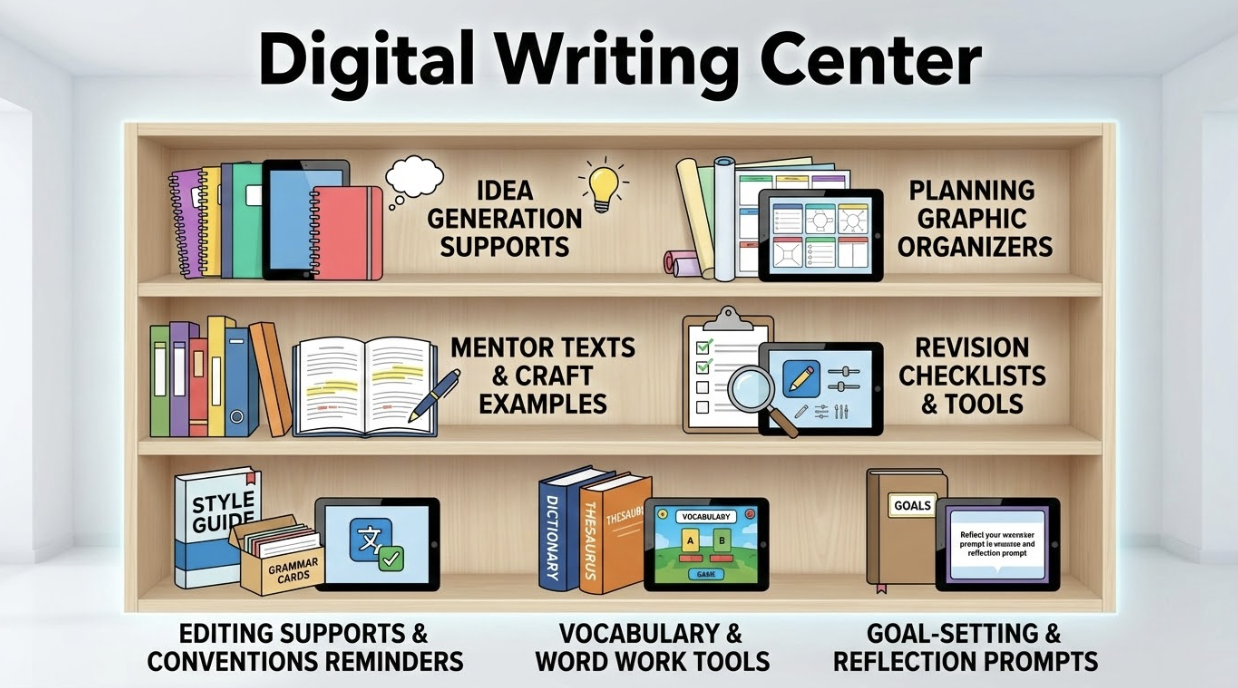
A digital writing center mirrors the purpose of a physical one—it houses everything a writer needs, but in an online space. This might live in Google Slides, a Padlet, or another shared platform. Inside, students can access tools that help them feel confident and successful in every phase of the writing process.
What to Include in a Digital Writing Center:
- Paper choice: Booklets, stationery, graphic organizers, sticky notes, and different line formats—shared as PDFs, Google Slides, or templates
- Revision tools: Checklists, demonstration texts, annotated examples, and short videos modeling revision strategies
- Mentor texts: Books, excerpts, student samples, or shared writing pieces
- Reference tools: Links to dictionaries, spelling charts, word banks, and genre-specific vocabulary supports
Digital writing centers are especially powerful because they’re always available. Students can access them during independent writing time, small group work, or at home. They also make differentiation easier, allowing teachers to add genre-specific tools, targeted supports, or extension options without changing the physical space.
The Bottom Line
Whether physical, digital, or a blend of both, writing centers are about creating space—space for independence, choice, and authentic writing behaviors. They shift the classroom from a place where teachers give writers what they need to one where writers seek what they need.
When students know where to go for support, they don’t wait to be rescued. They work with greater agency and engagement.
And that’s the real goal of any writing center: not just organizing supplies, but cultivating writers who know how to use them.
Discover more from TWO WRITING TEACHERS
Subscribe to get the latest posts sent to your email.


I love this! Even if students are still doing it all on paper, this idea of digital writing centers can bridge the work done at school and at home. Brilliant!
My favorite part:
Perhaps most importantly, writing centers normalize the messiness of writing. They make revision visible. They say, Writers don’t just draft once and move on—they revisit, rethink, and refine. And they do so not from memory alone, but with carefully crafted supports.
LikeLike
To echo what Ana said, normalizing the messiness is important! When I think about my writing process, it’s so far from the linear way some kids are taught to believe writers write.
LikeLike
I totally agree! I actually just posted something on my IG a few days ago about that…I love doing work with teachers to think about their own writing process, which is usually so different from the writing cycle we teach kids.
LikeLiked by 1 person