
Estimated Reading Time: 4 minutes (769 words)
Audience: Teachers and Coaches, Grades 3-8
A Backstory
When I was still a classroom teacher, I remember my third and fourth-graders struggling with handwriting. They formed their letters in the most inefficient ways. Some of their words were illegible, not just to their peers, but to themselves! But what could I do? Handwriting wasn’t something we were supposed to teach. If they didn’t receive explicit handwriting instruction and master it in the lower grades, we just ignored it. Kids were moving towards digital literacy, anyway.
Now, more than ten years later, I still see the same thing when I visit upper-grade classrooms. And now that I have older children of my own, I see it with them. With so much phonics instruction currently happening in primary classrooms, hopefully, younger writers will be more proficient, but what about kids who have already passed those grades?
Why It Matters
Handwriting is not just about writing “neatly.” It does so much more for our writing and reading development, which are both deeply connected.
Handwriting supports fluency, legibility, and writing volume. When kids are struggling to compose letters, it demands all of their efforts, similar to a reader who has to spend all of their time on decoding. As their handwriting becomes more automatic, students can devote more of their cognitive load to spelling, sentence construction, and content. Steve Graham reminds us that if you want your upper-grade students to write more, handwriting plays a crucial role in that process. Read more here.
Handwriting builds letter recognition and reading foundations. According to an article from the Iowa Reading Research Center, explicit handwriting instruction improves both reading and writing outcomes, such as letter-name and sound knowledge, spelling, and word reading. Additionally, “The Importance of Handwriting Experience on the Development of the Literate Brain” teaches us that handwriting, rather than typing, helps learners link visual letter forms to motor production, supporting symbol recognition, and ultimately leading to literate brain development.
What We Can Do: Study Handwriting Through Lenses
While thinking about handwriting, I reached out to my friend, colleague, and thought partner, Melanie Meehan. She co-authored the upcoming book, Foundational Skills for Writing, with Maggie Roberts (Corwin, 2026). Our conversation helped me dissect handwriting in a few distinct ways.
When I used to watch my students write, I would notice how they formed their letters in such a different way from how I was taught. I automatically thought it was “wrong.” But now I’ve learned, that if they are forming their letters the same way every time they write, they’ve cemented that learning. And as long as their writing is legible and fluent, that letter formation is working.
Conversely, we might have students with meticulous handwriting. Their letters might be beautifully formed and “perfect.” Yet their writing might take them way too long. These are the writers we want to push towards fluency.
One way we study writing is by looking through the lenses of structure, development, and language conventions. We can apply the same approach to handwriting, examining it through the lenses of formation, legibility, and fluency. Studying our students’ writing through these lenses can help us identify areas of strength and next steps when it comes to handwriting.
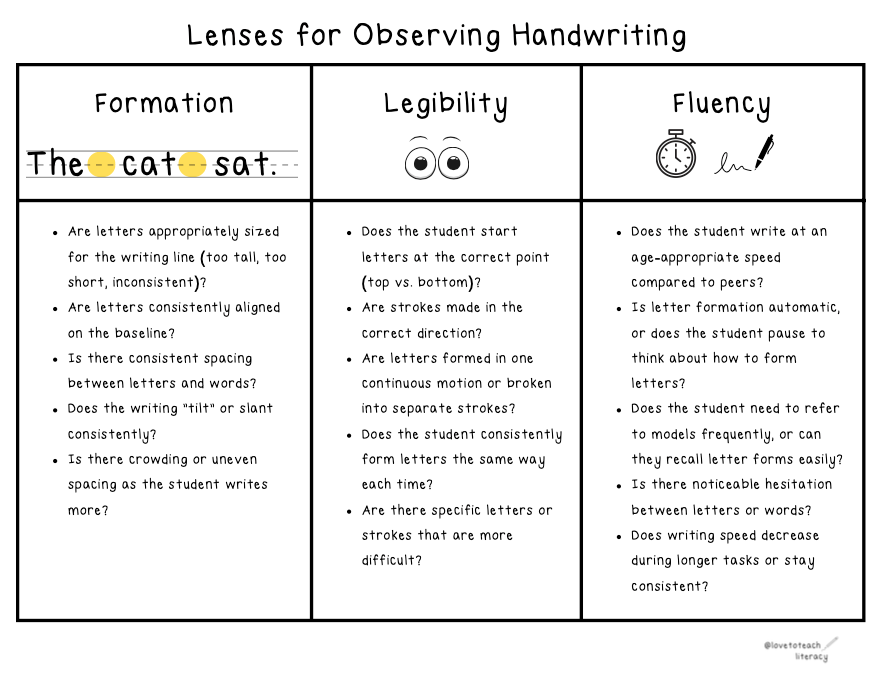
Formation
Observe students as they write. Ask yourself:
- Does the student start letters at the correct point (top vs. bottom)?
- Are strokes made in the correct direction?
- Are letters formed in one continuous motion or broken into separate strokes?
- Does the student consistently form letters the same way each time?
- Are there specific letters or strokes that are more difficult?
Legibility
While studying student work, you might ask yourself:
- Are letters appropriately sized for the writing line (too tall, too short, inconsistent)?
- Are letters consistently aligned on the baseline?
- Is there consistent spacing between letters and words?
- Does the writing “tilt” or slant consistently?
- Is there crowding or uneven spacing as the student writes more?
Fluency
Observe students as they write. Ask yourself:
- Does the student write at an age-appropriate speed compared to peers?
- Is letter formation automatic, or does the student pause to think about how to form letters?
- Does the student need to refer to models frequently, or can they recall letter forms easily?
- Is there noticeable hesitation between letters or words?
- Does writing speed decrease during longer tasks or stay consistent?
*While legibility can be assessed after writing, formation and fluency must be evaluated while writing.
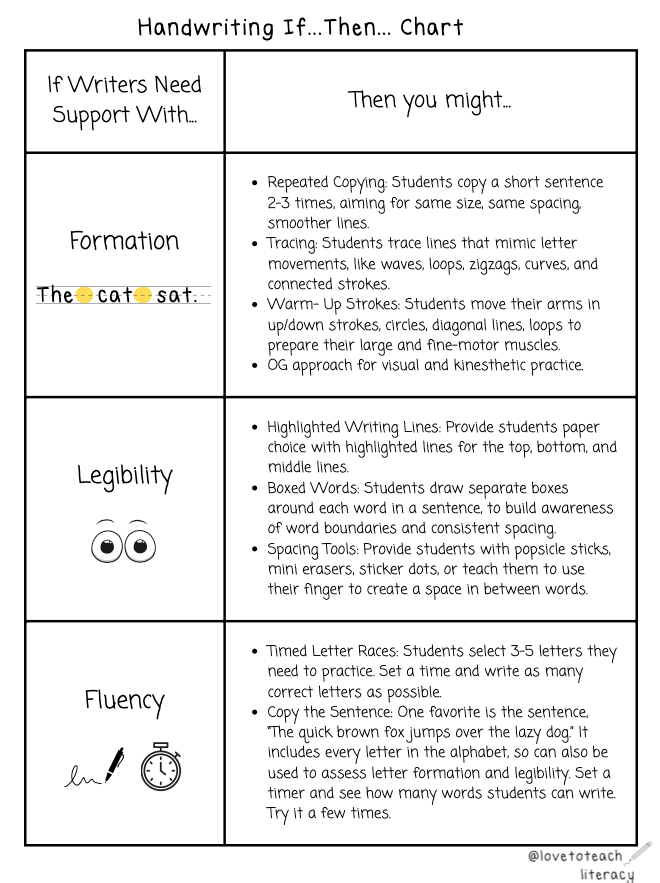
Depending on your observations, letter formation might be cemented already for your writer. The ultimate goal is for the writing to be legible and fluent. Once you’ve targeted the area(s) of need, you can plan your instruction accordingly.
See the “Handwriting If…Then… Chart” below for instructional ideas.
Final Thoughts
With the rise of digital technology, it’s easy to forget about the importance of handwriting. But remember, it’s not just a lost art. It’s the key to unlocking deeper reading and writing capabilities for your students.
Discover more from TWO WRITING TEACHERS
Subscribe to get the latest posts sent to your email.


I agree! Addressing handwriting explicitly in upper grades will make such a difference. The way you focus on legibility, formation, and fluency offers practical clarity for supporting student writers at all levels. Thanks for highlighting these foundational strategies, sharing excellent graphics, and making a strong case for attention to handwriting beyond the early elementary years.
LikeLike