Estimated Reading Time: 3 Minutes 24 Seconds (681 words)
Primary Audience: Instructional Coaches and Classroom Teachers

A Back Story
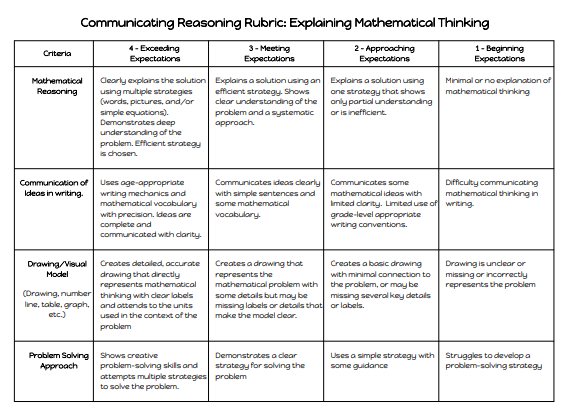
A few months ago, our school’s math coach, Lisa Wolff, led a faculty meeting on the topic of communicating reasoning in math. She defined this as students’ ability to clearly and precisely construct viable arguments to support their own thinking and to critique the reasoning of others. Lisa also shared a rubric she had developed, highlighting key components of this skill: mathematical reasoning, communication of ideas, and the use of drawings or visual representations. At its core, this work is about how effectively students can use the language and symbols of math to bring these elements together in response to a problem.
As I listened to Lisa’s presentation, I found myself genuinely excited. I kept thinking about the connections to writing instruction. Could the strategies we use to teach writing also help students strengthen their mathematical reasoning? I couldn’t let the idea go and decided to explore it further.
Partnering with a First Grade Teacher
I reached out to Jess Marino, a first-grade teacher. “I don’t know the math curriculum that well,” I told her, “but do you think this idea could work?”
Jess was totally on board. She explained that her students already used math journals to practice problem-solving and suggested we start there. We planned to use a shared writing approach to model how students might record their thinking in their journals.
Example in Action
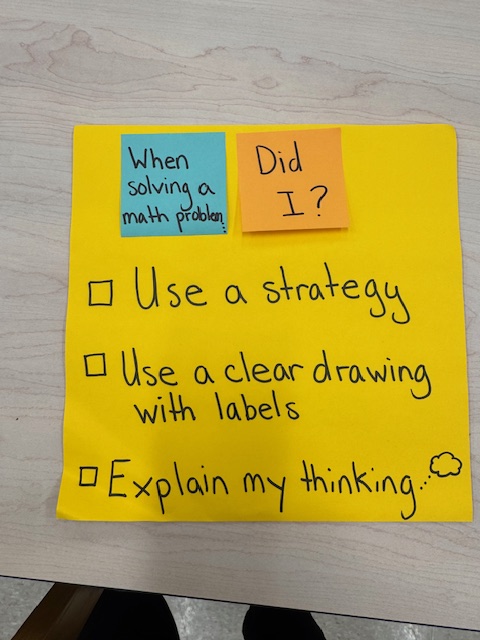
When I joined Jess’s class for the lesson, she began by asking the students why I, the literacy coach, might be interested in their math journals. One student chimed in: “Because journals are for writing math.” The connection between writing and math was already clicking!Jess introduced a kid-friendly checklist to outline the components of a strong math journal entry. Then, she shared the problem:
Spiky had 3 cards and Curly had 57 cards. How many cards did they have in all?
She referred to the anchor chart of strategies the class learned to solve addition problems. Students had a moment to generate possible strategies, just like they would brainstorm ideas during shared writing.
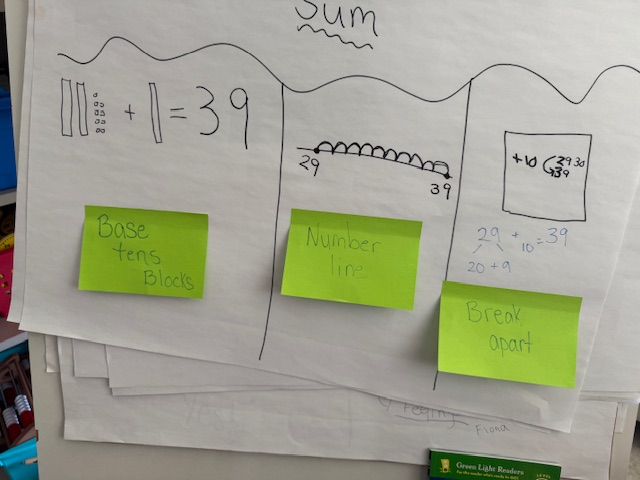
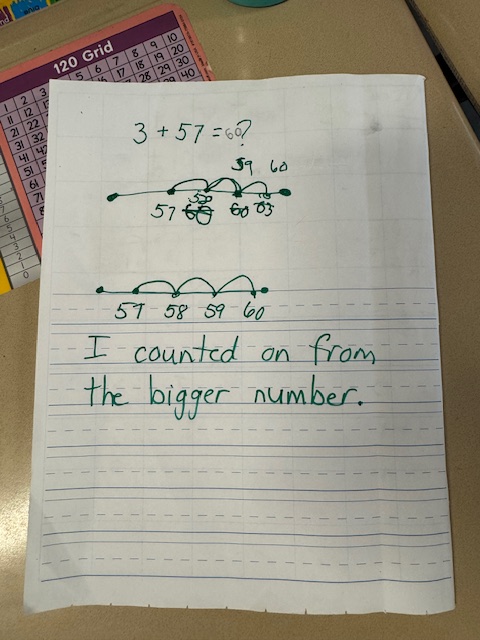
After a quick class discussion, students agreed that counting on from the larger number using a number line was the most efficient strategy. Jess invited a student to demonstrate the strategy under the document camera—similar to how we invite students to “share the pen” during interactive writing.
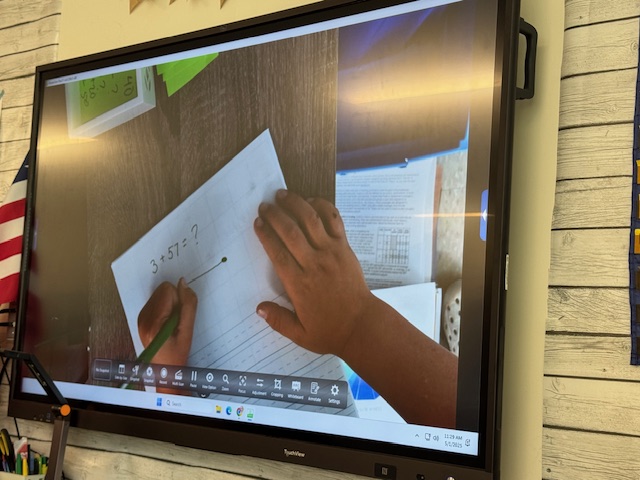
Next came the explanation. This was the perfect opportunity to use familiar writing strategies—like oral rehearsal and sentence starters. As we modeled explaining our thinking, we used transition words like First, Next, and Then. These were also added to a chart of sentence strips to support students during independent work.
Finally, Jess modeled writing the explanation using the students’ ideas. Just like that, the class had a clear example of what a strong math journal entry could look like.
What We Noticed
As students worked independently on a new problem, Jess and I moved around the room, conferring with them. It felt just like conferring during writing workshop. We used the checklist and the shared chart to guide our feedback.
Our feedback and coaching included:
- “I see you chose a strategy and made a clear drawing—now you’re ready to write your explanation.”
- When a student struggled to begin, I cued him with, “First…”—and after a few minutes of writing in the air, he was off and running.
- Some students wrote very short explanations. With a gentle nudge, like, “Can you say more?”, they added more detail (elaboration).
We also coached students to revise as they worked, helping them revisit the strategy chart if they were stuck or encouraging more precise vocabulary—just as we would in writing.
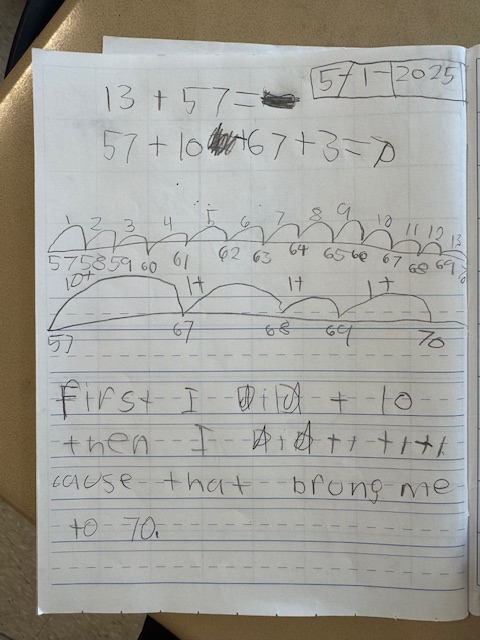
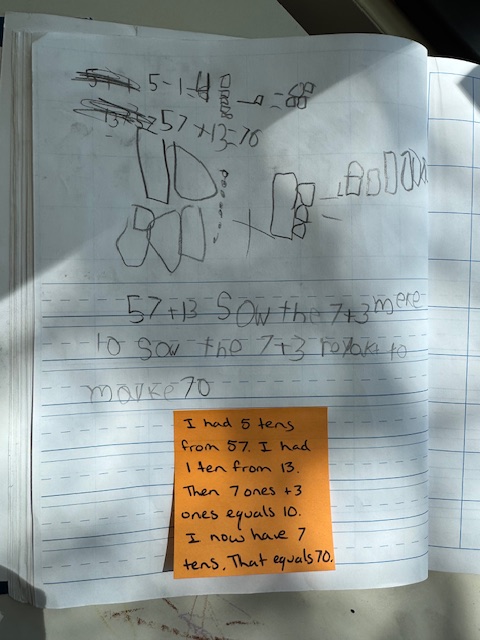
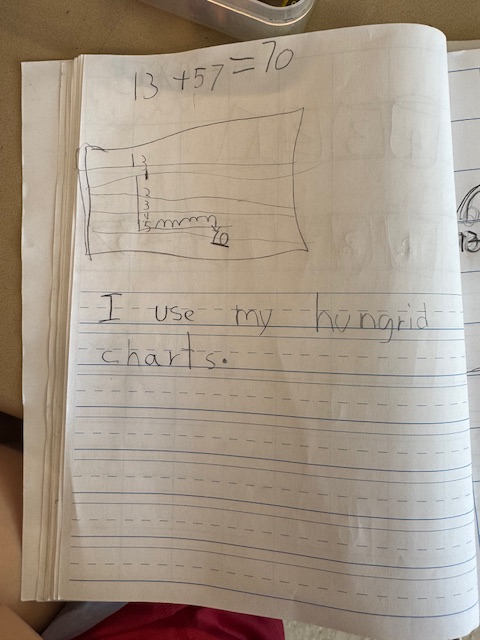
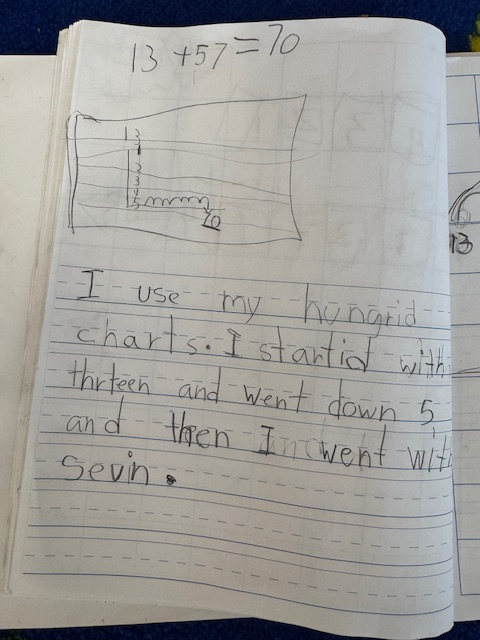
In this sample, you can see how this student had a very simple explanation of their thinking using words. However, when asked, she showed me how she used her hundreds chart to find the sum. I encouraged her to add onto her thinking, which you can see in the second photo.
One Final Thought
This experience reminded me that innovation in teaching often begins with a simple question: What if? By stepping outside our usual content areas and collaborating across disciplines, we open new doors for our students—and ourselves. Exploring the overlap between writing and math helped students deepen their thinking and gave us, as educators, a fresh lens through which to view our instruction. The biggest takeaway? We don’t have to reinvent the wheel. Sometimes, the strategies we already know and trust just need a new context to shine.
Discover more from TWO WRITING TEACHERS
Subscribe to get the latest posts sent to your email.


Brilliant! Our new math program is very language-based, so this is a timely post for me.
LikeLiked by 1 person
This must have been so powerful for the kids (and all of us) to see how the same process can be used in literacy and math.
LikeLiked by 1 person
Thanks for sharing!! I’m forwarding this to my math coach now!
LikeLiked by 1 person
Thanks for sharing!! I’m forwarding this to my math coach now!
LikeLike
Thanks for sharing!! I’m forwarding this to my math coach now!
LikeLiked by 1 person