Estimated reading time: 2 minutes 39 seconds. Contains 533 words.
Target Audiences: Classroom Teachers and Literacy Coaches
Writers from kindergarten to eighth grade bring many behaviors, challenges, and needs to a classroom. No matter the age, I have sat across anxious, frustrated, and reluctant writers, each requiring something tailored to their needs. One strategy I have used with various writing behaviors is contingency mapping. I did not know of this term until reading about this visual tool in the book FLIPP the Switch: Strengthen Executive Function Skills by Sheri Wilkins, PhD, and Carol Burmeister, MA. It is like an “If/Then” chart multiplied!
Catch Up Quick
Back in February, during our blog series about building your expertise, I wrote a post titled “Executive Function’s Role.” This post outlined some commonly observed behaviors and discussed the effects of executive function deficits in detail.
The Context
Contingency mapping is a strategy that can be used with students who exhibit difficulty with executive function and writing workshop environments. For instance, establishing a routine works with many students, but this can sometimes have the opposite effect on students with executive function deficits. We may try breaking a writing piece into manageable parts. Still, this isn’t enough for some writers, and a contingency map can visually help them see the connection between their behavior and a consequence or roadblock toward a positive outcome.

The Details
In the above template, try to imagine different scenarios within your writing workshops. The student who struggles to get started, the other who refuses to work with a partner, the one who rushes to finish something, or maybe even a student who lacks motivation and purpose. Let’s look at potential ways to fill in the template above for a usable contingency map.
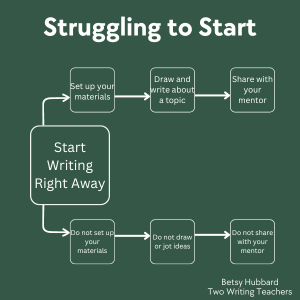
This contingency map assumes a classroom buddy, adult, or mentor student can share in the celebration of a positive outcome. When teaching young writers, I often asked the secretaries, counselors, lunch staff, and custodians to ready themselves for young authors to share their daily writing. This one-on-one attention was a huge motivator for many reluctant writers.
What are some other potential ways to break down a writing behavior to gain a positive move forward? As the template indicates, the momentum must be a reachable step forward. For instance, a desired outcome might be “write X amount of sentences.” The step forward would be based on the student’s success with writing a particular number of sentences and being ready to go further. The nuts and bolts of this contingency map might look like:
- Use Speech to Text Accommodation/Do Not
- Talk/Tell about your topic/Do Not
- Receive Credit/Do Not
This type of contingency map can work for a student seeking a grade or credit for their effort.
On the following day, you might change the contingency map as follows:
- Reread/Do Not
- Edit your punctuation/Do Not
- Receive Credit/Do Not
For a student who is not only reluctant due to poor writing experiences but has also developed a habit of refusal, other resources or staff within your building or school system may need to step in as support. Once a plan is established, choosing that one reachable goal is the best place to start.
One Final Thought
Every step is challenging when working with writers who challenge the routines or structures of the classroom environments we create. Utilizing our colleagues and resources within or outside our classroom can offer hope and success to the most significant challenges.
Discover more from TWO WRITING TEACHERS
Subscribe to get the latest posts sent to your email.


I’m delighted you shared this before Sunday’s pod. Thank you, Betsy!
LikeLike