Estimated Reading Time: 2 minutes 50 seconds, 572 words
Primary Audience: K-2 teachers, instructional coaches

The Context: Nothing is more important at the beginning of a new school year than getting to know your students and helping them get to know each other to build a strong classroom community. One of my favorite ways to do this in the primary grades is to use shared writing to create a “Getting to Know You” class book during the first weeks of school.
How It Works: On the first day of school, I introduce students to our “Getting to Know You” class book. I tell them that the pages are all blank because we are going to write the book together, and each page will be about a different person in our class. We brainstorm things that we would like to learn about each other, and I write them out as sentence frames. Then I invite the class to interview me using the sentence frames. After they have learned all about me, we collaboratively create a paragraph about me and I write it on chart paper in a shared writing style (check out this post Shared Writing 101: A Crash Course in Writing Together by Beth Moore for a detailed description of shared writing). Later, I type the paragraph up and print it out, glue it to the top of the first page in our class book, and then draw a picture of myself on the rest of the page.
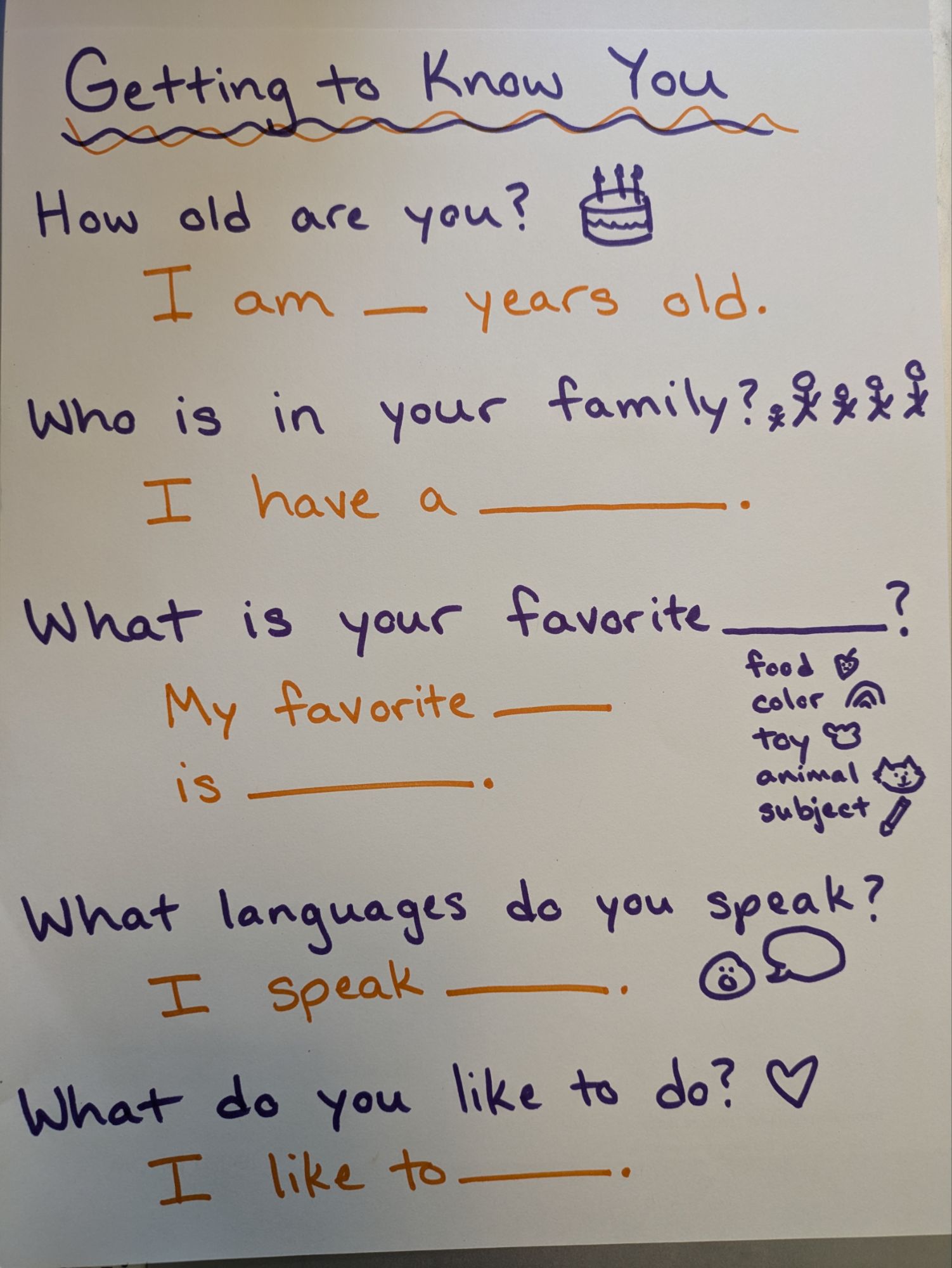

Every day after that there is a “Student of the Day.” Students know their day in advance and are encouraged to bring in photos or have their family email me photos that they would like to share with the class to help us get to know them. We start by reading the paragraph and looking at the portrait of the student (or teacher) from the previous day. Then, after the student of the day shares their photos, the class interviews them using the list of questions/sentence frames for support. Finally, we work together to write a paragraph about that student. Once I have the paragraph typed up, I put it on the next page of our class book, along with the student’s self portrait, so that we can read it together the next day. I also like to add a photograph of each student to their page.

The Impact: By the time we finish our “Getting to Know You” class book, students have learned all about each other, made connections through things they have in common, and discovered what makes them unique. The daily interviews have given students lots of oral language practice and laid the foundation for class discussions, which is especially helpful for multilingual learners.
Daily shared writing sessions have given me the opportunity to model and remind students of a variety of writing skills they might be rusty on after summer, like conventions. Plus, we have a book written by our class that goes into our classroom library for students to read during independent and partner reading time. This sets the stage for students to think of themselves as authors who write for a real audience.
The Bottom Line: Strong classroom community is the goal of all classroom teachers. With just 15-20 minutes a day of interviews and shared writing during the first weeks of school, a “Getting to Know You” class book can help you reach that goal.
*You can order blank big books online, or make your own using 11×17 inch copy paper or 12×18 inch construction paper.
Discover more from TWO WRITING TEACHERS
Subscribe to get the latest posts sent to your email.


Great idea to create a class book and to co-write the paragraphs with the students. It is a wonderful way to showcase a year of writing!
LikeLike
Oh I love this! I have done many versions of this type of community building. I think co-writing the paragraphs with the students is a great idea. It provides a wonderful model and the repetition with help students be able eventually write on their own. The class book will be something the kids will go back to again and again.
LikeLiked by 1 person
Oh I love this idea. I’ve done a lot of different versions of this kind of community building, but I really think writing the paragraphs together will give students a lot of practice writing. It is low stakes and has the repetition that kids need, so that they will eventually be able to do this themselves. The class book makes the writing enduring.
LikeLiked by 1 person
I love this idea for my newcomers’ class! Thank you!
LikeLiked by 1 person
I was teaching a newcomers’ class when I first started doing this project. It’s so great for language development!
LikeLike
what a great idea! Love this. Thanks!
LikeLiked by 1 person
I can not WAIT to do this!
LikeLiked by 1 person