
Estimated reading time: 2 minutes, 57 seconds. Contains 590 words
Audience: Classroom teachers, instructional coaches
The Context
Over and over, I hear teachers bring up the challenges of teaching students to learn, internalize, and transfer sentence structure that leads to writing fluency. I hear about sentence fragments. I hear about run-ons. And I hear about students with little or no demonstration of convention mastery. Sentence expansion has been a technique I’ve used with many students from early elementary grades up through middle school, and it has provided practice opportunities for creating increasingly complex sentences with consistent use of conventions.
A Quick Overview
Sentence expansion involves getting students to start with a simple sentence and then “grow the sentence.” You can decide how to challenge students to grow their sentences. Depending on the instructional focus, they can grow a sentence with an adjective (or two), a prepositional phrase, a dependent clause, or an explanation of sort. You can also provide pictures that inspire sentence writing.
Examples in Action
Starting With a Simple Sentence
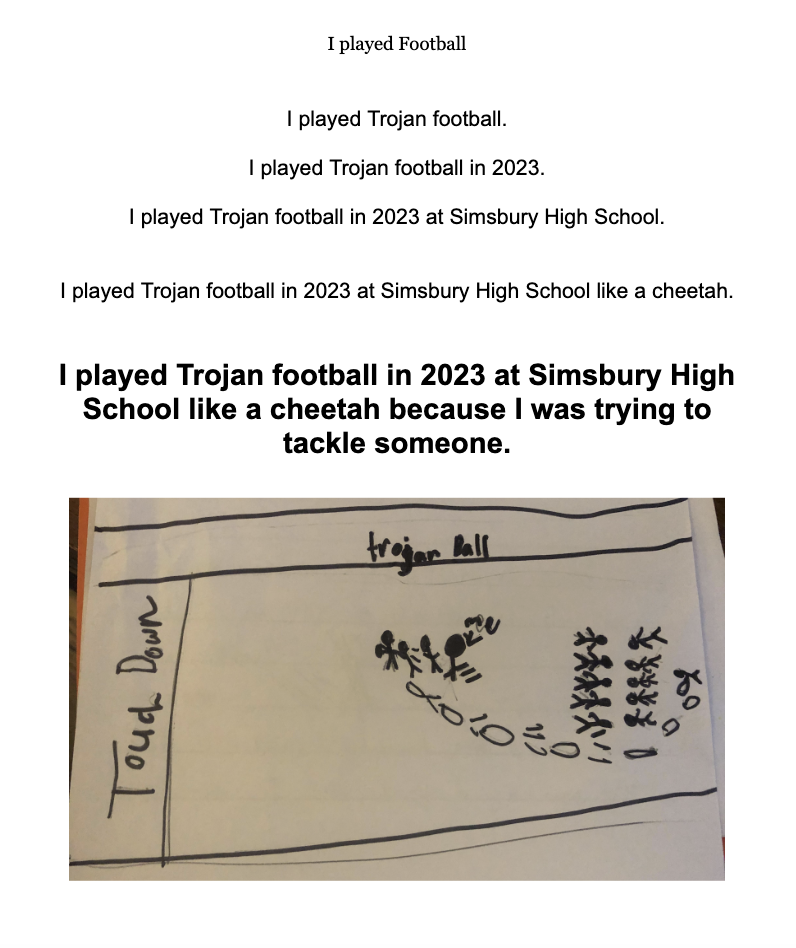
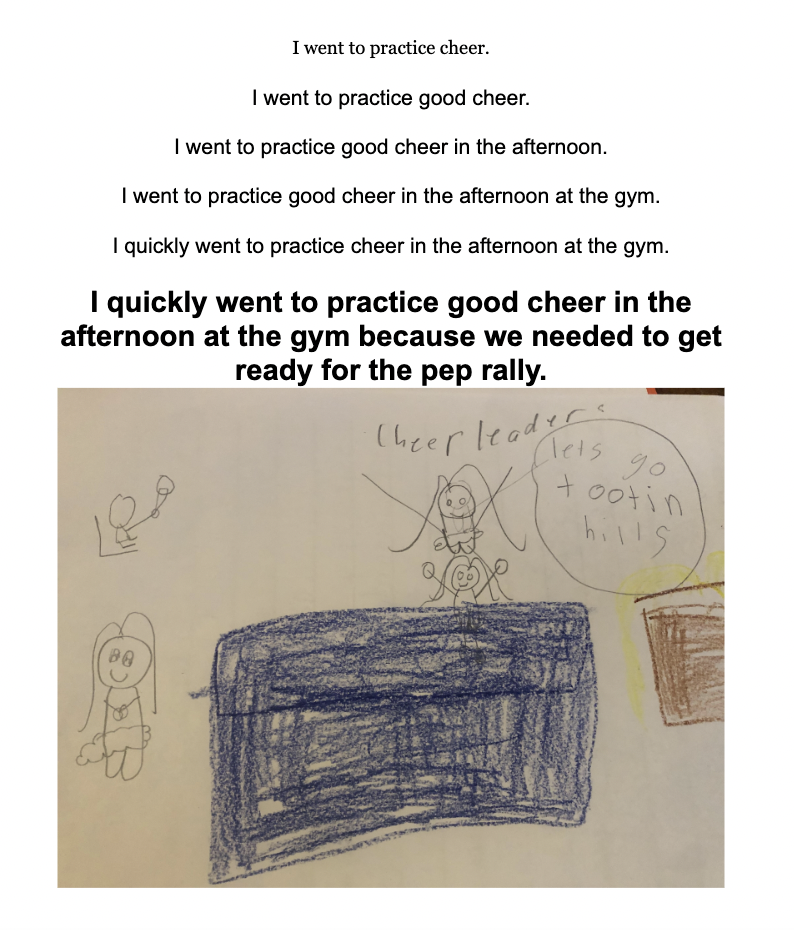
My friend Lisa, a third-grade teacher, challenged students to expand sentences through a series of steps. As you can see from the examples below, students began with a simple sentence, added an adjective, then a prepositional phrase, then an adverb or a phrase that answered the question of how, and finally a clause that addressed the why of the original simple sentence. Students had a fabulous time responding to the questions within their sentence and presenting their finished “sentence product” to their classmates. Even more importantly, many of them have worked to write more varied and complex sentences in their authentic writing, recognizing the many choices they have as writers to tuck extra information into sentences.

Starting With a Picture
Pictures are fabulous springboards for sentence building. I start by providing students with a picture that show someone or something doing something. When I am working individually with a student, I try to make the picture as responsive to events and interests in their lives as I can. When I am working with a larger group of students, I work to appeal to the masses. Regardless of the audience, I lean into a series of questions that their sentence has to answer:
- Who
- What
- Where
Once they are competent and confident at those three questions, then I add in additional questions such as when and why.




Using pictures has the power to remove barriers for some students who struggle to come up with their own ideas, and they provide practice for writing fluency and transcription practice.
How to Fit it In
If I had a magic wand, I’d make more time in a day. Since no one has given me that kind of power yet, I work hard to think about ways to fit a sentence two wherever and whenever I can. Depending on the picture, a sentence can fit into a content area. The cricket above would be a great addition for a lesson on animal traits or adaptations. SEL is another opportune time; who wouldn’t want to write a sentence about meditation and explain its importance? If sentence expansion becomes a routine that students need minimal direction in order to complete, I think there are many spaces and places to weave it in, and the benefits are worth the time.
Final Thoughts
While these routines do not constitute authentic writing, it helps to think of them as the equivalent of warm-up laps or stretching before an athletic game or scales before a musical composition. You can isolate and target specific skills, giving students practice opportunities that make some of the hard parts of writing a little easier. Writing is hard, and any extra energy that writers can give to the hard parts is energy that will help them grow and learn.
Discover more from TWO WRITING TEACHERS
Subscribe to get the latest posts sent to your email.


