Target Audience: Classroom Teachers and Literacy Coaches
Estimated Reading Time: 3 Minutes and 38 Seconds (728 words)
How We Got Here
As our school continues to brainstorm ways to support all students across the school day, our principal has been working hard with our school’s Occupational Therapist, Dr. Kelly Yagud, to think about strengthening areas such as students’ fine motor skills, executive functioning, and emotional regulation. Kelly has shared tools and supports and has been working with grade-level teams. The topic of writing lines and paper choice arose in recent grade-level meetings. This led our OT to do some informal observations across the school, and she learned that kids weren’t always using their writing lines appropriately. In fact, many upper-grade students were using their composition notebooks like blank journals!
Together, Kelly and I decided to start with our first and second-grade teams by taking a closer look at student handwriting, specifically their use of writing lines.
The Details
Each teacher brought writing samples to the meeting. Kelly guided us in determining what to look for to analyze whether students used the paper appropriately. We looked for students whose letters and words “sat” on the writing line versus those whose words floated between lines. We also looked for variations in size. Did students’ tall letters look taller than the short letters? Were hanging letters dipping below the writing line? Teachers were researching and assessing with a new lens.
What teachers realized was that many students were not using their writing lines. After some reflection, we realized that, in recent years, we have systematically focused on letter formation. We have not been teaching kids how to use their writing lines! In that grade-level meeting, we decided on small shifts we could implement immediately. These shifts included:
- Modeling thinking about writing lines when writing in front of students.
- Determine places throughout the school day where we could coach and hold students accountable for using writing lines. We decided that we could reinforce and provide students with feedback during small group work and dictations.
- Using reminding language and visuals to encourage transfer to students’ writing during Writing Workshop

The Impact
Teachers left our meeting empowered and ready to see if they could impact change with a small shift in their instructional practice. One second-grade teacher, in particular, went back to her classroom that day and simply began by naming the letter size, which was tall, small, and hanging. The language gained at the meeting was immediately implemented to feed those who needed it- the children.
Another first-grade teacher, realizing that her class used blank whiteboards for a lot of phonics practice, simply had students draw a writing line for themselves. Immediately, kids were aware of where their letters sat on the line.
A Quick Side Story
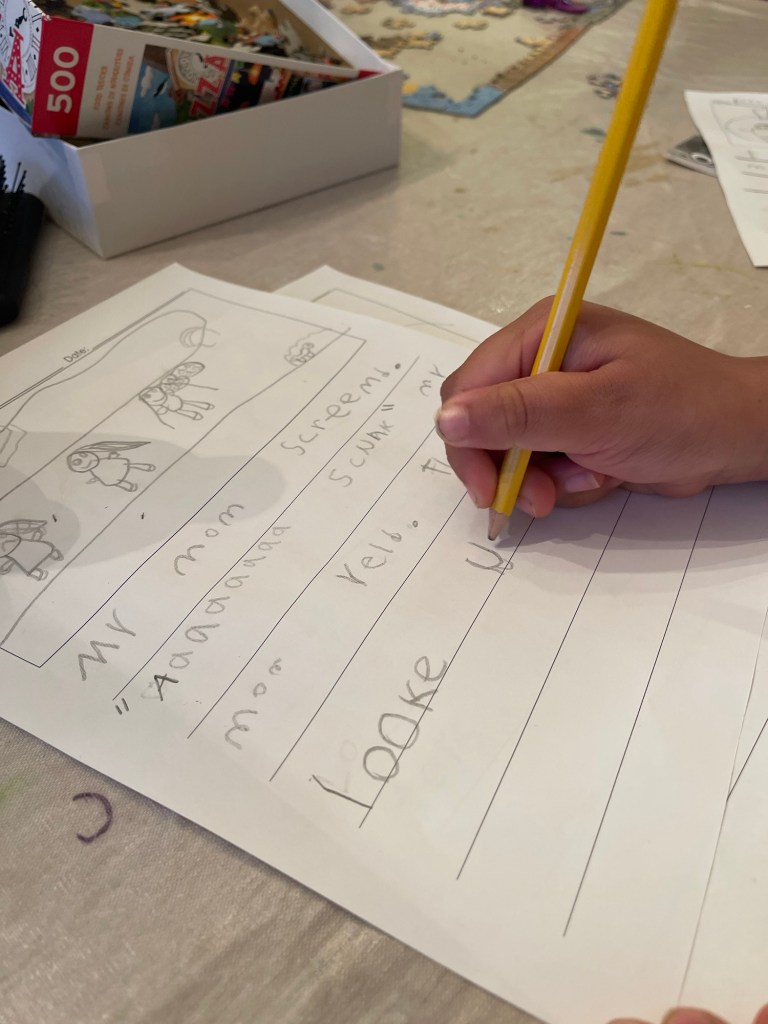
Every time I get ready to share a post here on Two Writing Teachers, I always ask my writing partner Dawn, “is this worth writing about?” I have questioned the importance of writing lines and whether this work matters for others or is this just something our school is grappling with. I didn’t have to look any further than my own first-grade daughter, Rose. We recently did some writing at home; you can read more about that here. As we wrote, I quickly found myself layering in work to help her use her writing lines. This confirmed that this work matters in more places than just our school.
What’s Next
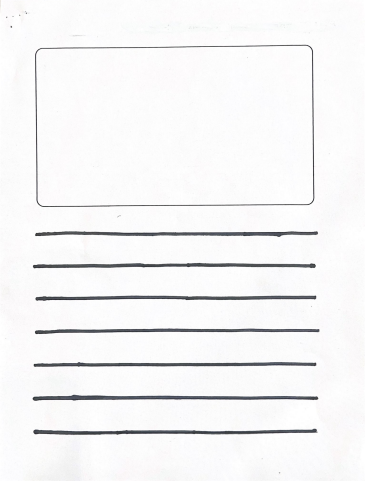
As we move forward, we plan to study the impact of the small shifts we are making to help students better understand and use their writing lines. We know that this work will take coaching and feedback. From there, we will determine if there are students who need additional scaffolds. Our OT, Kelly, has already begun sharing ways to modify writing paper for students who have trouble getting their letters to sit on the line. She simply used a marker to make the writing lines more bold. We are excited to see how these small shifts in our instruction may have big results for our writers. By focusing on writing lines in our primary grades, we hope that students’ writing will be more legible and that as they move across the grade levels, they can transition their learning to use tools, like composition notebooks.
Discover more from TWO WRITING TEACHERS
Subscribe to get the latest posts sent to your email.


We recently talked about this article in a staff meeting. Like you, it led to some immediate small shifts we were able to make to support our students! https://www.aft.org/sites/default/files/graham.pdf
LikeLiked by 1 person
Thank you for sharing this. I just forwarded to our team and look forward to exploring.
LikeLike
I enjoyed following your team’s reflective process. You have a great group of collaborators!
LikeLiked by 1 person
Jessica, I like the simple graphic your team created. Thank you for sharing it. It seems like you have simplified the old lined paper we used to use that had different colored lines for the top, middle and bottom line. There was even a line to show how far the hanging letters were to go. All letters sit on the line is a great piece of advice. Then tall, short and hanging letters can be tweaked from there. I’m sure I can use this with the young writers in my life.
LikeLiked by 1 person