
Estimated reading time: 3 minutes, 36 seconds. Contains 722 words
Target Audience: Teachers and Coaches, Grades 3 and Up
Why it Matters
When teaching persuasive writing, my colleagues often ask how to get kids to care about what they’re writing. Students, especially younger ones, are often hard-pressed to think of issues they’re concerned about. Over the years, I’ve come to realize it’s not a lack of caring about the world around them. For many, these topics of conversation don’t arise often. So, the thought of them coming up with ideas on their own is a difficult one.
I’ve found that students need some scaffolding when it comes to thinking about issues or problems they’d like to take a stand on. First, they often need support or conversation around what the different issues are, and they need a way to gauge the intensity of their response to different issues.
The Details
To start discussion, I’ve either started students out with a pre-made list of social and societal concerns, or I’ve had them develop one together as a group, with prompting. I’ve also differentiated this activity by focusing on problems within the classroom or school. It’s important to note that trauma-informed instruction has a role here; I need to be careful around certain topics from time to time.
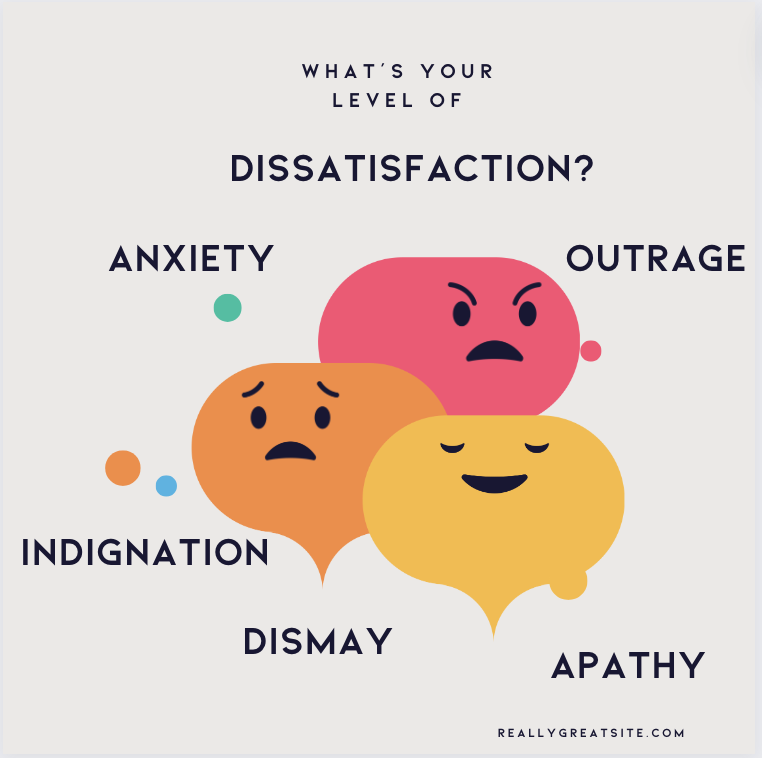
Enter the dissatisfaction spectrum.
How it Works
We encounter problems in our world, both big and small. From rude behavior to racial and economic injustice, we interact with things that bother us all the time.
People can use their bodies as cues to gauge responses to the problems around us. I’ve developed a scale that helps students (and grown-ups!) to tap into the physical reactions they have when thinking about a problem. The level of physical response often correlates to the level of emotional intensity we bring to a particular issue. Deeper feelings, in turn, result in a deeper desire to express those feelings and do something about them.
Responses to a problem can range:
- Apathy: shoulder shrug
- Dismay: a shake of the head
- Indignation: balled fists, a quick rush of blood or emotion
- Anxiety: a lasting, unsettled feeling in the head, gut, or chest
- Outrage: the inability to sit still

Once students use this spectrum to gauge their responses, they often make a few discoveries:
- We often have physical responses to feelings before we’re aware
- Some problems aren’t as important to us as we think
- Some problems are more important than we think
- We can learn about ourselves from the amount of anxiety and outrage we feel
- This guide gives perspective when other problems or issues arise
- We can channel difficult feelings productively to make a difference
Once students have identified areas of “anxiety” or “outrage,” it’s time to put feelings to work. In our classrooms, the first step is often a time to free write about their issue. For students who need to verbalize their thoughts before writing them, it helps to group kids and allow for an oral, round-robin rant. What my colleagues and I have discovered is that there is almost never a student who’s stuck on this assignment. In fact, it’s quite the opposite. Once students get going on their topic, it’s hard to stop them! The feeling in the room becomes intense, focused, productive:

And the teachers aren’t the only ones impressed by what happens here. The students look at their work and often think, “Wow. I really DO have something to say.”
From there, the options open up to students and teachers. Next steps include:
Learn more. Students might seek out nonfiction text, online resources, or community experts to discover how they can be stronger advocates for issues they feel strongly about.
Express it. Whether it’s a 3-paragraph essay, a letter to the editor, or a work of allegorical fiction, writers move beyond the original “rant” to articulate their thoughts clearly and concisely.
Do more. Some students will not be satisfied putting words behind their feelings, and they will want to do something to educate and organize their community: letters to the editor, speeches, morning announcements, fliers, posters, social media campaigns, drives. What’s the dirty little secret to these actions? They all involve writing in one way or another, but now the audience and purpose are real.
One Final Thing.
Persuasive writing is a powerful tool for writers. It allows them to recognize and articulate feelings, and it creates an avenue for expression, empowerment, and change in the community. Using the dissatisfaction spectrum is one way to bring students in touch with their emotions and identify the topics that matter most in their lives.
Discover more from TWO WRITING TEACHERS
Subscribe to get the latest posts sent to your email.


LOVEEE! So excited to give this a try next month.
LikeLike
Thank you! I’m anxious to see how it goes!
LikeLike