Estimated Reading Time: 4.5 minutes. (Contains 872 words.)
Target Audience: K-6 Classroom Teachers
What’s New: Welcome to Reading Workshop: Structures and Routines That Support All Readers by Brenda J. Krupp and Lynne R. Dorfman demystifies the reading workshop and provides K-6 educators with everything they need to launch and sustain a successful reading workshop.
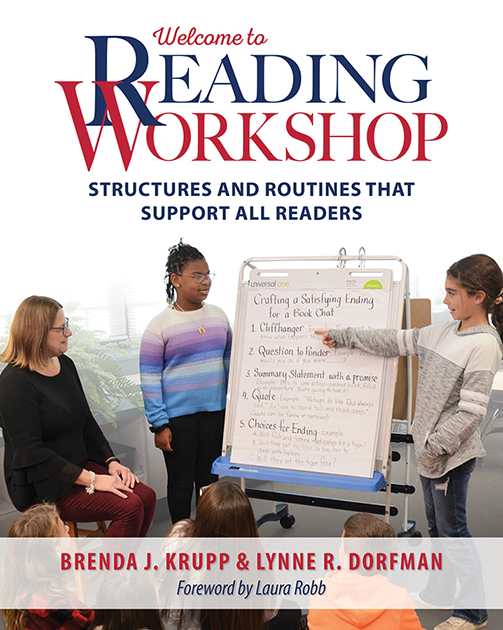
Why It Matters: In a one-size-fits-all world, Welcome to Reading Workshop allows educators to “create reading communities where students become engaged, joyful, and competent readers of both academic and recreational texts” (pg. xxiii, 2023). Krupp and Dorfman’s book is not a curriculum or a prescriptive text about how to teach reading. Instead, it offers elementary school teachers and literacy coaches “ways to scaffold instruction that can include phonemic awareness, phonics, reading fluency, vocabulary development, and comprehension skills (pg. xxiii, 2023).”
Yes, But: We live in a time where phrases like “science of reading” and “research-based instruction” are bandied about everywhere from school board meetings to newspaper articles. Anyone who knows me well understands I am one of those middle-ground people. As the parent of a Dyslexic child and as a literacy specialist, I believe systematic phonics instruction and reading workshops can co-exist. So do Krupp and Dorfman. They state, “The reading workshop framework allows for comprehension instruction and phonics instruction to co-exist. One does not trump the other. Both are important for growing readers. Our youngest readers benefit from strategic phonological instruction as well as learning strategies to make meaning from the text. Hand in hand, these two components work together to build competent readers” (pg. xxiv, 2023).
Zoom In: Students need to write outside of the writing workshop. One of my favorite ways to engage kids is to have them write about their reading. Written responses to reading help to ensure kids are actively participating. Krupp and Dorfman state, “Written responses in a reader’s notebook or book log can help students make their thinking visible and permanent while fostering revision possibilities. Reader response opportunities help to grow a reader’s identity, fostering the conscious notion of ‘I am a reader’ in all reading workshop community members” (pg. 49, 2003). Children’s writing about reading is not just about observing the characters, making predictions, making intertextual connections, or discussing the theme. When writing about reading is at its best, it’s composed in response to something that affected a child so intensely they had to write about it on their terms.
Look Inside the Book: Readers’ notebooks are where students go beyond sticky-note thinking and conversations with classmates. This notebook allows students to grapple with different aspects of a text and make meaning out of them. So what goes in them?
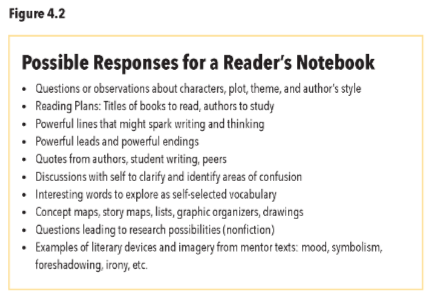
The best way to showcase what a reader’s notebook looks like is to show students your own. You can discuss some guidelines from there by co-creating a chart with students.
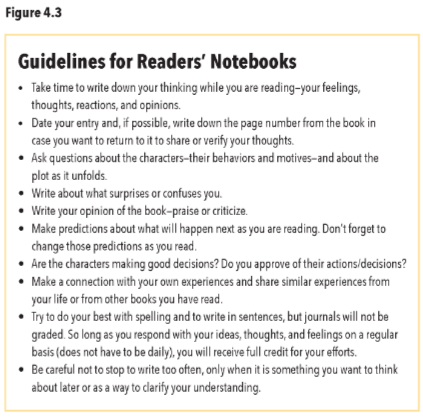
While students can respond in writing before, during, and after reading, I want to focus on after-reading responses. I think this is the most exciting response since it allows us to understand how a text impacts a reader. Authentic writing about reading can be shared with others. Plus, it’s REAL. After all, when I finish a book, I want to discuss (in person, via text, or over email) a book with someone and share my thoughts. I may review it on StoryGraph, but I don’t dash to my closet for a shoebox to make a diorama!

The Bottom Line: Young readers are eager to engage with books that leave a lasting impression. If teachers cultivate a classroom reading community, students possess an innate longing to communicate the delight and awe from a compelling read to fellow book enthusiasts.
Go Deeper:
- Archived posts from the “writing about reading” category on Two Writing Teachers
- Welcome to Reading Workshop: Structures and Routines that Support All Readers by Brenda J. Krupp and Lynne R. Dorfman
- Writing About Reading Blog Series on Two Writing Teachers
Giveaway: I’d love to hear your thoughts on written responses to reading. There is a book giveaway for those who share comments!
You can win a copy of the book Welcome to Reading Workshop: Structures and Routines that Support All Readers by Brenda J. Krupp and Lynne R. Dorfman, which Routledge donated. Comment on this post by Friday, December 29, 2023, at 11:59 p.m. EST to enter. The winner will be randomly selected and announced at the Bottom of the post by Tuesday, January 2, 2024. Please provide a valid email address when you post your comment. If you win, my contact at Routledge will ship the book to you. If you are the winner, you will receive an email from me with the subject line “TWTBLOG – WELCOME TO READING WORKSHOP.” You must respond with your mailing address within five days, or a new winner will be selected.
Comments are now closed.
Congratulations to Laurie whose commenter number was selected. She’ll receive a copy of Welcome to Reading Workshop.
Discover more from TWO WRITING TEACHERS
Subscribe to get the latest posts sent to your email.


This book looks perfect for me to use with their book club books to make writing that is truly connected. I’d love to share this with the teachers I mentor as well.
LikeLike
Given that so many states are now spending thousands of dollars on packaged programs, this is the book we need right now. Teacher expertise matters. Focusing on the many ways to develop a reading community and the many ways to teach reading is vital.
LikeLike
Appreciate your middle ground comment. Also your comment about how writing should also happen outside of writing workshop. I am just getting ready to start a “reader’s notebook” with my kindergartners after the Christmas break. This article was affirming.
LikeLike
“While students can respond in writing before, during, and after reading, I want to focus on after-reading responses. I think this is the most exciting response since it allows us to understand how a text impacts a reader.” Making connections to texts and writing about our responses is such an important way for students to make their thinking visible while preparing to discuss ideas with their peers.
LikeLike
I am very interested in ideas for giving students the opportunity and support to respond authentically to the texts they read. I was also excited to see a new book addressing reading workshop.
LikeLike
This line: “I believe systematic phonics instruction and reading workshops can co-exist.” Yes! The snippets you shred from the book made me think that this is a book I NEED! Thanks for your review!
LikeLike
This post is so important right now. Systematic phonics instruction can exist in conjunction with both a readers and workshop! The focused instruction will serve the growth and development of all readers and writers! Thank you Stacy!!
LikeLike
Phonics and comprehension are equally important! I’d love to read this book.
LikeLike
I’m interested to know more about how this books approaches authentic response to reading.
LikeLike
I love that the focus of this book is to scaffold instruction, integrating what I am already doing in my classroom.
LikeLike
This book looks awesome! Kids need modeling and guidance to build a reader’s notebook.
LikeLike
Hooray for SOR existing with a Reading Workshop! I could not agree more
LikeLike
One year I was extra intentional about helping kids understand that their reading notebooks were a place for them to process what they read, and that they could decide what to write about based on what they needed. It really paid off toward the end of the year, when I overheard two kids discussing how they wre using their notebooks differently to understand a book they read. Definitely a heartwarming moment as a teacher. This book sounds excellent, and I love the shift of readers notebooks for the reader instead of the teacher.
LikeLike
I am convinced that middle ground is so important to talk about with educators. I was so happy find out about this book. I’m excited to read about it and share with other educators.
LikeLike
Interested to read this book! So many times kids default to retelling when writing about reading.
LikeLike
I appreciate the emphasis on written responses related to reading. One strand in our state standards is related to response skills. This is a difficult area for students and they need a lot of practice and explicit teaching by their teachers. I look forward to reading more about this in the book.
LikeLike
I haven’t used reader response notebooks in a while but I am eager to begin using them in my classes again. Although I teach high school students, many of them either struggle with reading or are disinterested. I am eager to make independent reading Fridays more interactive and I think introducing reader response notebooks for the spring semester would be helpful. I think there are wonderful ideas in this post; I’m printing it to begin incorporating some of these practices as of this Friday. Thank you!
LikeLike
This is a book that I can use with my adult students too! What a treasure!
LikeLike
I really enjoyed reading this article. I’m a new reading coach going through LETRS training with my K-3 teachers and studying Shifting the Balance with my 4th & 5th teachers. It’s so refreshing to read something validating my belief that structured phonics and structured literacy can co-exist with reading workshops. I’ve always been a firm believer in reading response notebooks and have tried many different structures, from composition notebooks to digital notebooks, I love them all. I also love allowing students to choose what to write about and how to write. I work at a magnet school for the arts, so I do my best to encourage using art/music/drama/digital art as a way to express student thinking about their reading too.
LikeLike
As an Instructional Coach, this is something my building is working toward. Our K-3 teachers have just completed LETRS training based on the Science of Reading and even doing so, teaching phonemic awareness and phonics purposefully is a struggle.
LikeLike
So happy to read about balance and that one doesn’t trump another. We need more balance in reading and writing. Thank you for this post.
LikeLike
I was so happy to hear someone else say that one does not trump the other. I as well, strongly agree that systematic phonics and reading workshop can co-exist. Both are important and give our elementary students the foundation they need to become proficient readers.
Reading workshop also gives the students opportunities to grow from what they know, but also flexibility that it is not just one way. There are various ways that students can grow their thinking and comprehension.
If schools only have systematic literacy blocks then we’ve learned nothing.
LikeLike
I agree that having students write about what they are reading plays an important role in students becoming better readers and writers. It is hard to incorporate writing outside of writers workshop sometimes, and this strategy is a great way to do so. Thank you.
LikeLike
This post is a great reminder of the benefits of reader response journaling. The suggestions presented are very useful and can be adapted for any and all reading. Asking students to share their thinking about their reading is such a benefit to critical thinking. Writing helps us to clarify our thinking.
LikeLike
In my school we are using a Science of Reading certified program. Even so, it is important for students to create a space where they write about reading. I am always looking for new ideas to give to students to create entries into their notebooks. Their notebooks should show a space where their thinking and creations are located.
LikeLike
This is a wonderful post, Stacey. I appreciate your honesty about being a person who resides in the middle. I have always been there too. One of the things I loved about readers notebooks was the depth and breadth of formative assessment opportunities they provide for students, teachers, and families. Readers who write about their reading employ incredible thinking resources. Notebooks can be flexible, support UDL opportunities, and provide students with tools to participate in discussions that will continue to build meaning for students. I think sometimes teachers get caught up in the muck of what they think a reading notebook must be, instead of using them to infuse joy and reflection.
LikeLike
I’m on my 6th Readers Notebook and love Sri model for my students the ways I make my invisible thinking about a text I read visible on the page. I’d love to win a copy of this book to encourage me more. Fingers crossed that I win!!
LikeLike