
Estimated reading time: 3 minutes, 22 seconds (Contains 675 words)
Target Audience: K-12 Teachers
A Backstory: Last week, a little after 8 PM (also known at my house as “the magical hour of surprise homework reveals”), my fourth grader announced that she needed my phone to do a little research on what chicken tenders really are. Then, after researching, she needed to write an essay to take to her teacher the very next day.
As the literacy coordinator for the district, I’m well-versed in both our curriculum and our literacy program’s scope and sequence and, not surprisingly, chicken tenders are not part of the fourth-grade curriculum. But my daughter was both adamant and motivated, and in less than an hour she had researched (thank you, Wonderopolis), drafted an essay, and created a diagram of all of the edible parts of a chicken. The next morning she carefully slid the handwritten paper into her folder to present to her teacher when she got to school.
I will admit that my daughter naturally enjoys writing, but this work was driven by more than just her love for the written word. At the heart of this moment in her writing life was something we too often forget to present to our writers: a spontaneous invitation and opportunity.
How We Got Here: Over the past several years, the landscape of writing instruction has gone through many transformations. Though we know how important it is to give kids authentic opportunities to write, the reality is that programs, standards, and simply too few moments in the school day don’t always allow us to give writers the freedom and flexibility that we wish they could have.
By opening ourselves up to the possibilities that lie within writing invitations, we can still hold true to our scope and sequence while also sneaking in opportunities for application and exploration throughout the day.
How It Works: The thing about spontaneous moments of writing invitation (just one type of “teachable moment”) is that they are unpredictable. My daughter’s teacher probably didn’t start the day with “assign an essay about chicken fingers” written into her planbook. But she has a teaching gift, one that is within reach for all of us if we open ourselves to the possibility: she listens to her students, builds upon their curiosity, and has fun throughout the process.
If you, too, would love to capture some spontaneous moments of writing, here are some places to begin:
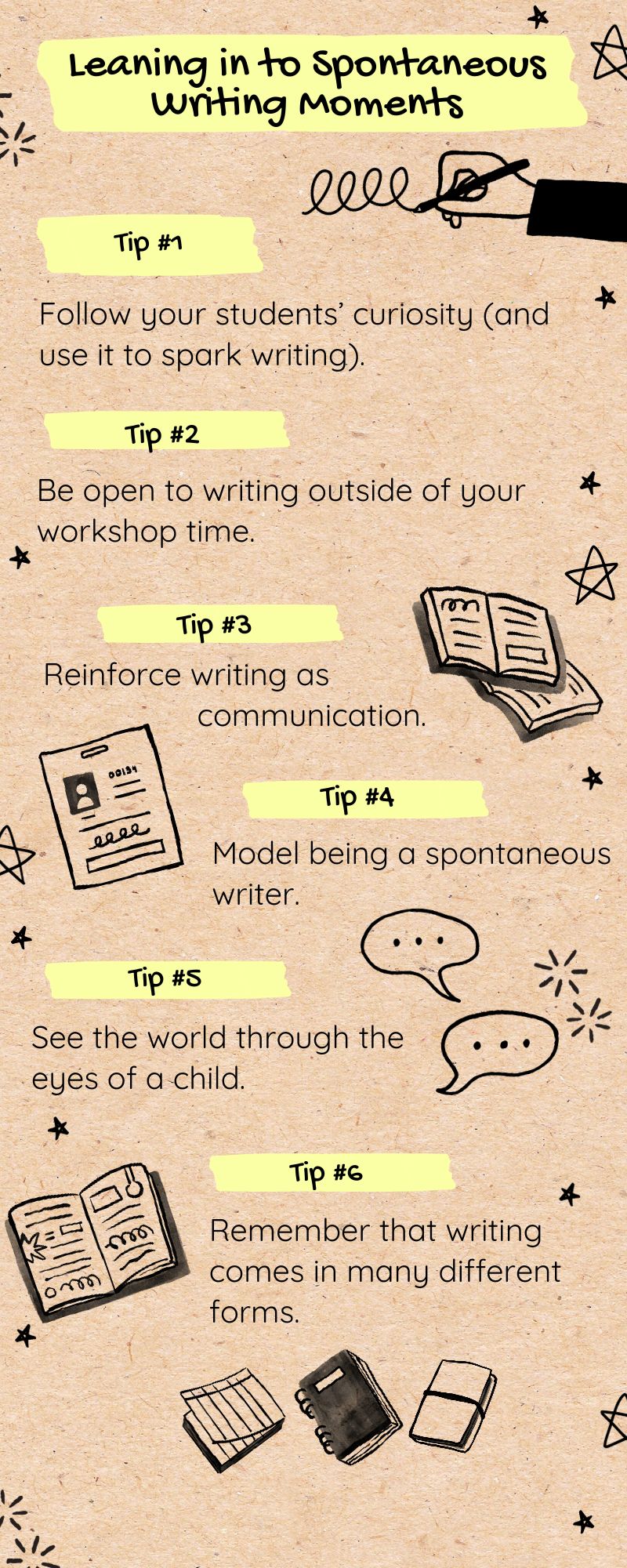
- Follow the curiosity. Listen to the questions students ask and the topics they can’t stop talking about and use these to invite students to jot down their wonderings, their thoughts, or even a short paragraph or essay.
- Be open to writing outside of the workshop. Kids can write during math, science, social studies, art, or any other subject across the day. Writing does not have to be contained in a silo.
- Reinforce writing as communication. When students have ideas to share, invite them to draft an email, post a question, or even–to the horror of teachers from generations past–write a note to pass to a friend in class.
- Model your own spontaneous writing. You have no idea how far announcing, “Wait! I need to write that idea down” might go for a group of impressionable young writers.
- Think like a child. What is going on in their world that is exciting and new? What is so important that it must be captured on paper? Things that seem insignificant to adults might just be the most important thing in the world to our students. Prompt kids to jot down what’s important to them. (A notebook is a great place to capture this writing!)
- Remember that writing takes many shapes and forms. Some writing is formal (essays, reports) while other writing is messy, incomplete, and meant for no one’s eyes except those of the writer. Be open to the possibilities of both.
Going Deeper: While we know that direct and explicit instruction is an essential part of developing strong writers, there are also ample opportunities for authentic, student-driven writing across the day.
If you’re looking for a place to start–or rekindle–this work, extend your learning by checking out these posts on writer’s notebooks:
- Entry Points to Get Students Writing in Their Writer’s Notebook: Our Favorite Things by Stacey Shubitz
- Ten Possible Minutes: Sacred Writing by Betsy Hubbard
- Notebooks as a Writer’s Tool Blog Series
Discover more from TWO WRITING TEACHERS
Subscribe to get the latest posts sent to your email.


