Estimated Reading Time: 4 Minutes (805 Words)
Primary Audience: Literacy Coaches and K-6 Teachers
A Back Story
A few years back, our school-based literacy team made a vow that whenever we were looking at student data, we would never look at a reading running record without looking at a current piece of writing from the same child. This change in practice came because we were noticing a trend. There were several students who had never been on our radar for any type of literacy support, that were suddenly bubbling up around third or fourth grade. We were seeing discrepancies in their spelling but also in their ability to decode multisyllabic words. “They just can’t spell!” was a common utterance.
Looking back, we realized that these were students that learned to read easily. As primary-grade readers, they never caught our attention. But we wondered what might have happened if we had had a closer eye on their encoding (spelling) at the time. Would we have noticed any signs that may have shown a need to tighten up their phonics knowledge?
Our vow stuck, and looking at a students reading alongside their writing is now common practice. This lens has alerted us to ways we can adjust our phonics instruction to meet the needs of all students.
Why It Matters:
When it comes to phonics instruction, transfer is the ultimate goal. We want all of our students to apply their phonics knowledge to read and write accurately so that they can comprehend and communicate with others. As diagnostic practitioners, it is important that we look at students’ phonics acquisition from both a decoding and encoding perspective. This approach also solidifies for students that what they are learning as readers can also support their work as writers.
The Details
There are many ways to gather information about students’ ability to transfer their phonics skills to their writing. Here are a few ideas:
Try An Encoding Assessment: Administering a quick phonics encoding assessment that targets concepts taught can effectively determine what a child or a class needs. Last year, our school developed a spelling inventory (you can check it out here) that mirrored the phonics concepts assessed on our district decoding assessment. Using this data, we were able to quickly identify where students’ strengths were, collectively as a class and individually. We were also able to pinpoint targeted next steps.

Look At Student Writing: While encoding assessments are a quick way to gather a lot of data quickly, nothing compares to looking for that transfer in students writing. You may have students that can spell words accurately in isolation, but the moment they have to multitask- think about ideas, organize their writing, and use craft moves- spelling sometimes goes out the window. Looking at students’ writing pieces gives a real insight into students’ ownership and understanding. When looking at student writing, it is key to note what students are already doing well. Can you see evidence of the phonics instruction happening in the classroom? Then, identify the next step, along a phonics continuum, to tackle with students.
Example in Action
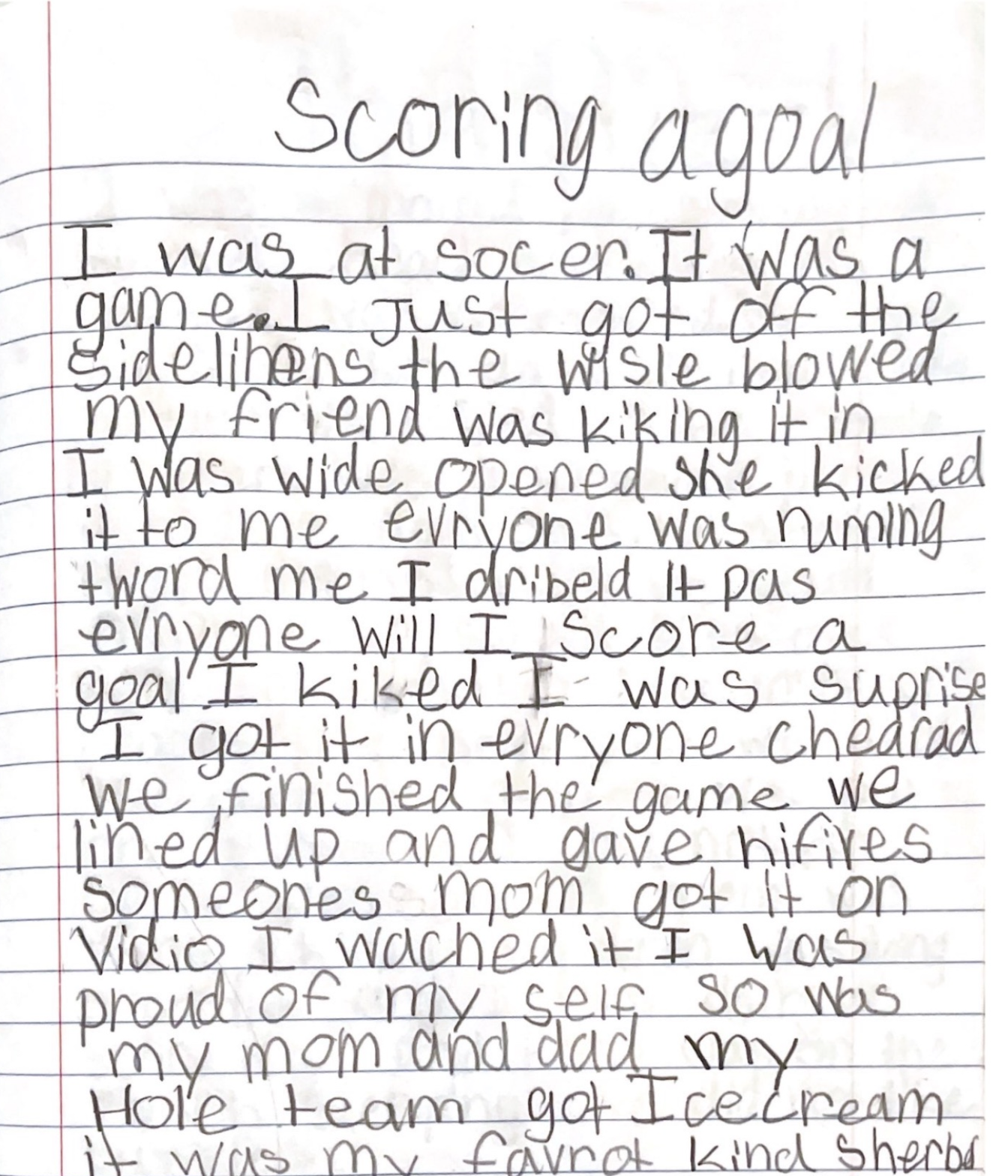
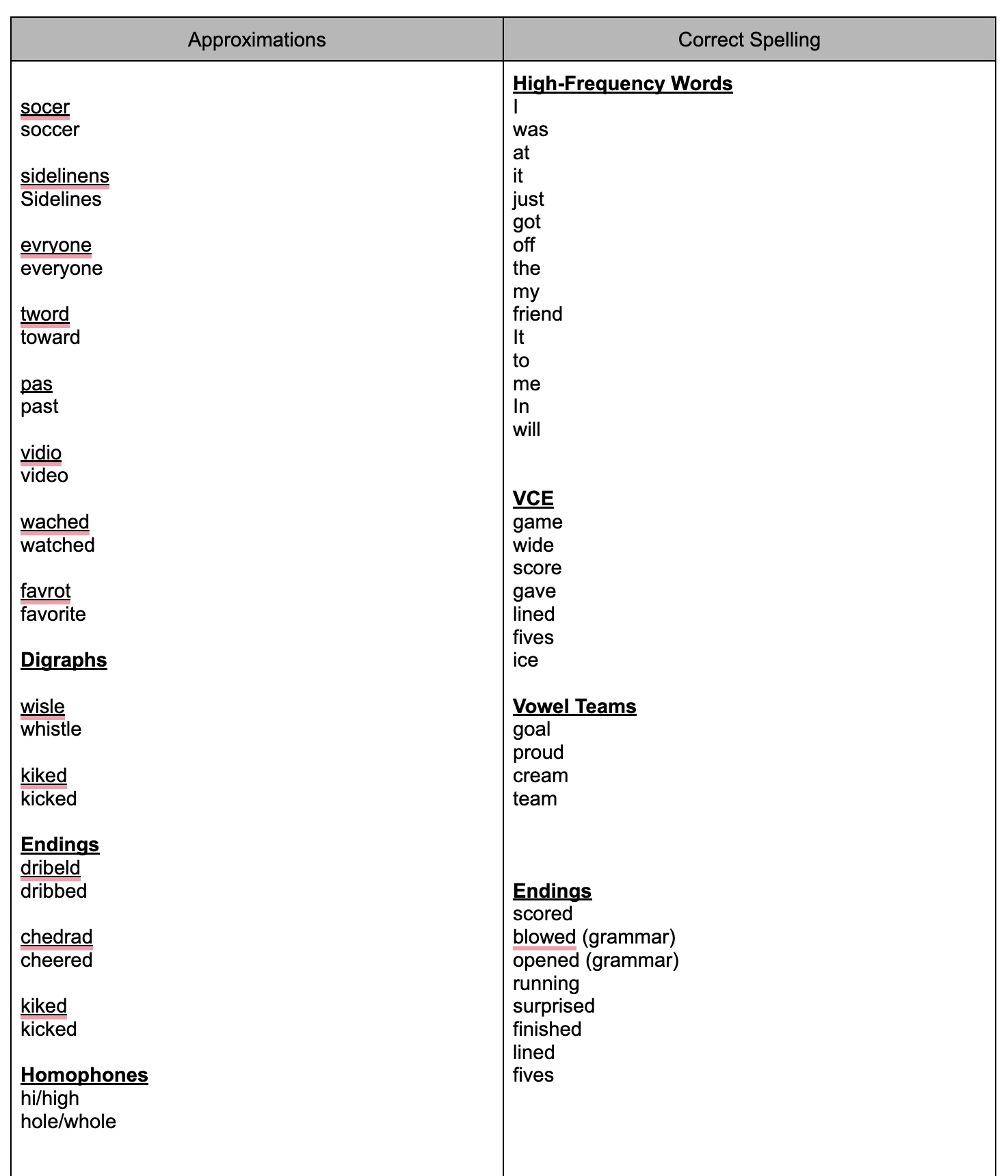
Below is a sample piece of writing I randomly pulled from one of my daughter’s old writing notebooks in order to show one way to look at student writing with a focus on encoding. I used a writing running record tool, you can access a blank copy here, to quickly analyze what she was doing well in terms of her encoding skills and possible areas that I might address next. You will notice that her simple high frequency words are spelled accurately along with her short vowels, blends, and basic digraphs. She understands the difference between long and short vowel sounds and spells words with silent e consistently. My next step for this writer would probably be to do some work with endings, while also layering in some work with grammar. Over time, I would support this student in transferring this new learning to her writing. This accountability will be key.
The Bottom Line
Taking the time to analyze students spelling, in isolation and in students’ actual writing, along a phonics continuum has been a game changer. This practice has helped us reflect on our phonics instruction and consider how we are embedding more explicit encoding instruction and practice for our students.
Identifying clear next steps for students has helped teachers and students stay focused. Spelling can often feel overwhelming, and it can be tricky to know where to start. We have found that having small and targeted goals feels manageable and successful. These focused goals have impacted the way we embed spelling small groups during writing workshop and also how we hold students accountable for these goals- ultimately allowing students to spend more time and energy on other areas of the writing process.
Discover more from TWO WRITING TEACHERS
Subscribe to get the latest posts sent to your email.


This is very helpful! Thank you for sharing!
LikeLike
This is such good work that you’ve all been doing. Thanks for sharing!
LikeLiked by 1 person