Estimated reading time: 4 minutes. Contains 778 words
Target Audience: Classroom and student service teachers, coaches, administrators
A Backstory: An Idea Takes Shape
Spring of 2022 found me discouraged, restless, in need of a challenge. To regain my spark, I wanted to embark on a transformation of the way we approach writing in our district. Remarkably, I had the enthusiastic support of administrators and colleagues. By summer of 2022, we had a cohort of classroom teachers ready to explore and broaden the teaching of writing as we knew it.
Today, I’ll share the work that laid the foundation for our writing initiative, offer ideas you can try, and I’ll preview what’s to come for our district.
How We Got Here: Laying the Groundwork
Our cohort began last summer with a reflective exercise I heard about in Melanie Meehan’s post about writing timelines. Together, we developed our own visual summary of our writing lives:

As we compared experiences, we determined that we all loved writing as self-expression…UNTIL. Until someone told us we weren’t good at it. Until it became a chore. Until someone responded insensitively. We all had our moments of UNTIL.
Our work, therefore, would be to approach writing for our students to put off that “UNTIL” moment as long as possible, to keep them loving the written word for the time they are in our care, and hopefully beyond.
What We Did: Vision, Creed, Choice Time
Vision: Together, we examined current beliefs and practices of writing instruction, and we allowed ourselves to dream of an ideal. Our conversations led us to craft a vision for our writers. It has grounded our work across the district, and it sets the tone for every session. Before we engage in planning activities, we re-commit ourselves to this vision.
In District 30, every child is a writer. Students begin to see themselves as confident, skillful writers when they have ownership and choice in their work, when they care about what they are writing, and when language provides them with a genuine, purposeful outlet for self-expression.
-District 30 Writing Vision
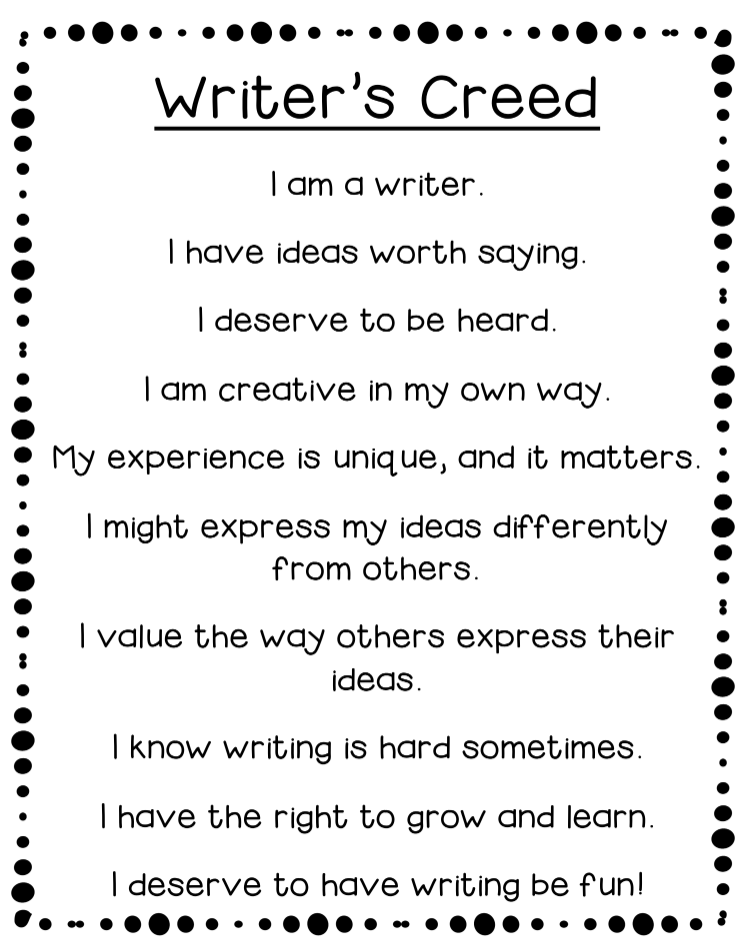
Creed: Our cohort felt it was important to build an affirmation for our young writers. This affirmation could foster positive attitudes, develop common language around writing, and build a sense of writing community. The result was a Writer’s Creed that now hangs in every elementary instructional space across the district:
Choice Writing Time: With our vision and creed in place, our cohort wanted to put those ideas into practice. We knew that instant, monumental change would be overwhelming. Still, we wanted an activity that would give us “bang for the buck” with respect to agency, expression and writers’ self-esteem. Enter Choice Writing Time:

Our writing cohort had faith that offering our students regular, no-strings-attached time for composition would result in much more excitement and joy for writing, a joy that would extend into other areas of writing instruction.
The Impact: By the Numbers
At the end of the current school year, 41 staff members completed a survey about how choice writing time went for them this year. Every single teacher reported conducting choice writing time, with over 80% of staff stating that it was “amazing” or “pretty good,” with students enjoying their time. In the teachers’ words:
- Kids love writing and are choosing to write during other times of the day- play, extension, etc. Students who typically struggle with writing or literacy in general were choosing to write and make books.
- Students have LOVED writing this year!!! I think the choice writing brought them joy, and this spread into our writing units. They would beg for writing time!
- Actually, there [sic] biggest growth came not from choice time, but how I changed the way I teach writing as a whole. As they became more confident writers, students valued choice time more.
We’ll call that a win!

We also had 17% of our staff whose experience was not as positive. Of those teachers, most of them reported challenges such as students who would repeatedly not write, a lack of student stamina, and difficulty with committing to the time on a consistent basis. Our team agreed that more support is needed to keep everyone feeling successful.
What’s Next
Due to the success of our initial roll-out, we were able to expand our writing cohort to include two classroom teachers at every grade level. Now, with more minds at work, we’re able to expand on our current efforts and deepen our offerings for students and teachers, including:
- Writing material kits to support Choice Writing Time
- Troubleshooting guides to make Choice Writing Time more rewarding for all
- “Writing Life” units to parallel our Lucy Calkins “Reading Life” units
- Articulation of skills K-5, especially in grammar, literary response, and peer feedback
- Narrative writing units that are driven by independent student practice
One Final Thing
As school professionals, many of us have seen a steady decline in the joy of learning. Agency, autonomy and choice have taken a back seat to standardization and accountability. Our work as a district is meant to reclaim wonder and excitement for our students and for ourselves, and to fulfill our vision for writing as a means of self-expression and self-actualization.
Discover more from TWO WRITING TEACHERS
Subscribe to get the latest posts sent to your email.


I love this! I teach in South Los Angeles and students read/write about a 4th grade level in 7th grade. It’s so hard to motivate many of them because they believe they are “bad” writers. It takes a lot to get them to understand they are NOT bad at writing. We work together to get over that slump. I love the affirmations.
LikeLike
I am happy I stumbled across your post today, Lainie. I am so impressed with both your visioning process and your follow-through – kudos to you and your district! There is tremendous power in “choice” for students, to let them be leaders in their own learning. I love that their excitement about this writing spread to other areas of their school day – “They would beg for writing time!” Awesome!
LikeLike
I appreciate the thoughtfulness of the implementation and the documentation of this process here!
LikeLike
The data and teacher comments is powerful! You are impacting many young writers.
LikeLike