My daughter and I have very different packing procedures. She makes a list of everything she’s planning to take, and then she goes about locating and packing those items. I, on the other hand, collect my actual clothes, lay them out on the bed in piles of shirts, pants, sweatshirts, undergarments, etc, and them pack them up. My mother has a different strategy, and she lays out outfits that coincide to the days she’ll be away. We are all effective packers, and we are all liable to forget a toothbrush.
One of our new fifth-grade teachers approached me today, asking me about how to teach the story mountain lesson.
“That’s how they’re supposed to plan,” she said. “At least that’s what I’m told.”
She was relieved when I suggested that the story mountain could be a choice, as opposed to a requirement, and she invited me to teach the lesson since she wasn’t sure how to change gears and offer a repertoire of planning strategies instead of just one way to do it. I love being asked to teach a lesson, so I made a chart and brought it into her room.
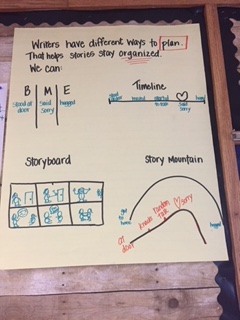
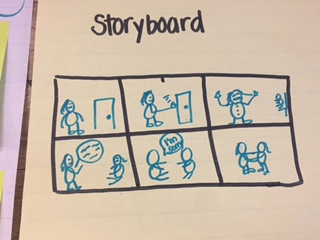
During the active engagement component of the minilesson, I asked the students to turn and talk about which strategy they were planning to try and why. Listening to their conversations, many of them gravitated toward the storyboard, and I pointed out that my pictures were not meant to be works of art, but representational sketches to make sure my story kept focused and on track.
The overriding message that they all understood was that the plan shouldn’t take longer than the story itself. Before setting them off to try out a strategy, I reminded them of the purpose of a plan. One of the students suggested that I box out the word organize on the chart I’d shared with them.
All around the room, students tried and completed different types of plans. Motivation and engagement were high, and students tried different plans for different ideas. The benefit of having multiple plans of multiple ideas will help boost the volume as students move into drafting. Even in higher grades, many students benefit from writing multiple pieces, and they are set up to do that if they complete drafts quickly.
Since I’ve seen how well my daughter’s and mother’s packing methods work, I’ve tried both. I appreciate their strategies, and I prefer my own. Just as the three of us accept our packing differences, we appreciate each other’s packing competence, just as we should accept and appreciate planning preferences.
Discover more from TWO WRITING TEACHERS
Subscribe to get the latest posts sent to your email.


Loved these ideas! What a simple way to add choice into the writing process. I shared your post with my language arts teammate because she’ll implement this immediately. Thanks for sharing!
LikeLike
This post was jsut in time for me. I am teaching a lesson about story arc today, and I am excited to share these different methods with my students.
LikeLike
I love this, Melanie. I love that it offers writers choice AND a strategy, all at the same time. So smart.
LikeLike
You took the words right out of my mouth, Dana!
LikeLike
Love this post and can’t wait to share it with teachers! Thank you, thank you, Melanie!
LikeLike
Melanie, this is so concisely written and (as Fran said), spot on! What you’re communicating speaks to the fact that all writers work differently. I think back with regret to the “graphic organizers” I used to force my students to complete as their “brainstorms.” And I’ll never forget the day I tried one out myself, only to find it totally did not work for me! Your post is a great reminder that writing workshop is a supportive teaching framework that encourages and honors the authentic choices writers make in the real world.
LikeLike
Planning . . . as in many parts of the bigger concept of “organization” is sometimes difficult to teach. A student could be “mentally planning” even though he/she appears to be staring into space. Such a great post, Melanie, and so spot on. Choices ALWAYS!
LikeLike
Kurt Vonnegut’s shapes of stories is also a great planning tool. There are so many, it’s probably best to pare them down to just a few.
LikeLike
We will be starting to write hero stories this week. I am reminded to show my students the many ways they can plan their stories, along with the hero wheel and Read, Write, Think interactive. Do you ever worry about too many choices? I’m thinking my students can combine them. Try them out. See what works…
LikeLike
Love this post! The planning options are great ideas I will incorporate into my teaching. Love your opening anecdote & how you circle back to it. (I hate packing but like the chance to go away!)
LikeLike
Thank you for the reminder and explicit examples of choice for student planning. All too often, Ss don’t take the time to map out where their stories are going. Your post helps simplify some of their options, making them accessible while taking the guesswork out of how to plan. Thank you!
LikeLike